
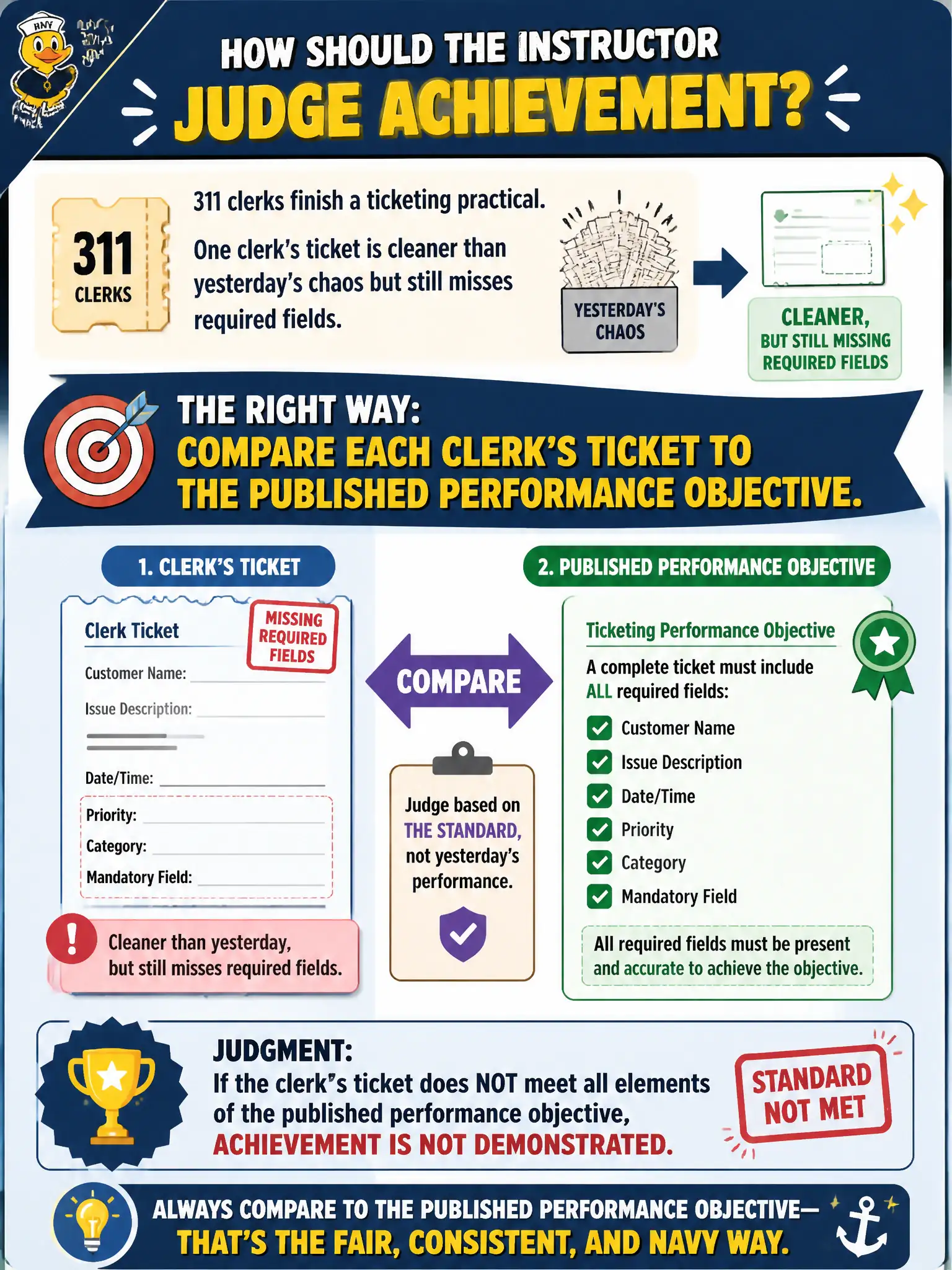
311 clerks finish a ticketing practical. One clerk's ticket is cleaner than yesterday's chaos but still misses required fields. How should the instructor judge achievement?
Select an answer to reveal the explanation.
Short Explanation
Better than a dumpster fire is not the same as hitting the target. Hold the ticket up to the published objective, not to yesterday or to the speed demon in the next chair.
Full Explanation
When 311 clerks finish a ticketing practical and one clerk’s ticket is cleaner than yesterday’s chaos but still misses required fields, the instructor must compare each clerk’s ticket to the published performance objective. Improvement over a personal baseline is encouraging but is not the standard; municipal service quality is defined by the objective, not by relative mess reduction. Passing anyone whose ticket looks better than yesterday fails criterion-referenced evaluation by confusing growth with mastery. Curving scores against the fastest clerk fails absolute standards and injects competition where completeness matters. Passing the whole roster because the city is short-staffed fails integrity of evaluation: staffing pressure does not rewrite the published ticketing standard. Exam caveat: judge against the objective, not against yesterday, peers, or vacancy rates. Operational check: open the published ticket checklist, mark missing required fields as not yet met, coach the gaps, re-observe, and record pass only when the ticket meets the objective—even if it is already "better than yesterday"—so residents receive complete 311 records. Incomplete 311 tickets create rework for the next clerk and confusion for residents who expect a complete municipal record, which is why "better than yesterday" cannot replace the published field checklist when you judge achievement.