
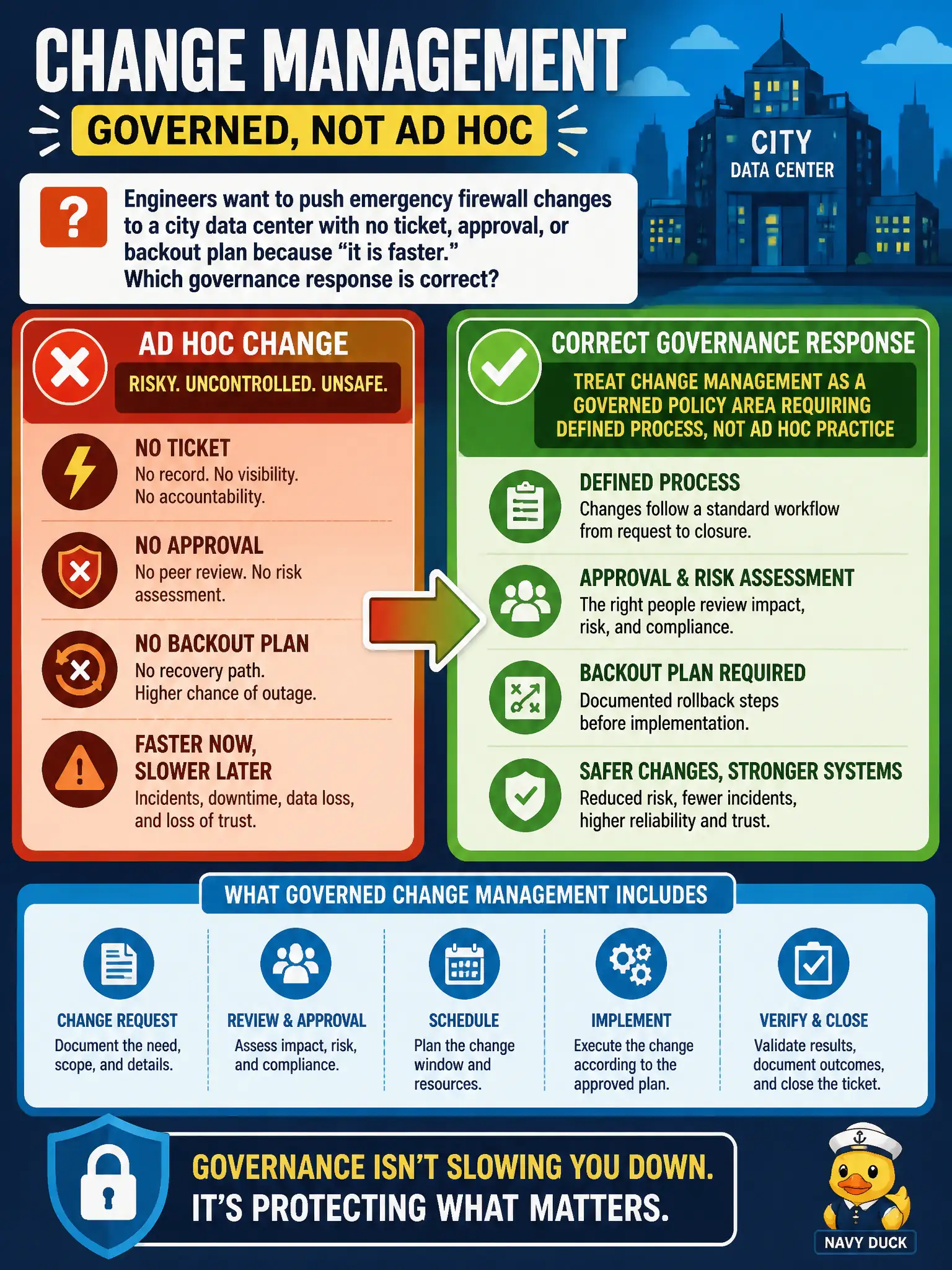
Engineers want to push emergency firewall changes to a city data center with no ticket, approval, or backout plan because “it is faster.” Which governance response is correct?
Select an answer to reveal the explanation.
Short Explanation
Change management is not red tape for its own sake—it is the city’s policy that risky firewall edits get approval, impact thought, and a backout path. “Faster” undocumented pushes are how outages and holes sneak in. Emoji retrospectives are not a change record.
Full Explanation
Change management is a governed policy domain: production changes—especially emergency firewall changes in a city data center—require defined process even when urgency is high. Proper change control includes a request, impact and risk assessment, approval by authorized roles, scheduling or emergency change procedures, testing where feasible, implementation documentation, and a backout plan. Emergency paths accelerate approval and documentation; they do not eliminate them. Treating change management as optional “because it is faster” trades short-term speed for outages, unexplained deny/allow rules, and unrecoverable mistakes on systems that protect municipal services.
Agreeing that speed always outweighs change control for production firewalls normalizes unmanaged risk. Allowing undocumented changes after a retrospective emoji provides no audit trail, approval, or backout. Replacing the change policy with verbal approvals only during business hours fails nights and weekends—when many emergencies occur—and still lacks durable records. Exam caveat: change-management policy questions expect structured process, including emergencies with expedited but documented controls—not ad hoc engineer discretion. Operationally, maintain an emergency change procedure with after-hours approvers, require ticket and backout notes even for urgent firewall pushes, review emergency changes in the next CAB, and measure whether city data-center firewall changes leave a complete, recoverable audit history.