
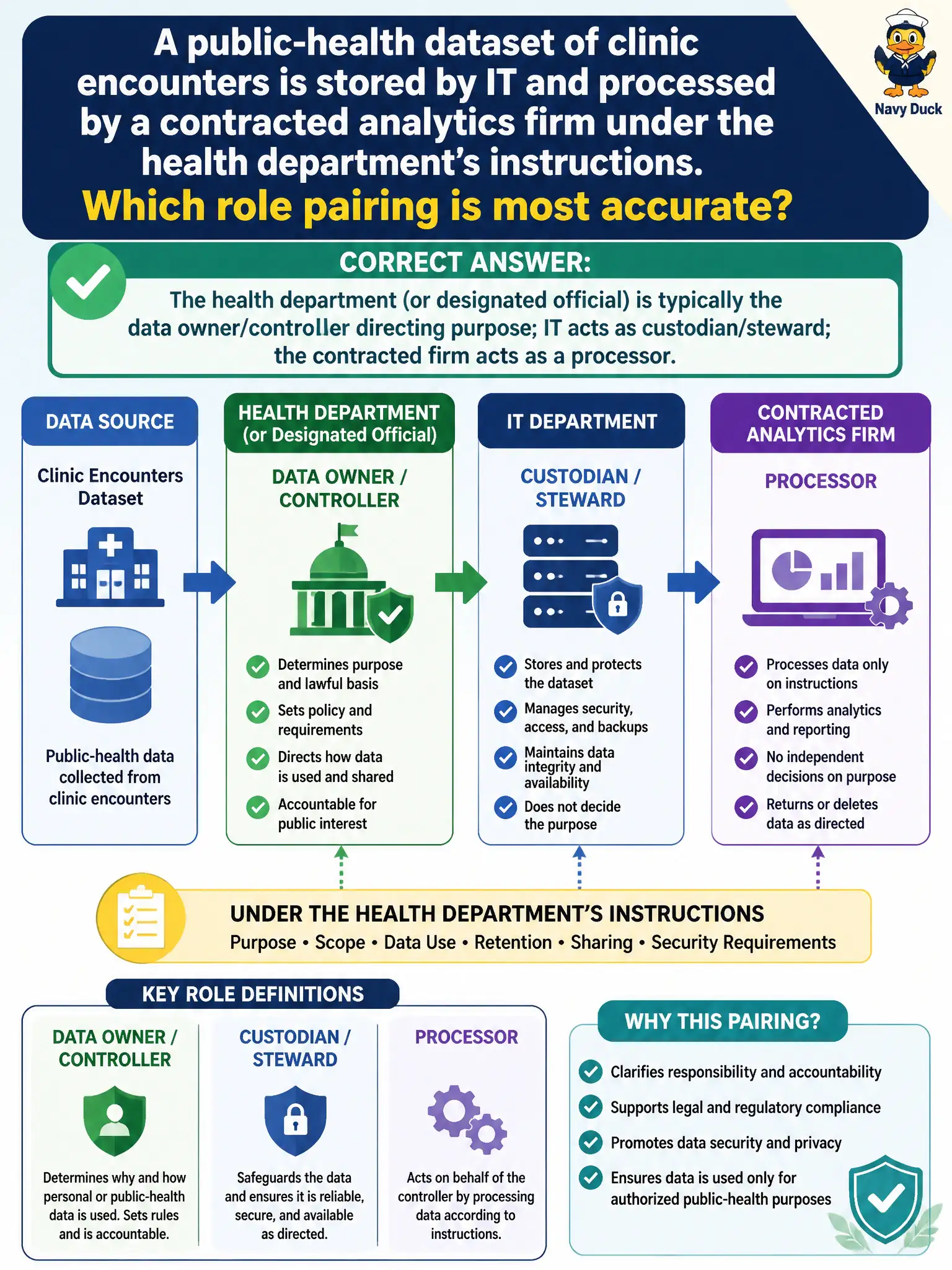
A public-health dataset of clinic encounters is stored by IT and processed by a contracted analytics firm under the health department’s instructions. Which role pairing is most accurate?
Select an answer to reveal the explanation.
Short Explanation
Owners/controllers decide why the health data exists and what is allowed; custodians/stewards keep it safe day to day; processors handle it on someone else’s instructions. Here the health department steers purpose, IT shepherds the systems, and the analytics contractor processes under contract. Read access alone does not crown someone controller.
Full Explanation
Data governance roles separate accountability for purpose from day-to-day care and from processing under instruction. For a public-health clinic-encounter dataset, the health department or a designated official typically acts as data owner (and, in privacy regimes, controller): deciding why the data are collected and for what purposes they may be used. IT often acts as custodian or steward, implementing storage, access controls, backups, and integrity protections. A contracted analytics firm that processes the data only under the department’s instructions acts as a processor (or similar service-provider role), not as the party that sets primary purpose. That pairing keeps legal accountability with the public body while allowing specialized processing under contract and oversight.
Calling the analytics firm the owner and the health department a custodian with no duties reverses accountability and misstates typical public-sector and privacy-law roles. Treating IT staff as personal owners who may sell the dataset ignores organizational ownership and likely law. Asserting that anyone with read access becomes the controller automatically confuses access with governance authority. Exam tip: owner/controller directs purpose; custodian/steward safeguards; processor acts on documented instructions. Operationally, name the health-department owner in a data inventory, contractually bind the analytics firm as processor with purpose limits and security clauses, ensure IT custodian controls are auditable, and prohibit secondary use outside approved municipal purposes.