
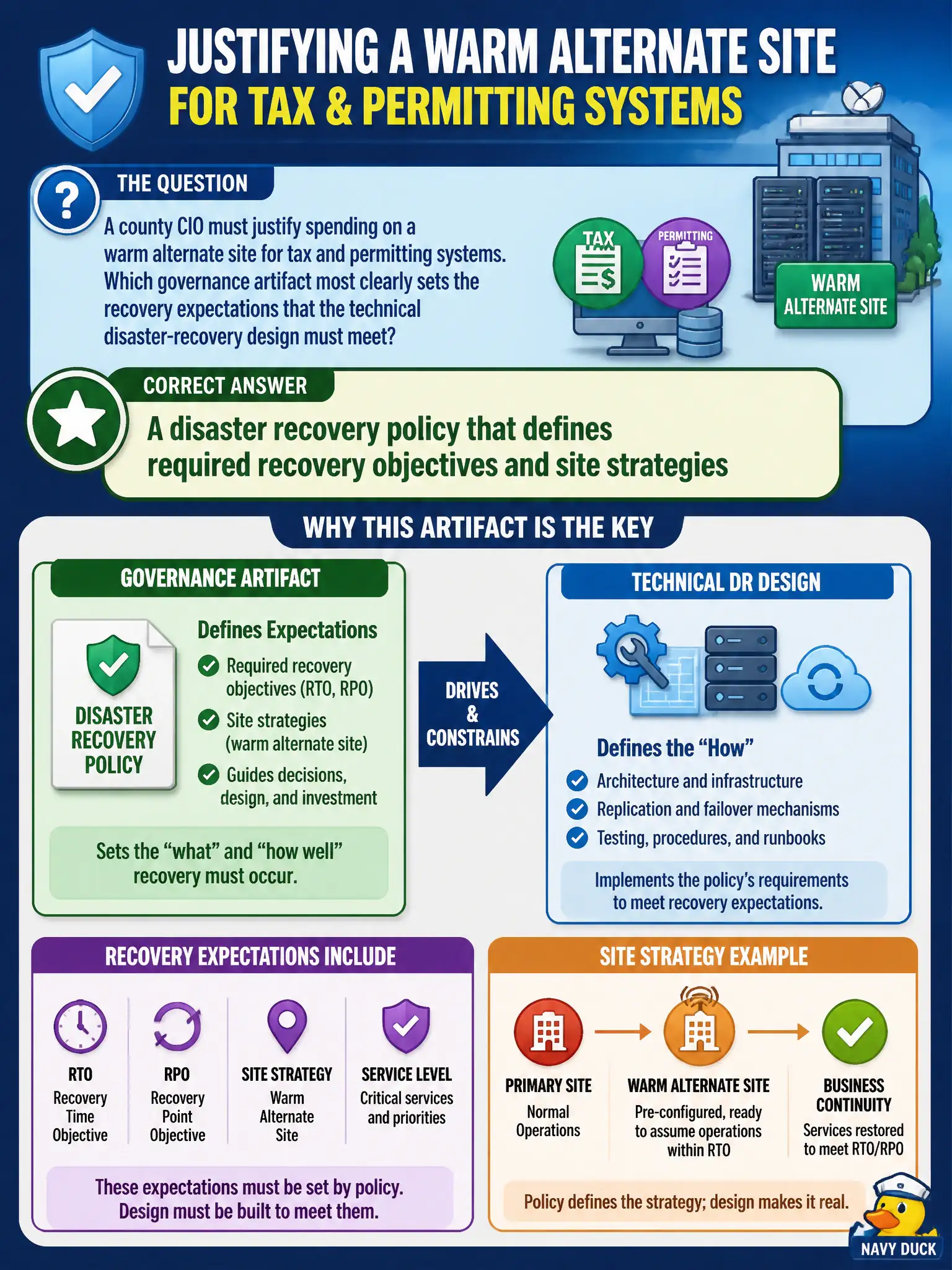
A county CIO must justify spending on a warm alternate site for tax and permitting systems. Which governance artifact most clearly sets the recovery expectations that the technical disaster-recovery design must meet?
Select an answer to reveal the explanation.
Short Explanation
Picture the policy as the city council's marching orders for continuity—before anyone buys racks or cloud capacity. The DR policy says how fast and how complete recovery must be; the architecture then has to live up to those rules, not invent them.
Full Explanation
Disaster recovery policy is the governance instrument that states what municipal leadership requires for continuity before engineering teams buy racks, cloud capacity, or replication licenses. In a county setting, an approved DR policy typically defines recovery time objectives and recovery point objectives for tax and permitting workloads, names acceptable site strategies such as warm alternate facilities, and sets testing and reporting cadence. Those policy numbers become the success criteria that the technical disaster-recovery design must meet; architecture implements policy rather than inventing objectives after the fact. A volunteer runbook drafted by one administrator after an outage can capture useful procedures, yet it lacks formal authorization, scope across systems, and leadership-backed RTO/RPO commitments. Without policy backing, that runbook cannot justify capital spend on a warm site or bind vendors and operators to measurable recovery targets. A marketing brochure that describes citizen-portal uptime goals is an external communications artifact. Brochures are not binding governance controls, often omit data-loss tolerances and site-strategy decisions, and can inflate expectations without funding or test requirements behind them. An informal chat channel where operators share backup tips supports tribal knowledge but provides no durable, auditable statement of recovery objectives, ownership, or approved strategies. Chat history is not a substitute for policy when the CIO must defend alternate-site investment to finance and elected officials. Exam caveat: SY0-701 separates governance documents that set requirements from operational artifacts that execute them. When a question asks what sets recovery expectations that design must meet, look for an approved DR policy with objectives and strategies, not procedures, marketing copy, or informal collaboration tools. Operational check: Confirm the DR policy is current, maps critical municipal systems to RTO/RPO and site strategy, was approved by the appropriate authority, and that technical designs and budget requests cite those policy figures rather than ad hoc targets invented by a single engineer.