
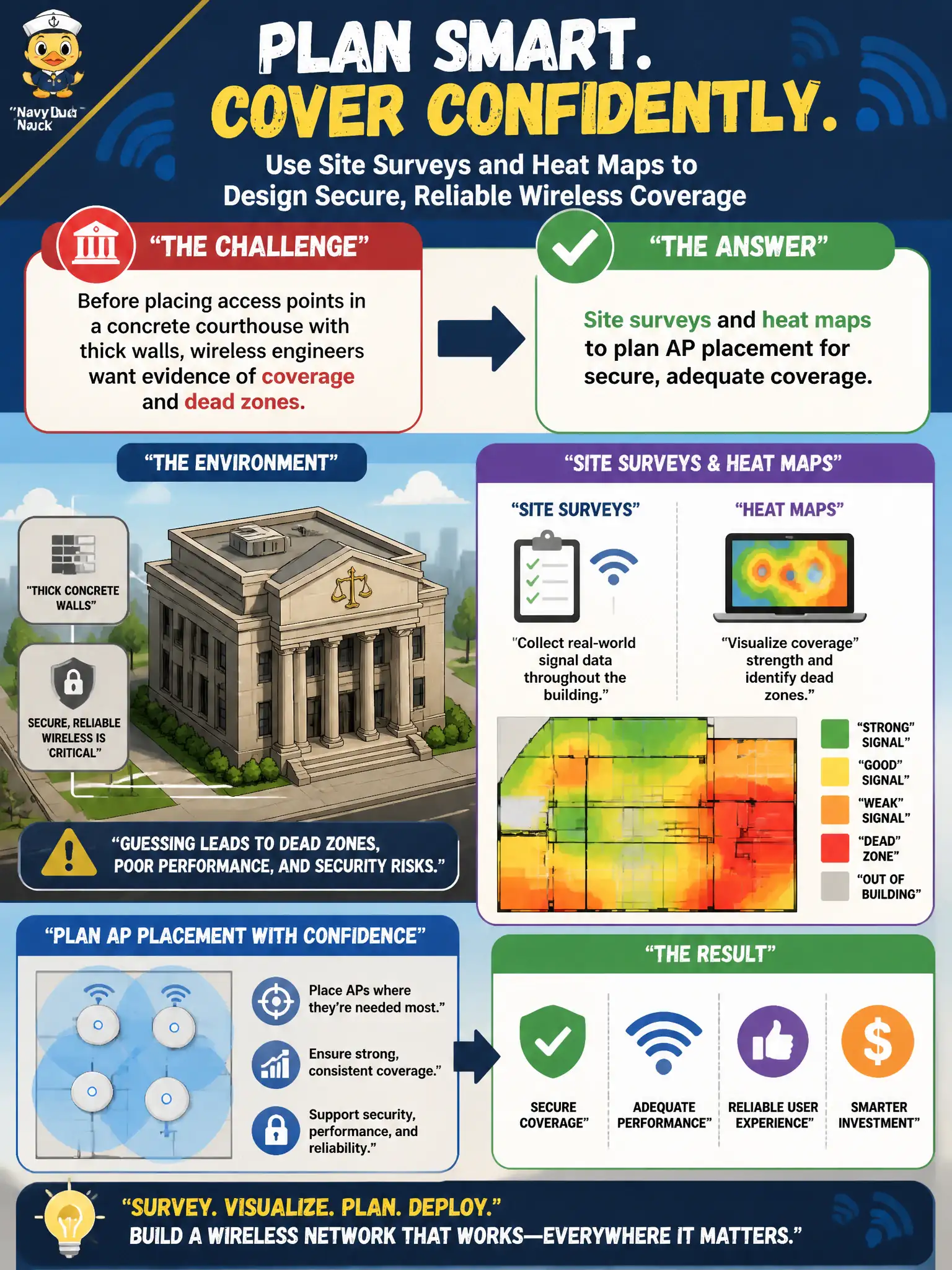
Before placing access points in a concrete courthouse with thick walls, wireless engineers want evidence of coverage and dead zones. What should they use?
Select an answer to reveal the explanation.
Short Explanation
Thick courthouse concrete eats Wi-Fi. Site surveys and heat maps show where signal lives and dies before you bolt APs to the wall. Guessing from outlets alone is how you get dead zones in the basement hearing rooms.
Full Explanation
Courthouse and municipal buildings with thick concrete, elevators, and basement chambers rarely get usable Wi-Fi by guesswork. Site surveys and heat maps measure how radio frequency actually behaves in that environment—attenuation, interference, channel overlap—so access-point placement delivers secure, adequate coverage where clerks, attorneys, and public kiosks work. Planning from measured data prevents dead zones that drive risky workarounds and over-coverage that wastes spectrum. Random AP mounting based only on available electrical outlets optimizes for power convenience, not RF performance or security boundaries. Assuming a single lobby AP covers every basement chamber without measurement ignores structural attenuation common in older civic buildings. Disabling all encryption until coverage complaints stop trades confidentiality for a temporary comfort that never justifies cleartext municipal traffic. Exam caveat: wireless design questions favor survey-driven placement over convenience heuristics. Operational check: perform a pre-deployment survey, validate coverage with a post-install heat map under realistic client density, and confirm encryption and segmentation remain enabled wherever signal is improved.