
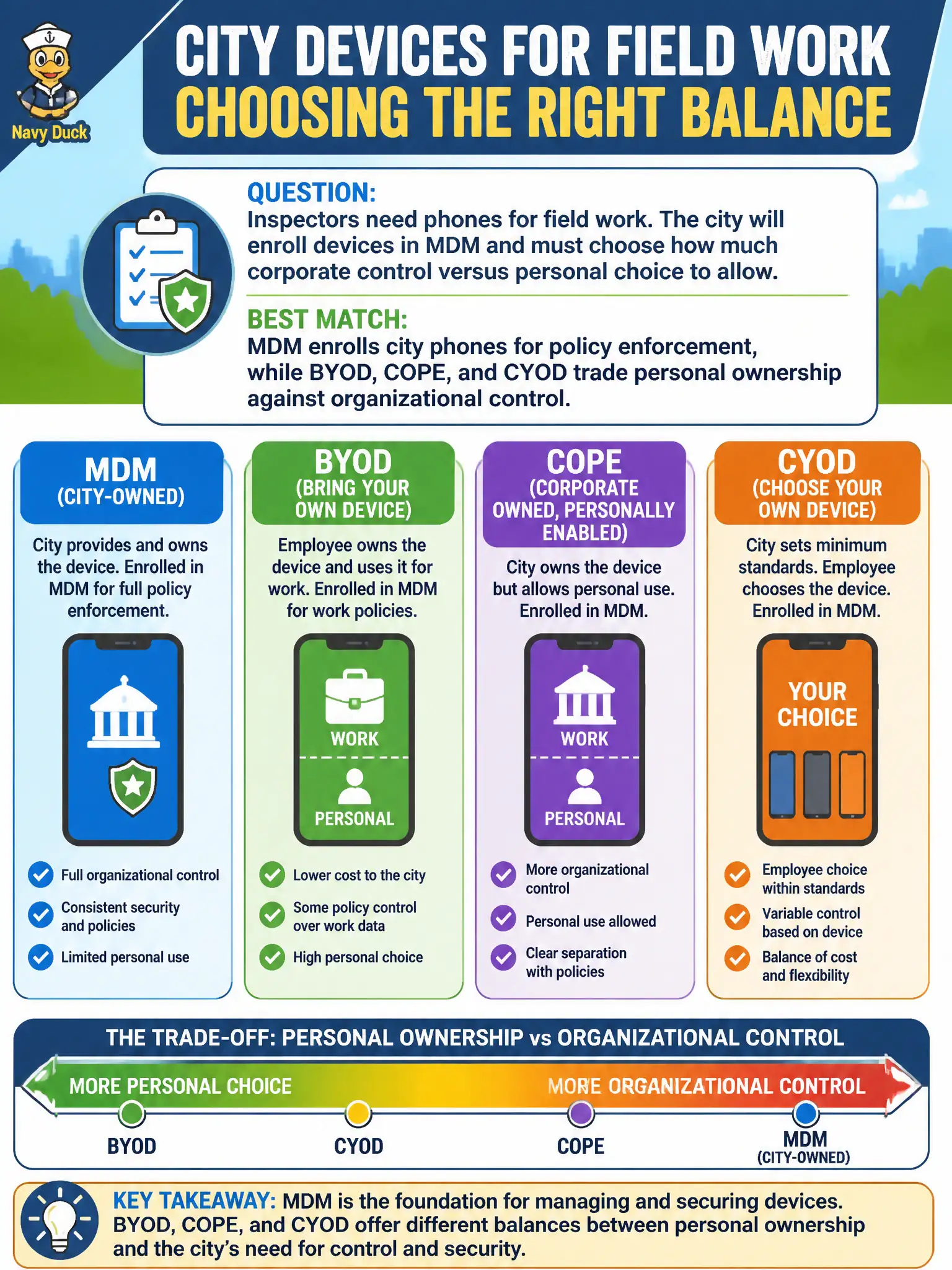
Inspectors need phones for field work. The city will enroll devices in MDM and must choose how much corporate control versus personal choice to allow. Which statement best matches common deployment models?
Select an answer to reveal the explanation.
Short Explanation
MDM is how the city puts the seatbelt on the phone. BYOD, COPE, and CYOD are different deals about who owns the device and how much control the city gets—pick the model that matches how much you need to manage those inspectors' handsets.
Full Explanation
City-issued and field phones need both enrollment mechanics and clear ownership models. Mobile device management (MDM) enrolls devices so the municipality can enforce encryption, passcodes, app allow lists, remote wipe, and inventory. BYOD, COPE, and CYOD describe who buys and owns the hardware and how much control the organization retains: personal devices under policy (BYOD), organization-owned personally enabled (COPE), or choose-your-own from an approved list (CYOD). Inspectors’ promises to avoid public Wi-Fi do not replace technical enrollment and policy enforcement. Declaring MDM unnecessary if staff avoid public Wi-Fi confuses one risk behavior with comprehensive device control. Claiming BYOD always gives the city more control than COPE or CYOD without tradeoffs reverses typical control curves—organization-owned models usually afford stronger mandates. Misdefining COPE as employees buying any phone with no enrollment erases both the organizational ownership and the management profile that COPE implies. Exam caveat: separate the enrollment technology (MDM) from ownership models (BYOD/COPE/CYOD); stems often mix them. Operational check: enroll every city phone in MDM before field use, document which ownership model applies, and verify that lost-device wipe and compliance checks actually succeed in a drill.