
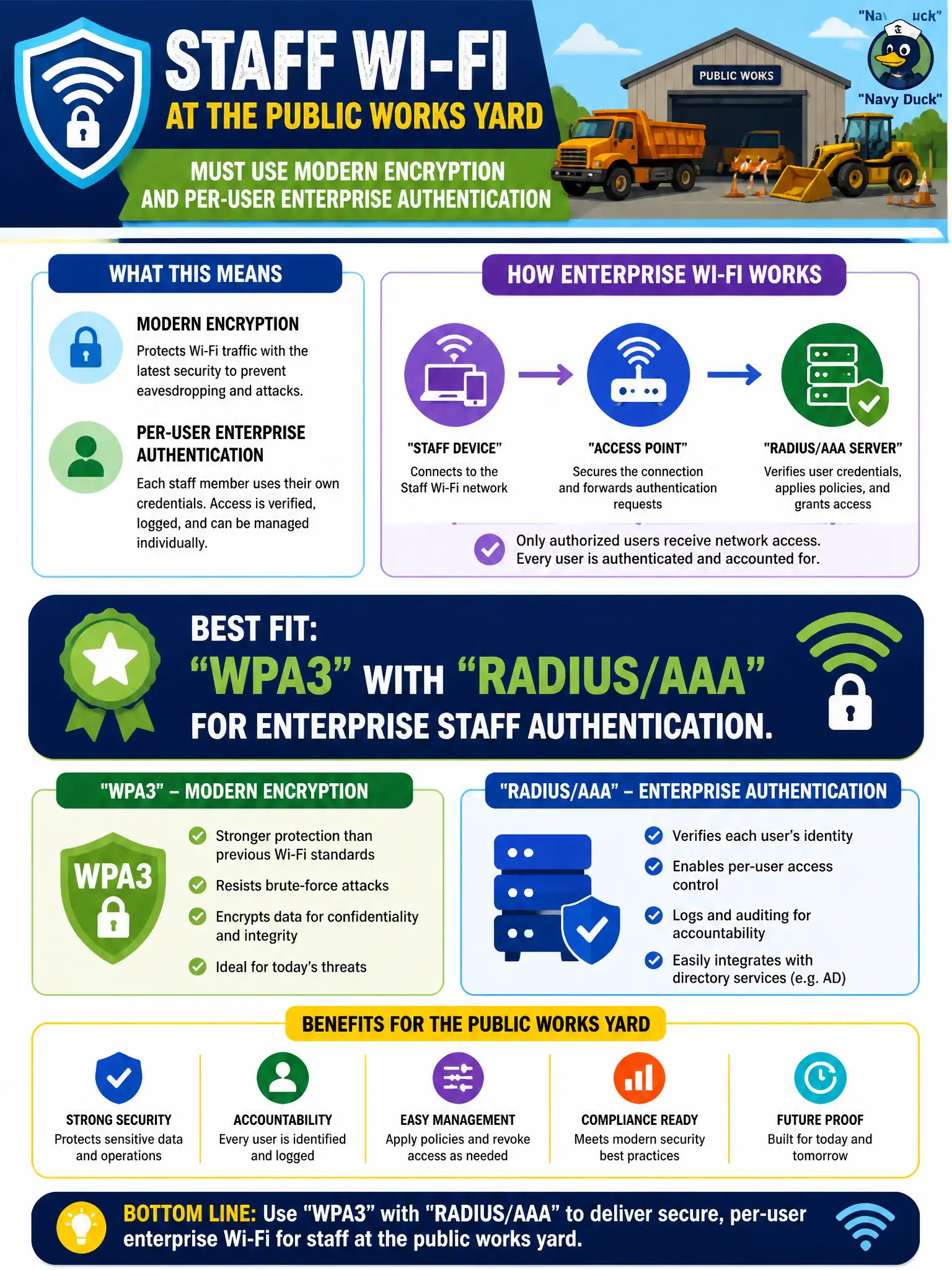
Staff Wi-Fi at the public works yard must use modern encryption and per-user enterprise authentication. Which settings best fit?
Select an answer to reveal the explanation.
Short Explanation
Staff Wi-Fi deserves grown-up locks: WPA3 for modern crypto and RADIUS/AAA so each person authenticates instead of sharing one dusty password on the wall. WEP and open SSIDs are museum pieces you do not want on the yard network.
Full Explanation
Staff wireless for municipal offices needs modern cryptography and per-user authentication. WPA3 strengthens protection against offline password attacks relative to older WPA2 deployments, while RADIUS/AAA with 802.1X binds each clerk or inspector identity to a session instead of sharing one static passphrase. That pairing supports accountability, rapid revocation when staff leave, and policy differentiation between employee and guest SSIDs—requirements that open shared passwords cannot meet for city networks handling sensitive citizen data. An open SSID with a shared social-media password posted in the break room advertises both the network and its secret, defeating confidentiality and auditability. WEP with a single static key rotated only during leap years uses a broken cipher and glacial key hygiene that exam content treats as obsolete. MAC filtering alone without encryption or AAA provides trivial spoofable allow lists and no confidentiality for frames on the air. Exam caveat: enterprise wireless answers typically combine current encryption (WPA3) with AAA—not open SSIDs, WEP, or MAC filtering as primary controls. Operational check: confirm staff SSIDs require 802.1X via the city’s RADIUS servers, verify WPA3 (or transitional modes only where legacy endpoints force it), and spot-check that a disabled account can no longer associate.