
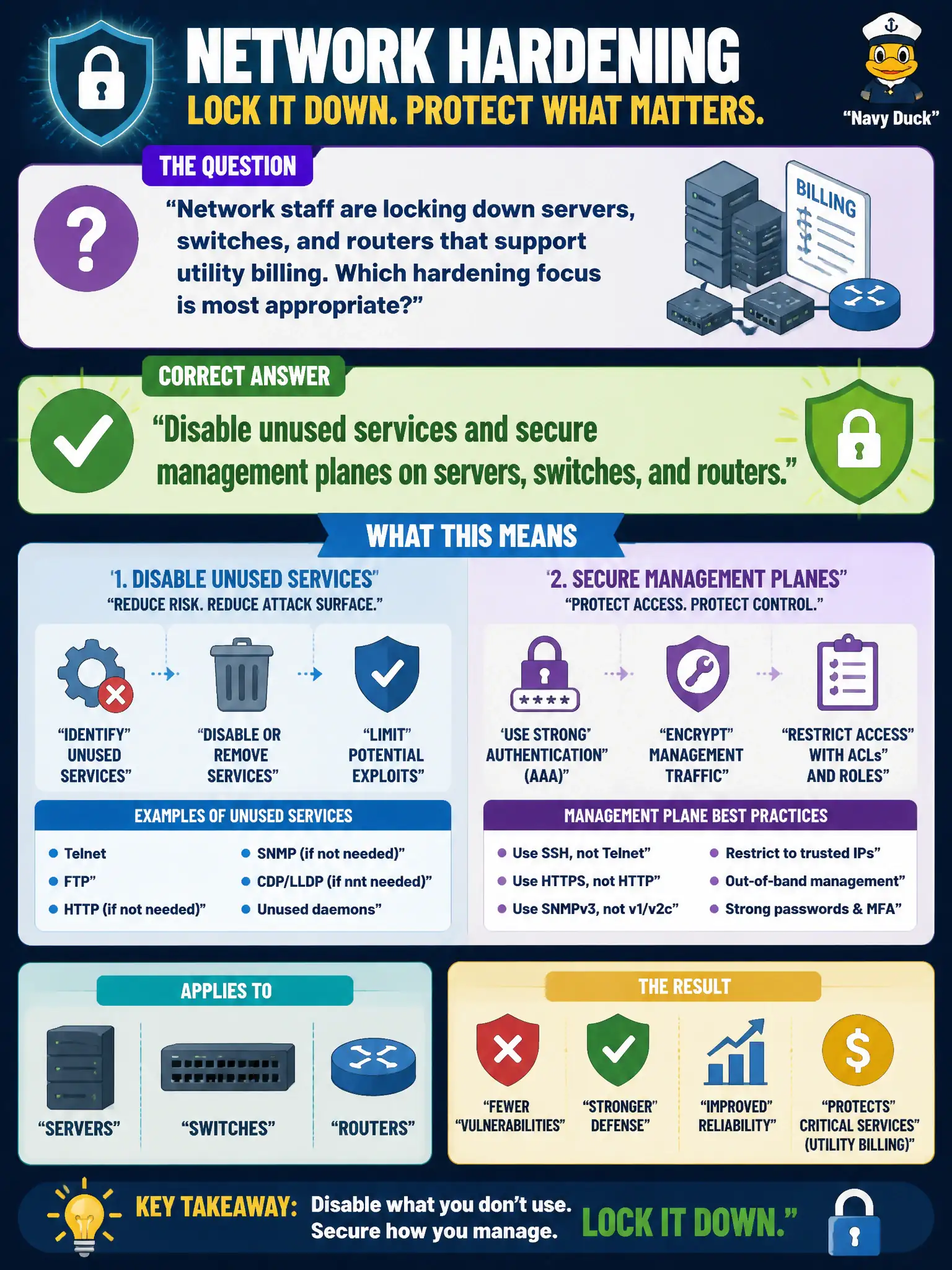
Network staff are locking down servers, switches, and routers that support utility billing. Which hardening focus is most appropriate?
Select an answer to reveal the explanation.
Short Explanation
Hardening is turning off the doors you do not need and locking the ones you use to manage the box. Extra listening services and wide-open management from the Internet are invitations, not shortcuts.
Full Explanation
Hardening municipal servers, switches, and routers shrinks attack surface and protects how administrators reach those devices. Disabling unused services removes listening daemons that nobody needs but attackers gladly probe. Securing management planes—out-of-band networks, ACLs, MFA, encrypted admin protocols—keeps console and controller access away from the open Internet and away from general user VLANs. Together these practices turn infrastructure into a controlled, observable platform rather than a buffet of default services. Enabling every unused service so troubleshooting always has more daemons listening maximizes exposure for a convenience that rare debug sessions do not justify. Leaving management planes open to the entire Internet trades short-term convenience for credential stuffing, exploit attempts, and unauthorized reconfiguration. Removing all logging so hardened devices never generate alerts blinds operations; hardening without visibility cannot prove integrity or support incident response. Exam caveat: hardening is subtractive (disable unused) and protective (lock management), not the absence of monitoring. Operational check: inventory listening services on city infrastructure, disable what policy does not require, place management interfaces on restricted networks with strong authentication, and confirm logs still reach the SIEM after changes.