
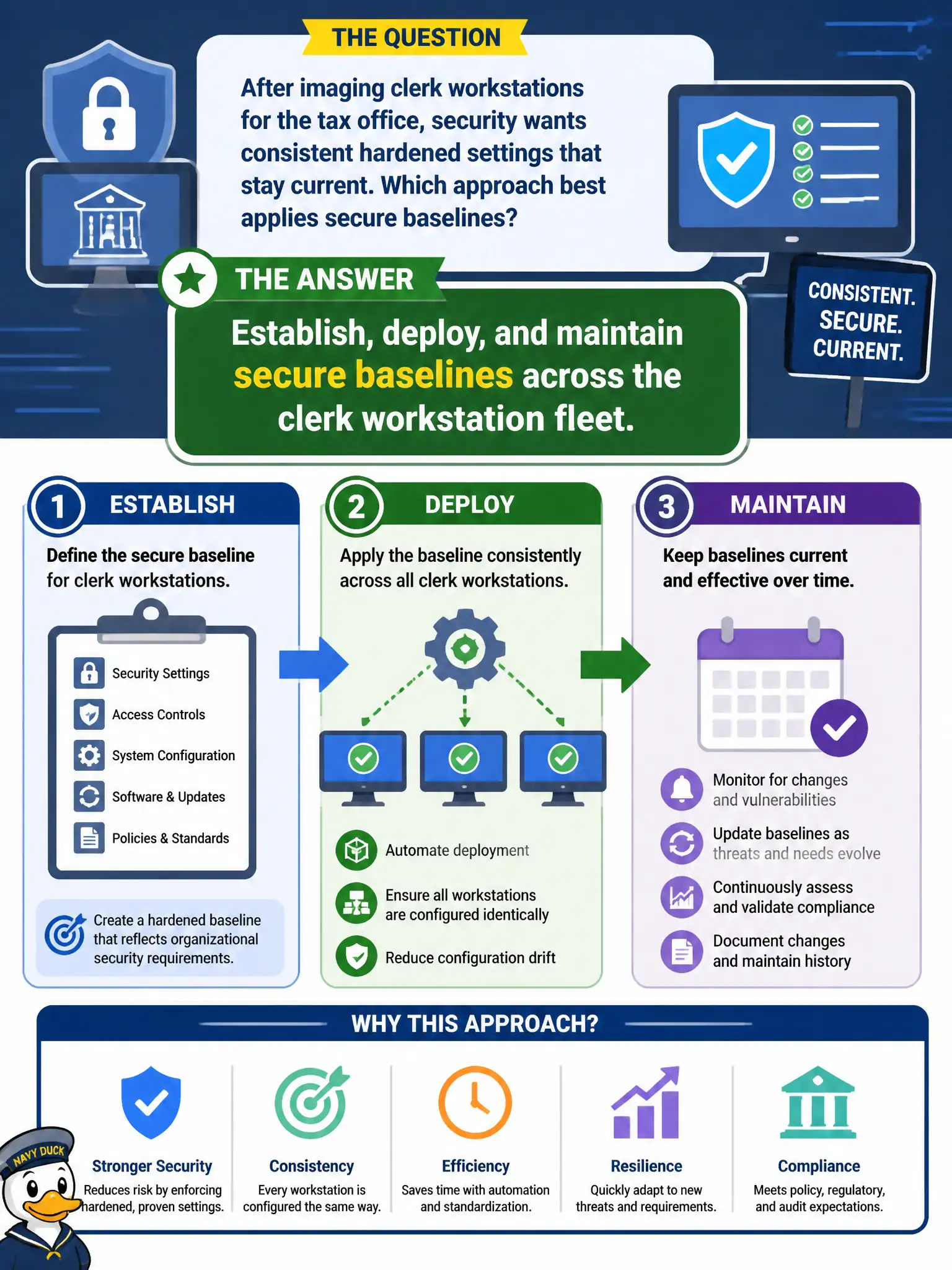
After imaging clerk workstations for the tax office, security wants consistent hardened settings that stay current. Which approach best applies secure baselines?
Select an answer to reveal the explanation.
Short Explanation
A secure baseline is the recipe you write, cook onto every clerk PC, and keep updated when the threat kitchen changes. Imaging with defaults and walking away—or letting everyone freestyle—leaves the tax office full of snowflake weak spots.
Full Explanation
Secure baselines for clerk workstations are living standards, not one-time images. Cities establish an approved hardened configuration, deploy it consistently across the fleet through imaging or configuration management, and maintain it as patches, threat intelligence, and policy change. That establish-deploy-maintain loop keeps counters, records offices, and remote clerks on a known secure footing instead of drifting into personal experiments or abandoned defaults. Imaging once with factory defaults and never revisiting configuration fails because threats and required controls evolve; yesterday’s image is today’s vulnerability surface. Letting each clerk invent personal security settings destroys consistency, complicates support, and leaves gaps wherever individual taste overrides policy. Publishing baselines only on paper without deploying them to imaged systems creates documentation theater—standards that never reach the endpoints citizens’ data actually touches. Exam caveat: baselines questions emphasize the full lifecycle (define, deploy, maintain), not merely writing a standard. Operational check: verify clerk images match the current baseline, measure drift with configuration scans, and schedule baseline updates tied to patch cycles and municipal policy changes.