
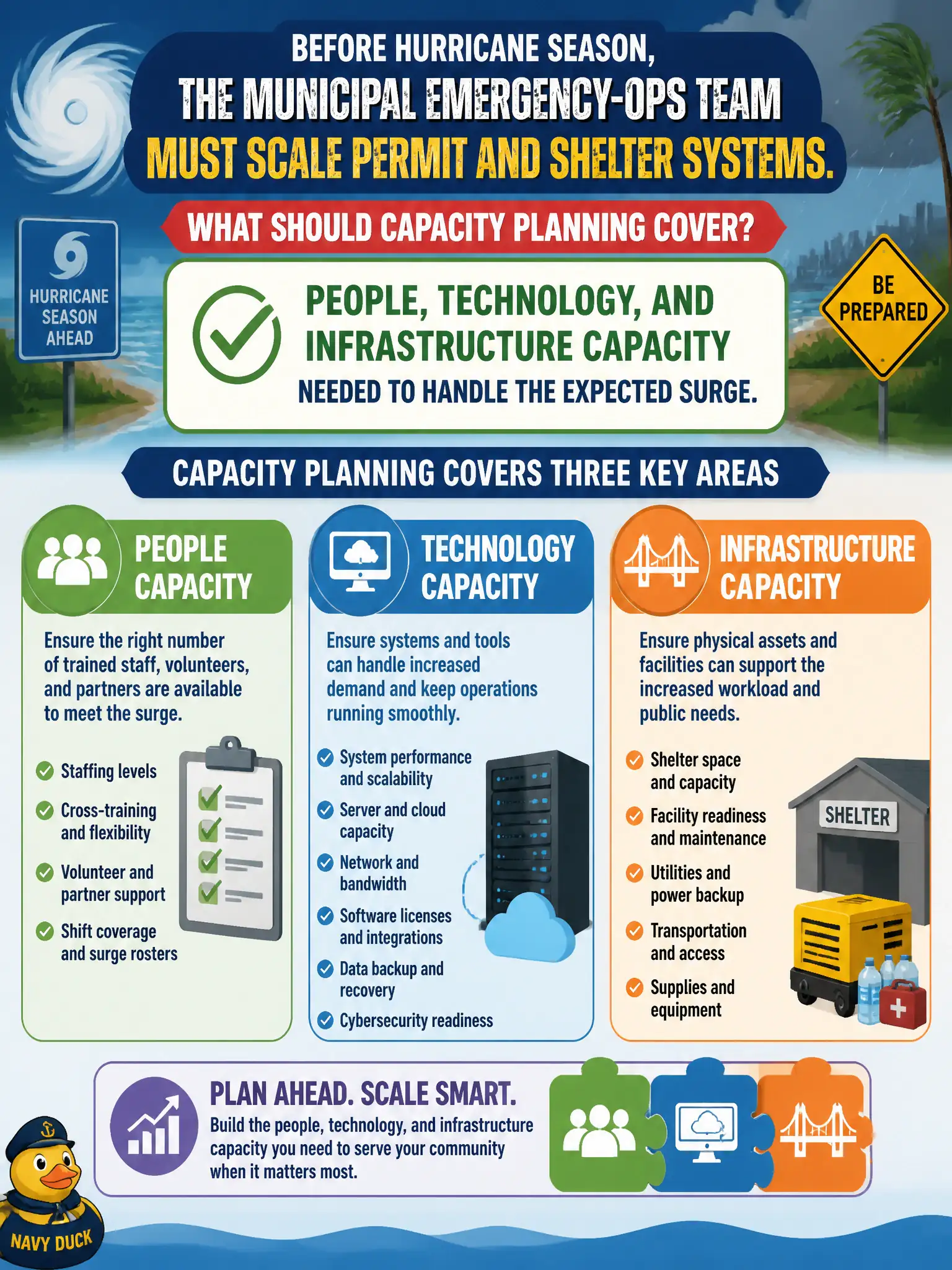
Before hurricane season, the municipal emergency-ops team must scale permit and shelter systems. What should capacity planning cover?
Select an answer to reveal the explanation.
Short Explanation
Capacity planning is not just buying bigger disks. Before hurricane season you size the people who will run things, the tech that will carry the load, and the infrastructure underneath—all three—or the surge will find the weak link.
Full Explanation
Capacity planning ahead of hurricane season for a municipal continuity surge is deliberately broad. Staffing levels for emergency operations, call centers, and technical recovery teams must scale with expected demand. Technology capacity—compute, storage, licensing, and application throughput—must absorb spikes in citizen requests and failover load. Underlying infrastructure such as bandwidth, power, cooling, and alternate-site floor space must not become the silent bottleneck. Effective planning sizes people, technology, and infrastructure together so the surge finds no single weak link when shelters open and permit systems relocate. Focusing only on disk free space on one database server ignores human shifts, network paths, and facility constraints that equally determine whether services stay available. Decorative lobby signage refreshes are unrelated to operational load and do not constitute capacity work. Marketing email templates for post-storm tourism address communications aesthetics, not the ability to run mission systems under duress. Exam caveat: capacity planning questions reward the holistic triad (people, technology, infrastructure), not the single technical metric that feels most IT-centric. Operational check: before hurricane season, document peak staffing rosters, verify alternate-site compute and circuit headroom against projected failover load, and run a tabletop that stresses all three dimensions until the first constraint appears—and then remediate it.