
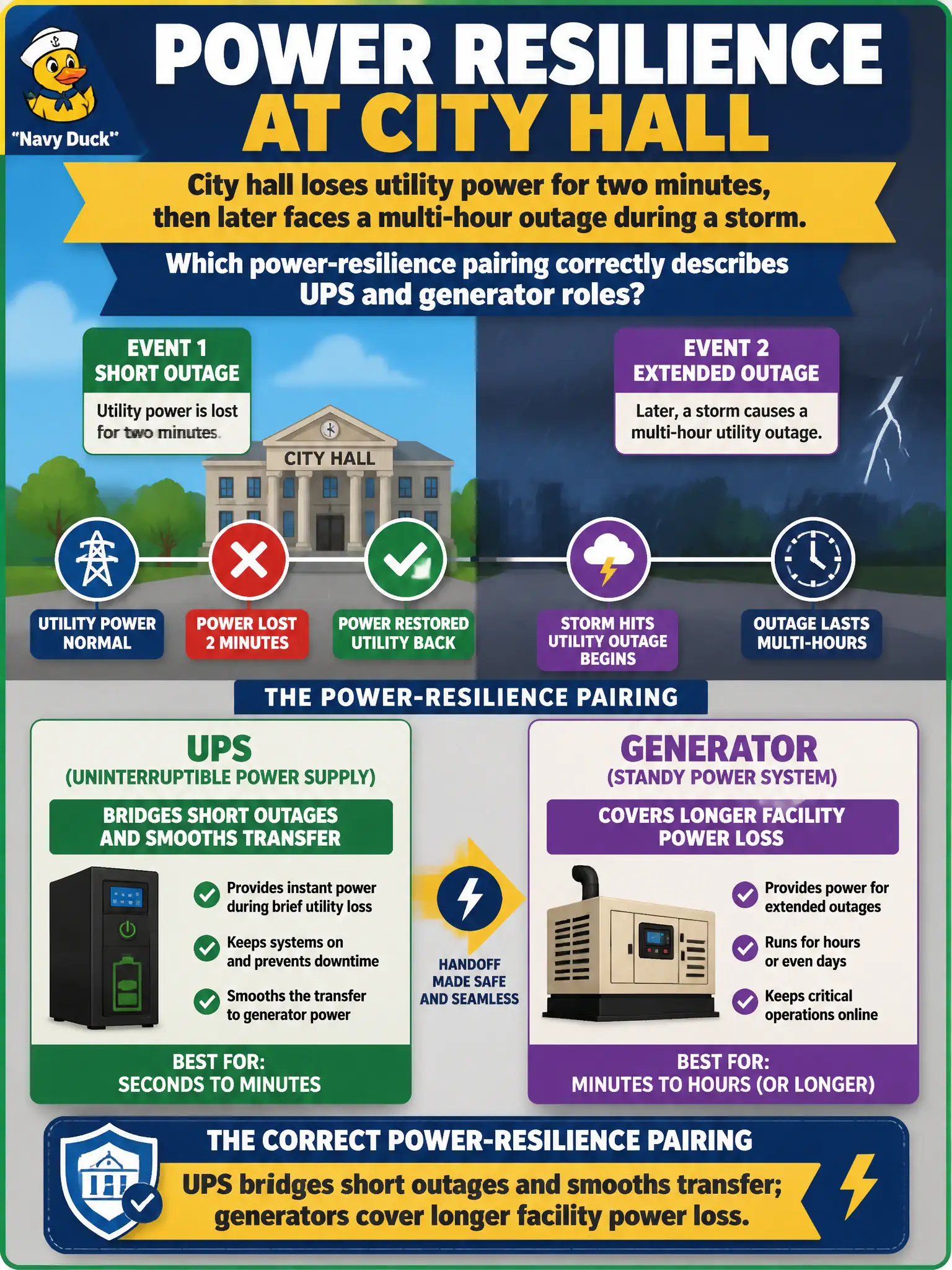
City hall loses utility power for two minutes, then later faces a multi-hour outage during a storm. Which power-resilience pairing correctly describes UPS and generator roles?
Select an answer to reveal the explanation.
Short Explanation
A UPS is the bridge across a short blackout—enough time for systems to ride through or hand off cleanly. Generators take the longer shifts when the storm knocks power out for hours. Backups store data; they do not keep the lights and servers running.
Full Explanation
Facility power resilience for a city campus separates short bridging from sustained generation. An uninterruptible power supply conditions power and supplies battery runtime measured in minutes so servers, network gear, and control systems ride through flickers, complete graceful handoff, or wait for generators to stabilize. Generators, once fueled and warmed, carry multi-hour or multi-day facility loads when utility power is lost to storms or grid events. Together they form the layered answer: UPS for the gap, generators for the outage. Nightly backups protect data at rest elsewhere; they do not keep HVAC, access control, or live workloads running while the lights are out. Claiming generators only handle sub-second flickers while UPS units run multi-day campus loads alone reverses the physics and sizing of each tool—generators are slow to start relative to UPS transfer, and UPS batteries are not designed as multi-day primary plants. Treating UPS as a complete replacement for generators on multi-day outages ignores fuel logistics, runtime limits, and maintenance realities. Dropping both UPS and generators from resilience planning because backups exist confuses data recoverability with power continuity; recovered backups still need electricity to restore and serve citizens. Exam caveat: Security+ often pairs UPS and generators as complementary power controls—do not pick the option that makes one obsolete. Operational check: measure UPS runtime under realistic municipal load, exercise automatic transfer to generators on a schedule, and confirm critical services (911-adjacent systems, identity, permit databases) stay within acceptable interruption during the UPS-to-generator handoff.