
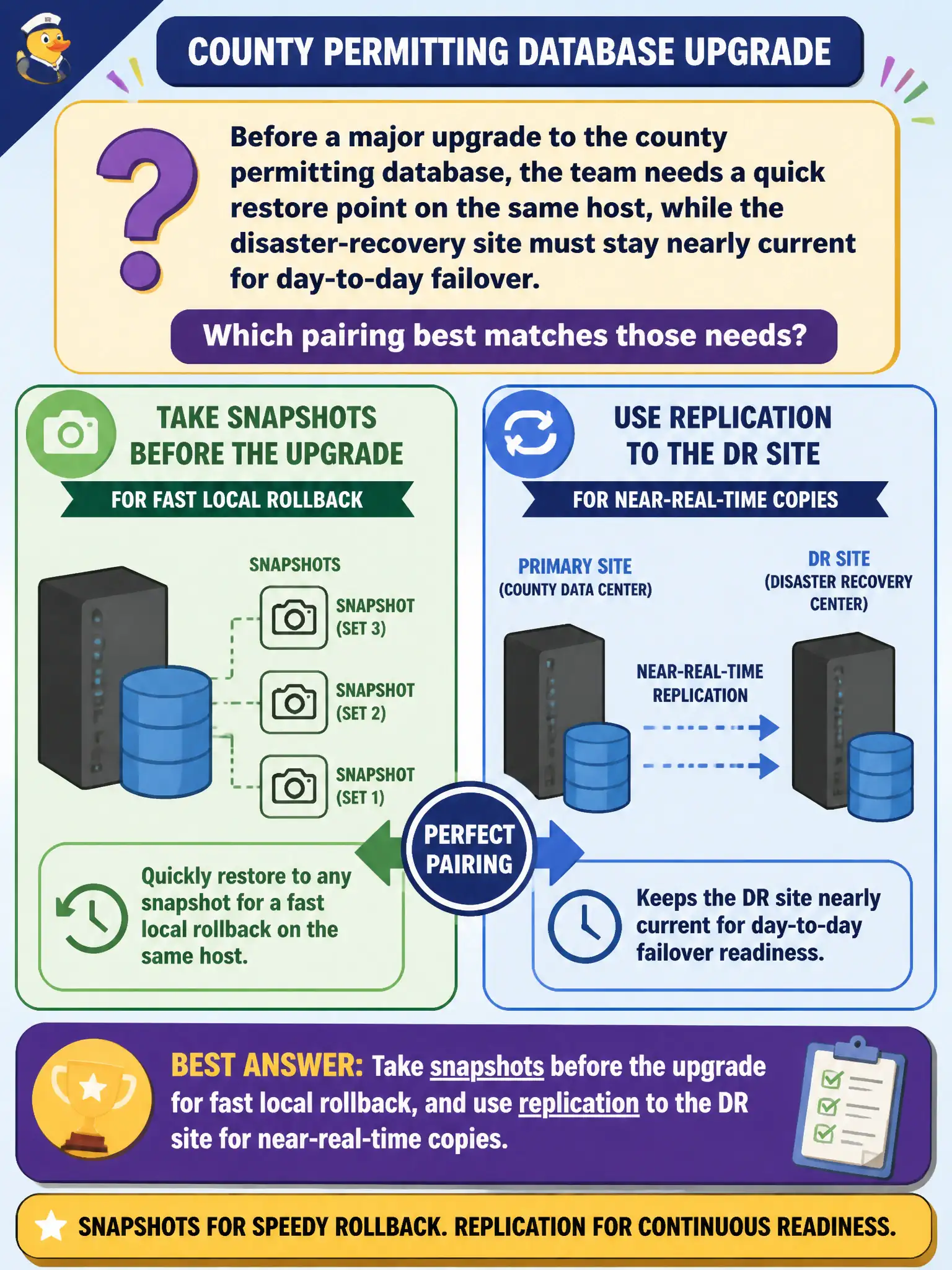
Before a major upgrade to the county permitting database, the team needs a quick restore point on the same host, while the disaster-recovery site must stay nearly current for day-to-day failover. Which pairing best matches those needs?
Select an answer to reveal the explanation.
Short Explanation
Think of a snapshot like a bookmark on the same book—you can flip back fast if the upgrade goes sideways. Replication is the overnight courier keeping a twin copy at the DR site almost current. Use both for different jobs: local rollback vs near-real-time DR.
Full Explanation
Municipal upgrade weekends on permit and GIS systems need two different recovery tools working together. Snapshots (or other local restore points) freeze a known-good image on the primary platform so operators can roll back quickly if the upgrade corrupts services, breaks schema, or strands citizen-facing apps. Asynchronous or continuous replication to the disaster-recovery site keeps a near-real-time twin elsewhere so a site-level failure does not depend on the same storage array that just failed the upgrade. Pairing local snapshots for fast rollback with DR replication for geographic continuity matches how cities actually run change windows: recover locally first when the building is fine, fail over when the building is not. Relying on continuous replication alone for upgrade rollback fails conceptually because replication ships forward the bad state almost as fast as it ships the good state; without a discrete pre-change restore point you may have nothing clean to return to on the primary. Yearly cold-site tape archives fail both jobs: restore latency is measured in hours or days, which is useless for an upgrade rollback and far from near-real-time DR. Journaling only application logs without snapshots or replication hopes rebuilds stay fast, but logs are not a substitute for consistent volume images or replicated datasets when databases and file stores must return to a known configuration under pressure. Exam caveat: snapshots and replication are complementary, not interchangeable—exam stems often tempt you to pick the newer-sounding continuous option and abandon local restore points. Operational check: before a municipal upgrade, confirm a verified snapshot or backup exists, test that rollback completes inside the change window, and separately verify DR replication lag meets the stated recovery point objective for the affected systems.