
The utility customer portal must stay available if one web node fails. How do load balancing and clustering differ as high-availability approaches?
Select an answer to reveal the explanation.
Short Explanation
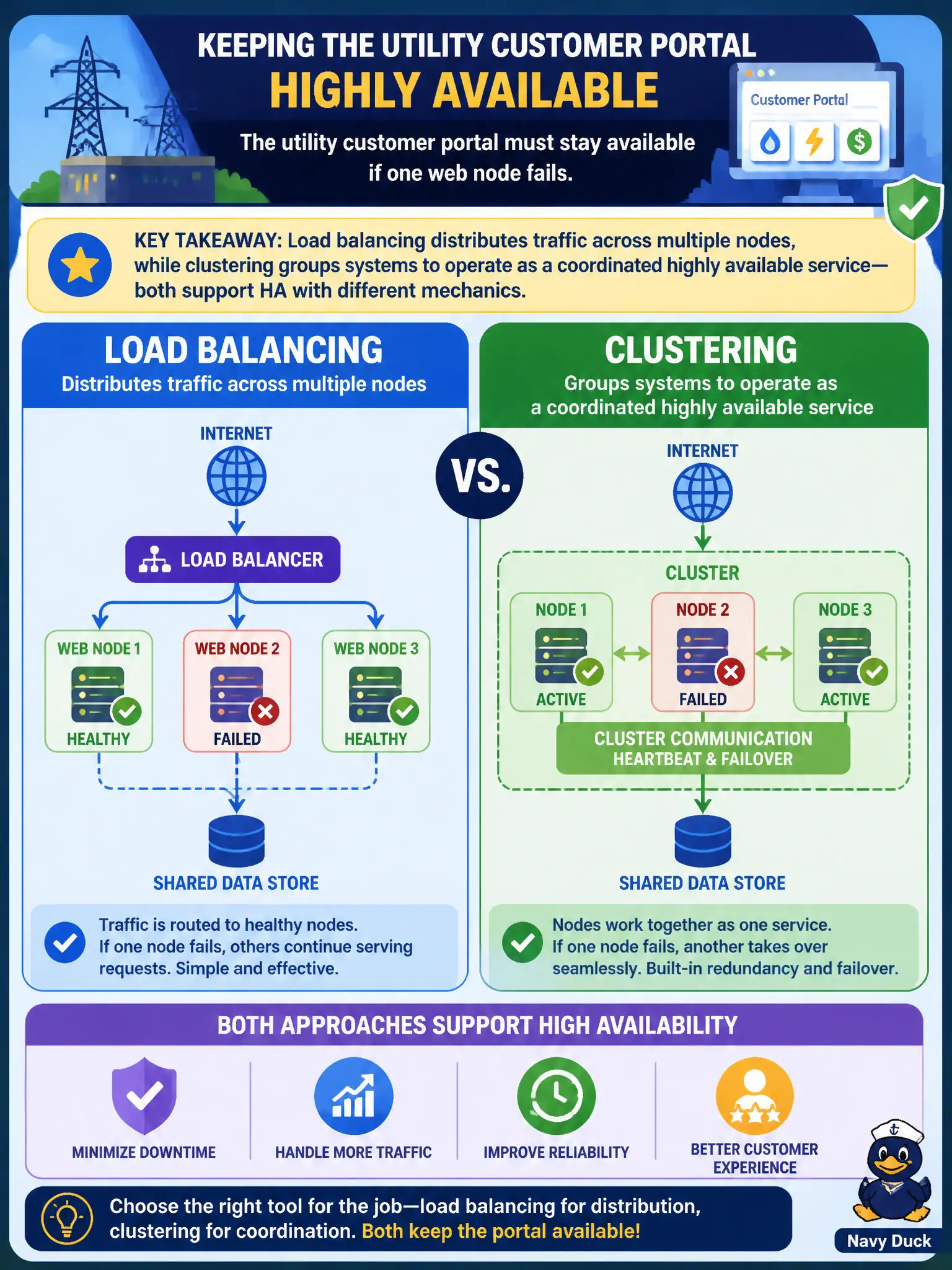
Load balancing is the traffic cop spreading visitors across portal servers; clustering is the team jersey making nodes work as one resilient service. Different plays, same goal: survive a node face-plant. They’re not backup jobs or classification stickers.
Full Explanation
Load balancing spreads inbound client connections across multiple nodes to improve scalability and to survive individual node loss for request handling. Clustering coordinates multiple systems to present a highly available service—shared membership, failover, and sometimes shared state—so the application remains available as a logical unit. Both patterns support high availability; they solve different mechanics in the architecture stack.
Saying load balancing only stores tape backups confuses traffic distribution with backup media jobs. Claiming clustering only changes DNS TTLs misstates cluster membership and heartbeat failover. Swapping the definitions—claiming clustering is merely connection spraying while load balancing means only active-passive memory sharing—muddies exam terminology. Treating neither as availability techniques and calling them classification labels is category error.
Exam caveat: active-active load-balanced farms and active-passive clusters both appear in HA designs; read the scenario for whether the need is traffic distribution, stateful failover, or both. HA is not automatic without health checks and tested failover.
Operational check: for a municipal portal, confirm the load balancer removes failed nodes from rotation, verify cluster failover for stateful backends, monitor health probes, and run planned node drains so availability claims match observed behavior.