
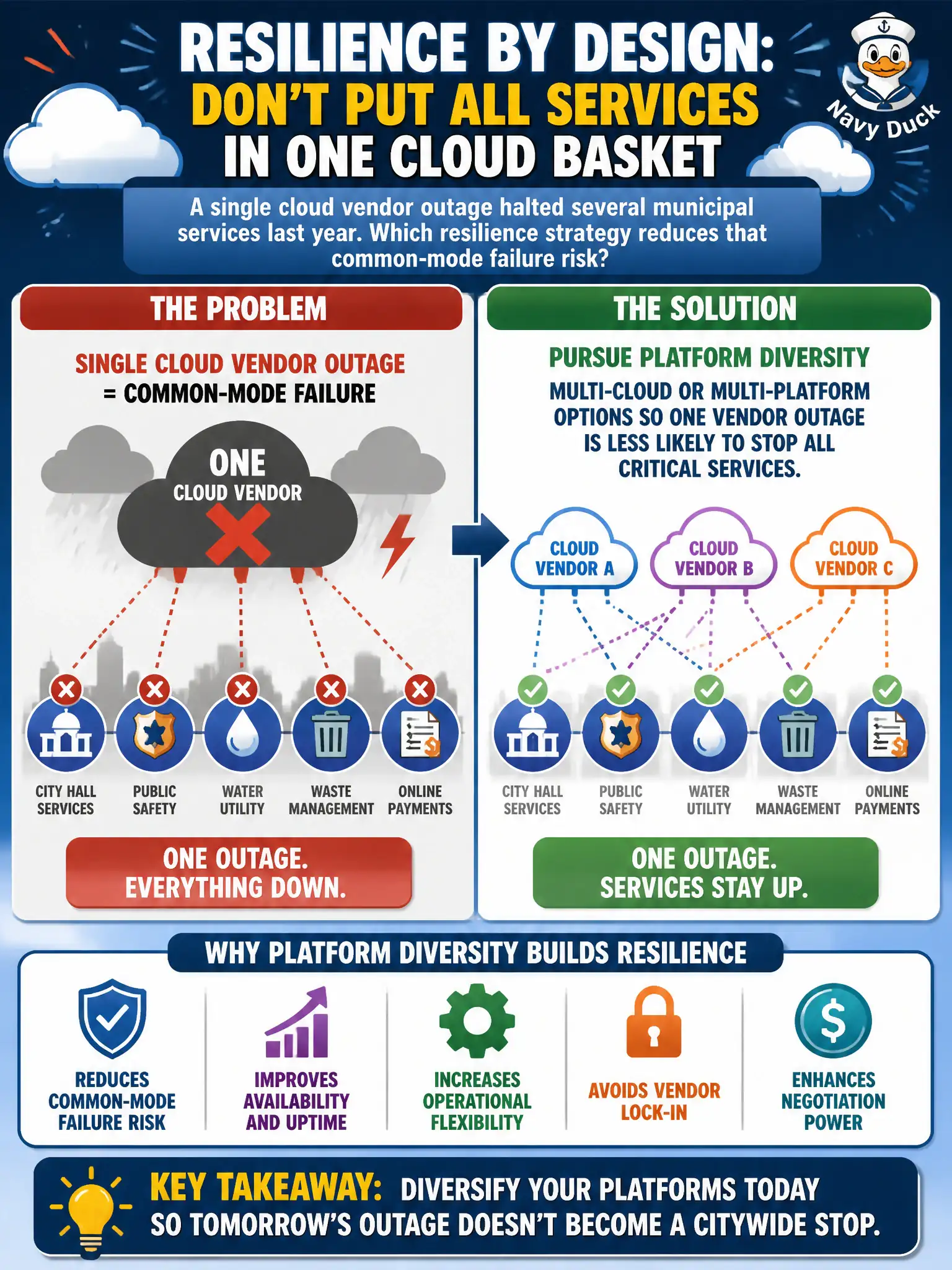
A single cloud vendor outage halted several municipal services last year. Which resilience strategy reduces that common-mode failure risk?
Select an answer to reveal the explanation.
Short Explanation
When one cloud sneezes and half city hall catches a cold, you’ve got a common-mode problem. Spreading critical bets across platforms is diversity—resilience insurance. Doubling down on the same vendor just buys a bigger sneeze.
Full Explanation
Platform diversity—including multi-cloud or multi-vendor options for critical services—reduces common-mode failure when a single provider suffers a regional or control-plane outage. Municipal continuity improves when not every essential workload shares one vendor’s fate and one contractual dependency tree.
Moving every remaining service onto the same failed vendor simplifies contracts while maximizing correlated downtime the next time that provider falters. Eliminating vendor alternatives to keep identical failure domains everywhere is fragility by design. Disabling monitoring so outages are noticed later does not restore services; it only delays response and lengthens citizen impact.
Exam caveat: diversity has cost and complexity—identity, networking, and skills must span platforms. Diversity without tested failover still fails. The exam targets avoiding single-vendor concentration for critical civic services, not mandating every app run everywhere at once.
Operational check: identify services that halted in the last vendor outage, prioritize alternate platforms or warm standbys for the highest-impact systems, rehearse cutover with clear owners, and keep monitoring enabled so the next provider incident triggers a practiced response—not a surprise.