
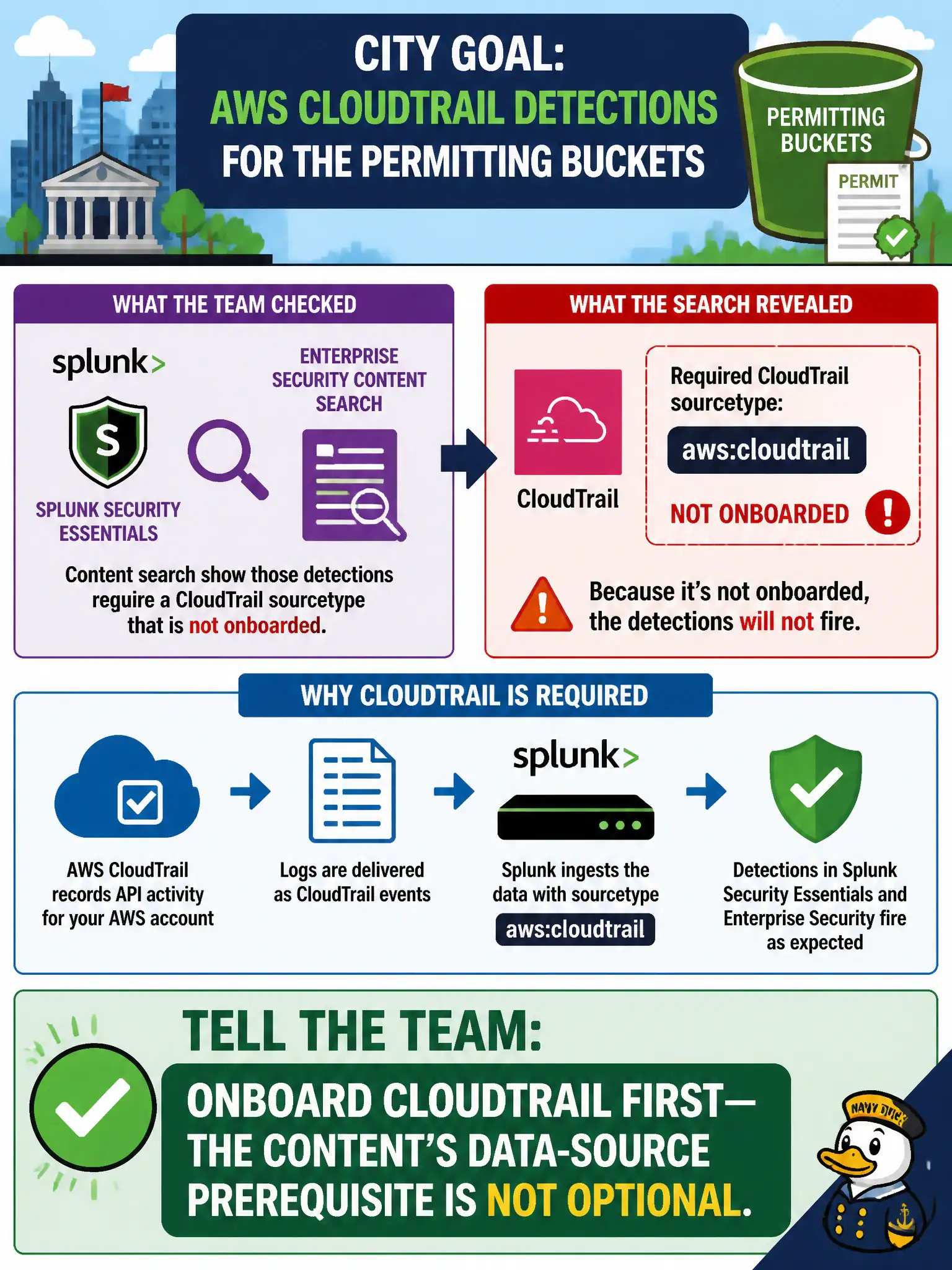
The city wants AWS CloudTrail detections for the permitting buckets. Splunk Security Essentials and Enterprise Security content search show those detections require a CloudTrail sourcetype that is not onboarded. What should the analyst tell the team?
Select an answer to reveal the explanation.
Short Explanation
Detections are recipes that need the right ingredients. If SSE says CloudTrail is required, turning the search on without CloudTrail just gives empty plates. Onboard the source, then enable the content.
Full Explanation
When Splunk Security Essentials and Enterprise Security content search show AWS CloudTrail detections for permitting buckets require a CloudTrail sourcetype that is not onboarded, the analyst must tell the team to onboard CloudTrail first—the data-source prerequisite is not optional. SSE and ES listings expose sourcetype and CIM prerequisites for a use case; enabling content without the audit feed yields empty or misleading results. Control-plane API evidence for bucket and IAM activity lives in CloudTrail (or the equivalent AWS API audit sourcetype), not in substitutes. Surface the gap before claiming detections are live.
Enabling the detections anyway because Enterprise Security will invent CloudTrail events from VPC Flow Logs fails by concept: flow logs are network five-tuples, not API audit records. Pointing detections at index=* and hoping an AWS field appears abandons prerequisite discipline for unbounded hope. Replacing CloudTrail with on-prem Sysmon as a CloudTrail equivalent confuses endpoint process telemetry with AWS control-plane audit.
Exam caveat: prerequisite stems on SPLK-5001 treat required sourcetypes as mandatory—VPC Flow, index=*, and Sysmon are not CloudTrail stand-ins.
Operational check: document the CloudTrail (or AWS API audit) gap from SSE/ES content requirements, onboard and CIM-map CloudTrail for the permitting account, re-check data availability, then enable the bucket-related detections only after events populate.