
A county IDS fires on a library VLAN, and Enterprise Security also shows a notable. How should the analyst treat the two systems?
Select an answer to reveal the explanation.
Short Explanation
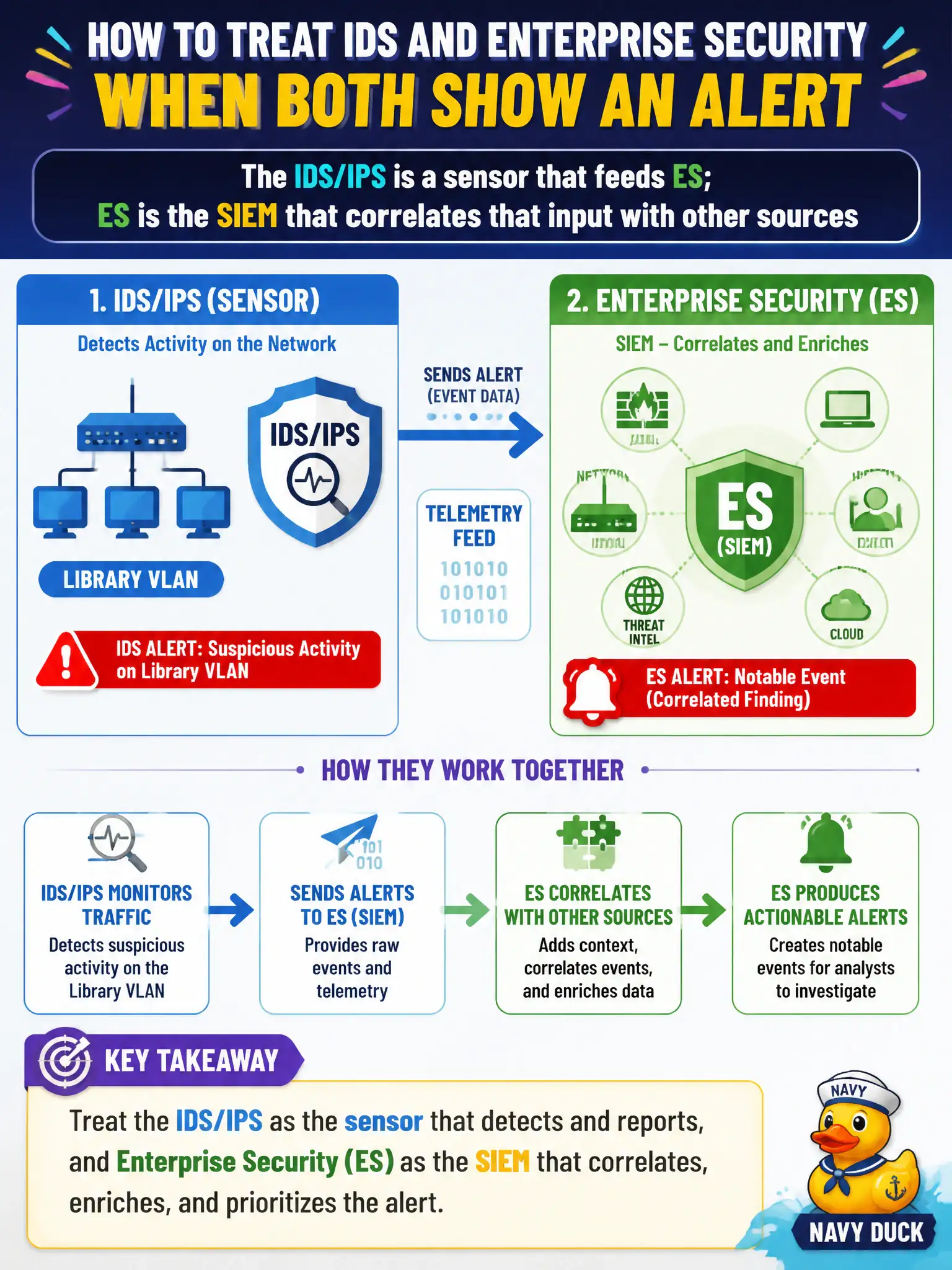
The IDS is a smoke detector; ES is the fire-panel that listens to many detectors at once. Keep the sensor as a sensor and the SIEM as the correlator—do not swap their job titles.
Full Explanation
When a county IDS fires on a library VLAN and Enterprise Security also shows a notable, treat the IDS or IPS as a sensor that feeds ES, and treat ES as the SIEM that correlates that input with other civic sources. The IDS provides detection on the wire; ES stores, enriches, correlates across identities and assets, and presents the notable for investigation. They are complementary layers in a municipal SOC architecture, not interchangeable products competing for the same job.
Calling the IDS the SIEM and ES only a packet broker reverses roles—Enterprise Security is not a packet broker sitting in front of the sensor. Claiming IDS alerts cannot enter ES so the notable must come from the badge system is false; IDS alerts commonly onboard into ES, and badge systems do not invent network IDS notables. Treating IDS and SIEM as the same product so the county should disable one collapses distinct functions defenders need together for library-segment visibility.
Exam caveat: know sensor versus SIEM; SPLK-5001 expects Enterprise Security as the correlation and investigation layer consuming IDS and other inputs.
Operational check: confirm the IDS sourcetype is onboarded and CIM-mapped, open the library VLAN notable in ES, verify the IDS event is among contributing raw events, and keep both systems enabled with clear ownership and tuning ownership.