
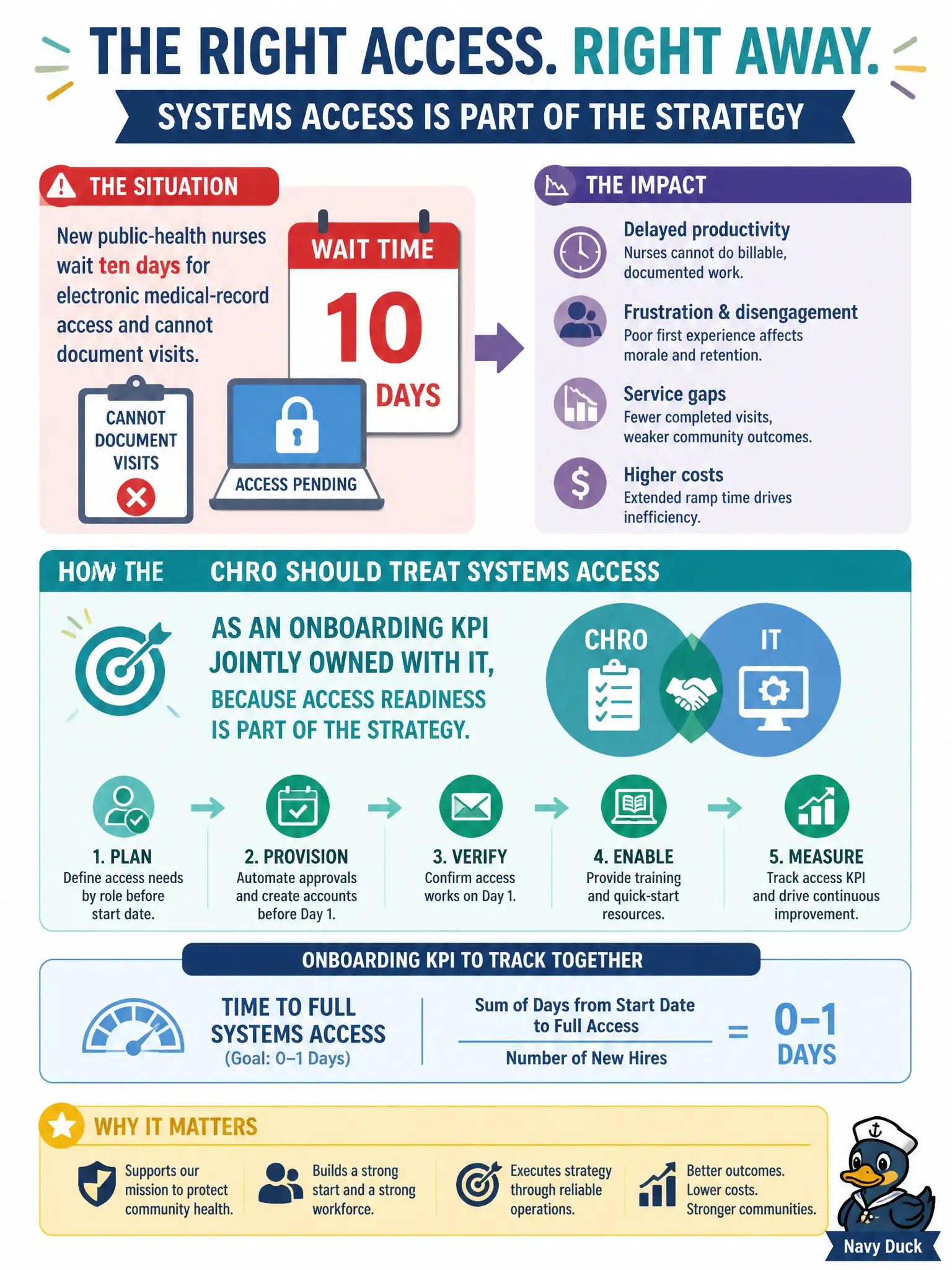
New public-health nurses wait ten days for electronic medical-record access and cannot document visits. How should the CHRO treat systems access?
Select an answer to reveal the explanation.
Short Explanation
A nurse without the chart system is a runner without shoes. If access takes ten days, onboarding is late—put that number on the HR-and-IT scoreboard.
Full Explanation
When new public-health nurses wait ten days for electronic medical-record access and cannot document visits, systems access is an onboarding KPI jointly owned with IT—not an IT-only ticket HR should ignore. A nurse without the chart system is a runner without shoes; delayed access means delayed productivity, incomplete clinical documentation, and avoidable risk. Access readiness is part of workforce strategy and must be scored and managed like any other onboarding outcome.
Treating access as an IT-only ticket HR should not measure abandons onboarding outcomes and leaves finger-pointing as the operating model. Treating delay as a probationary test of nurse patience is cynical and operationally wasteful. Lengthening classroom orientation until accounts appear hides the provisioning failure inside more seat time instead of fixing the handoff.
Exam caveat: joint KPIs must respect security provisioning controls; speed cannot mean skipping identity proofing or least-privilege rules. The concept is shared accountability for access readiness as onboarding strategy.
Operational check: set a day-one or day-two EMR access target; make HR and IT jointly report misses weekly; provision accounts on acceptance where security allows; track documentation lag tied to access delay; and escalate chronic misses to both executives until the median hits the target.