
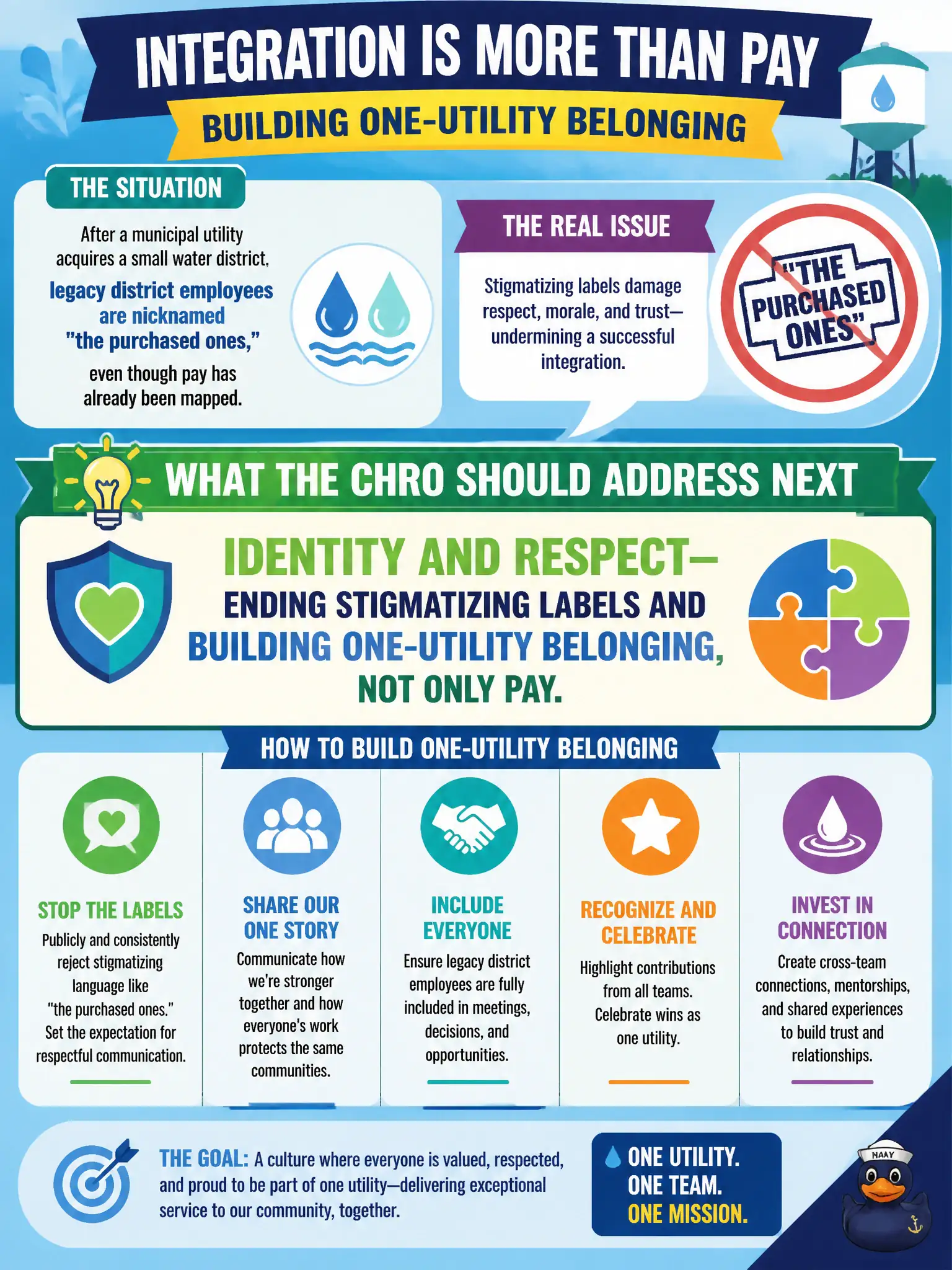
After a municipal utility acquires a small water district, legacy district employees are nicknamed "the purchased ones," even though pay has already been mapped. What should the CHRO's integration strategy address next?
Select an answer to reveal the explanation.
Short Explanation
If the shop still calls them "the purchased ones," the merger paid the bill and forgot the people. Respect is the integration work now—nicknames like that are a culture leak, not a joke.
Full Explanation
After a municipal utility acquires a small water district, pay mapping alone does not finish integration if legacy employees are nicknamed 'the purchased ones.' The CHRO's next integration work is identity and respect—ending stigmatizing labels and building one-utility belonging. Culture leaks through nicknames; leaving them unaddressed tells acquired staff they remain outsiders even when pay stubs match.
Another across-the-board pay bump treats identity issues as if they were always compensation issues and may be unaffordable. A gag order forbidding any mention of the former district suppresses history without creating belonging and can backfire. Immediate layoff of all acquired staff to make the nickname irrelevant is punitive and likely unlawful as an integration strategy.
Exam caveat: belonging work is not a substitute for fair pay, classification equity, or nondiscrimination compliance; it is the cultural layer after structural mapping. The concept is identity integration beyond compensation.
Operational check: brief supervisors that stigmatizing labels are unacceptable and corrective; run joint crew forums that surface respect issues; mix crews and projects deliberately; include belonging items in pulse surveys for acquired sites; and hold leaders accountable for climate, not only for payroll alignment.