
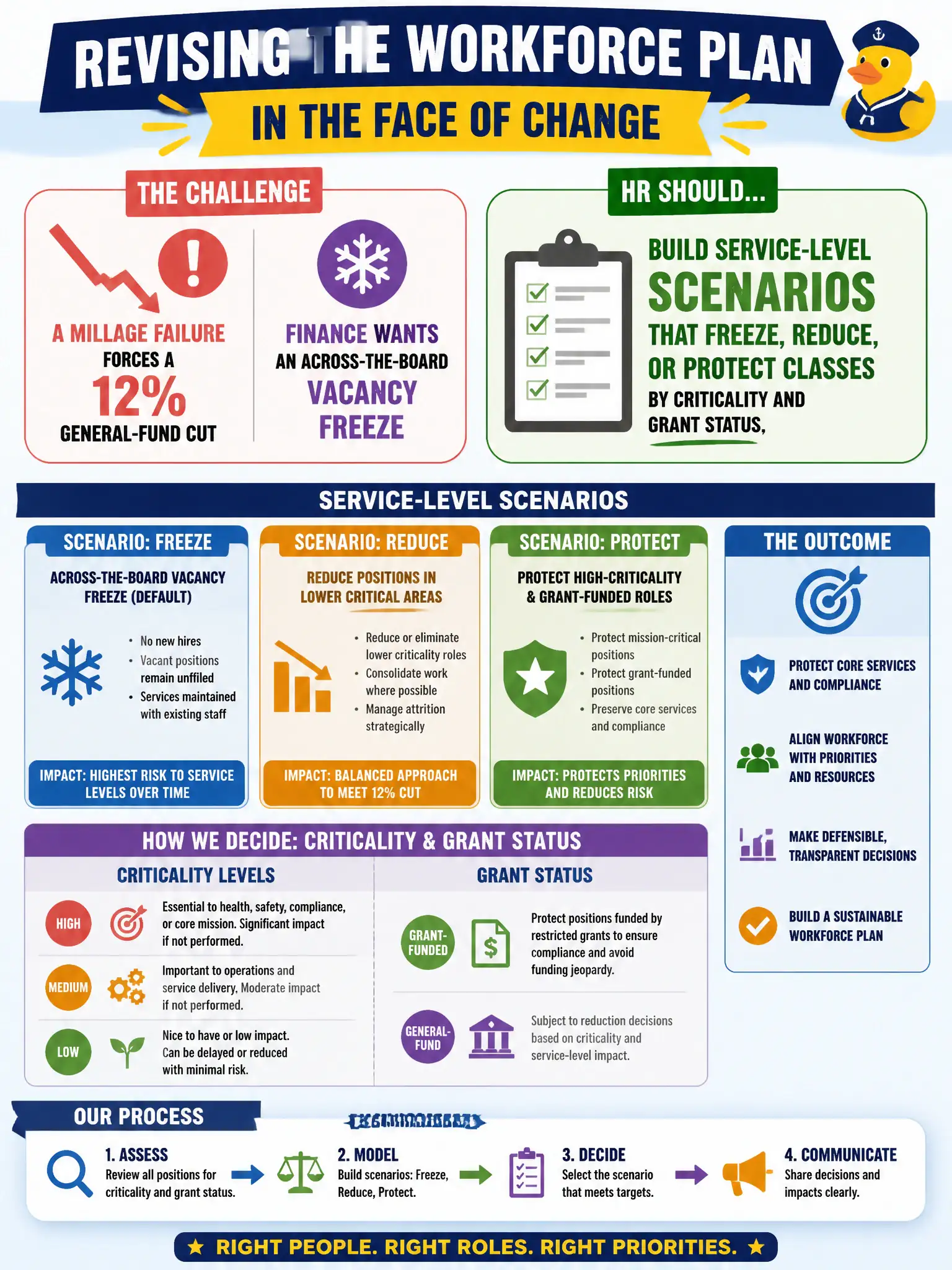
A millage failure forces a 12% general-fund cut, and finance wants an across-the-board vacancy freeze. How should HR revise the workforce plan?
Select an answer to reveal the explanation.
Short Explanation
An across-the-board freeze is like turning every faucet the same amount—the kitchen and the fire sprinklers both go dry. Public work is not equal: a grant-protected nurse is not a discretionary analyst vacancy. Scenario the classes—freeze, reduce, or protect—so the 12% hits least-critical service first.
Full Explanation
Across-the-board vacancy freezes treat unequal public services as equal faucets. When a millage failure forces a 12% general-fund cut and finance wants a uniform freeze, HR should build service-level scenarios that freeze, reduce, or protect classes by criticality and grant status. A grant-protected nurse is not interchangeable with a discretionary analyst vacancy; freezing both 'fairly' can breach grant terms and harm core resident services while protecting lower-criticality work. SPHR workforce planning under austerity is targeted, not symmetrical.
Freezing every vacancy equally so no department can claim singled-out treatment optimizes political optics over service outcomes. Halting all hiring until a future replacement millage abandons interim stewardship. Converting the entire cut into unpaid furloughs for every FTE may be bargained or legally constrained and is not the only, or best, targeted tool.
Exam caveat: criticality-based scenarios still require equitable process and nondiscriminatory criteria inside protected and frozen groups. The concept is differentiated service-level planning, not favoritism by personality.
Operational check: classify vacancies as protect/freeze/reduce with grant and statutory notes; model resident-facing service impacts; align with finance on dollars and with counsel on legal constraints; present scenario packages to the manager; and document why each protected vacancy stays open.