
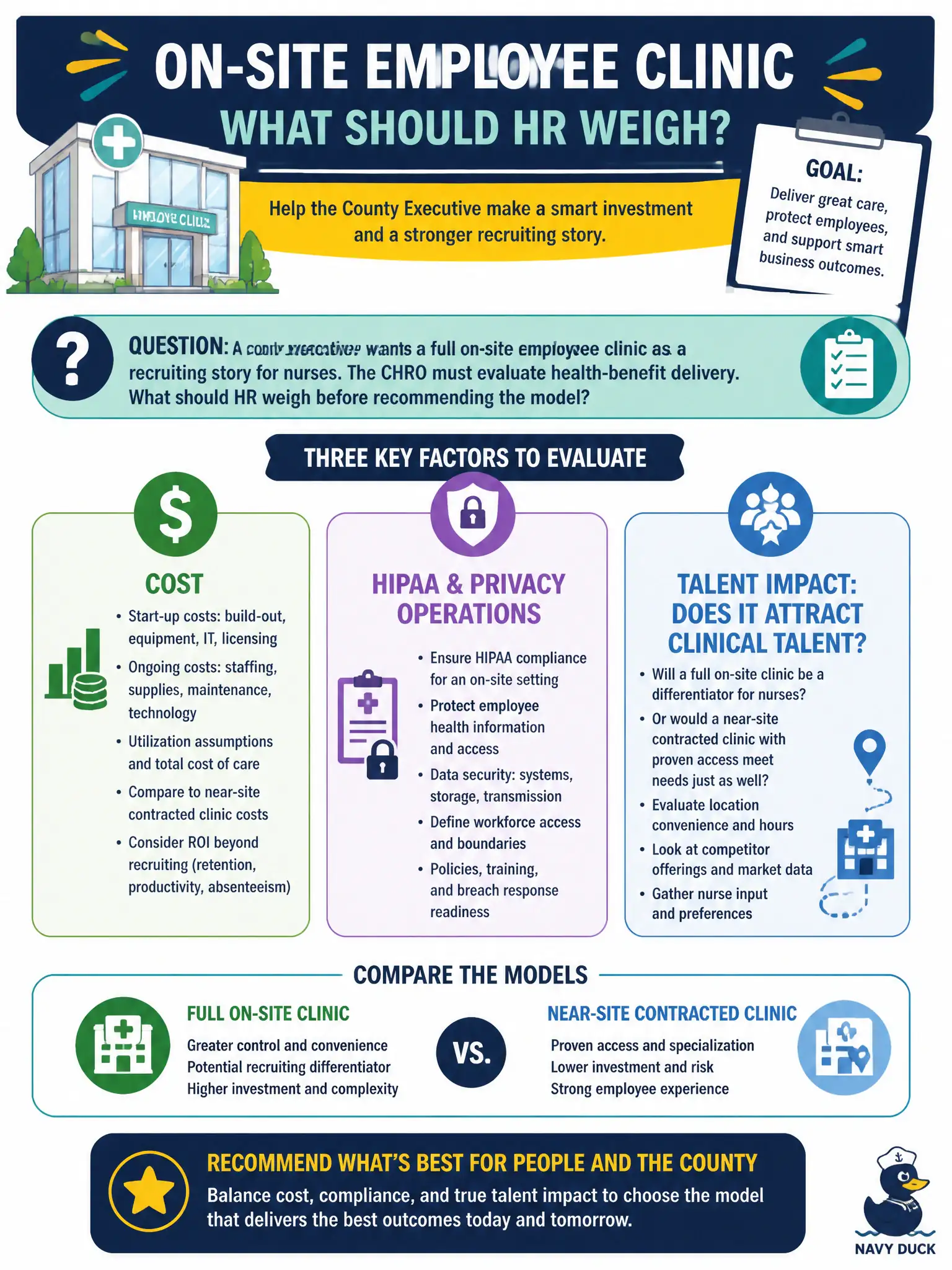
A county executive wants a full on-site employee clinic as a recruiting story for nurses. The CHRO must evaluate health-benefit delivery. What should HR weigh before recommending the model?
Select an answer to reveal the explanation.
Short Explanation
Building a mini-hospital in the parking lot sounds impressive until nobody is there to unlock it. Nurses notice whether care is real, private, and staffed—not whether the county owns the building. Sometimes a clinic down the street that actually has appointments beats a shiny empty suite.
Full Explanation
On-site versus near-site care is a benefit-delivery choice for a county workforce, not a facilities trophy for nurse recruiting ads. Before recommending a full on-site clinic, the CHRO should weigh fully loaded cost, HIPAA and privacy operations, credentialing, and evidence that the model actually attracts clinical talent versus a contracted near-site clinic with proven access. Delivery design that cannot be staffed or that mishandles medical information becomes a liability rather than an attractor.
Staffing the clinic entirely with unlicensed wellness coaches so HIPAA supposedly never attaches misstates both clinical and privacy reality and can create unauthorized practice and data-handling risk. Treating the clinic as a first-year replacement for the medical plan and workers' compensation conflates ambulatory access with insurance and statutory coverage it cannot replace. Announcing the clinic in recruiting ads before designing clinical operations sells a story the county may not be able to deliver safely.
Exam caveat: near-site contracted models can still require privacy agreements and quality oversight; "contracted" is not "hands-off." Operational check: build a side-by-side cost and access model for on-site versus near-site, require a HIPAA operations plan and credentialing path before any recruiting claim, and pilot access metrics before capital commitment.