
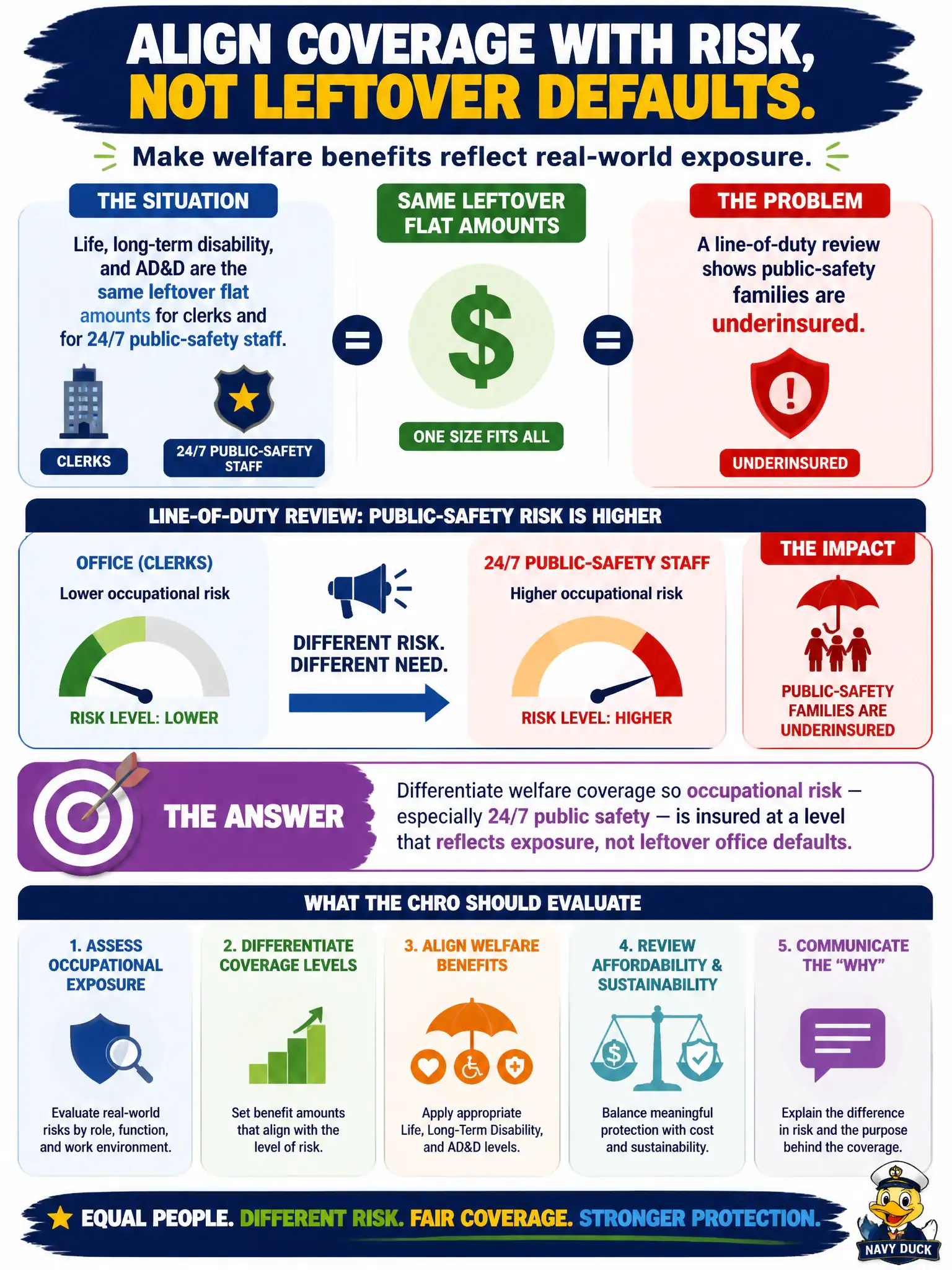
Life, long-term disability, and AD&D are the same leftover flat amounts for clerks and for 24/7 public-safety staff, and a line-of-duty review shows public-safety families are underinsured. What should the CHRO evaluate?
Select an answer to reveal the explanation.
Short Explanation
Same life and disability for a desk and a night engine company is like issuing one-size raincoats in a hurricane. Welfare benefits should follow the risk. Public-safety families should not sit on leftover office defaults.
Full Explanation
Welfare-benefit strategy—life, long-term disability, and AD&D—should reflect occupational risk, not leftover office defaults. Twenty-four-hour public-safety roles carry higher fatality and disability exposure than clerical work; when a line-of-duty review shows public-safety families underinsured under a flat schedule shared with clerks, the CHRO should differentiate coverage to match exposure. That is benefits design as duty-of-care and retention for high-risk civic roles.
Dropping AD&D for public safety because workers' compensation is assumed to cover everything misstates the limited scope of workers' comp relative to group life, AD&D, and LTD income replacement for families. Giving every employee the same tiny increase preserves uniformity theater without fixing underinsurance where risk is highest. Replacing disability coverage with a crowdfunding policy is not a benefits strategy and fails predictability for catastrophic events.
Exam caveat: risk-based differentiation must still meet nondiscrimination and bargaining rules and should be documented as job-related exposure, not favoritism. Operational check: compare current life/LTD/AD&D schedules to peer public-safety benchmarks and to line-of-duty loss scenarios, then propose tiered schedules with cost and council briefing before renewal.