
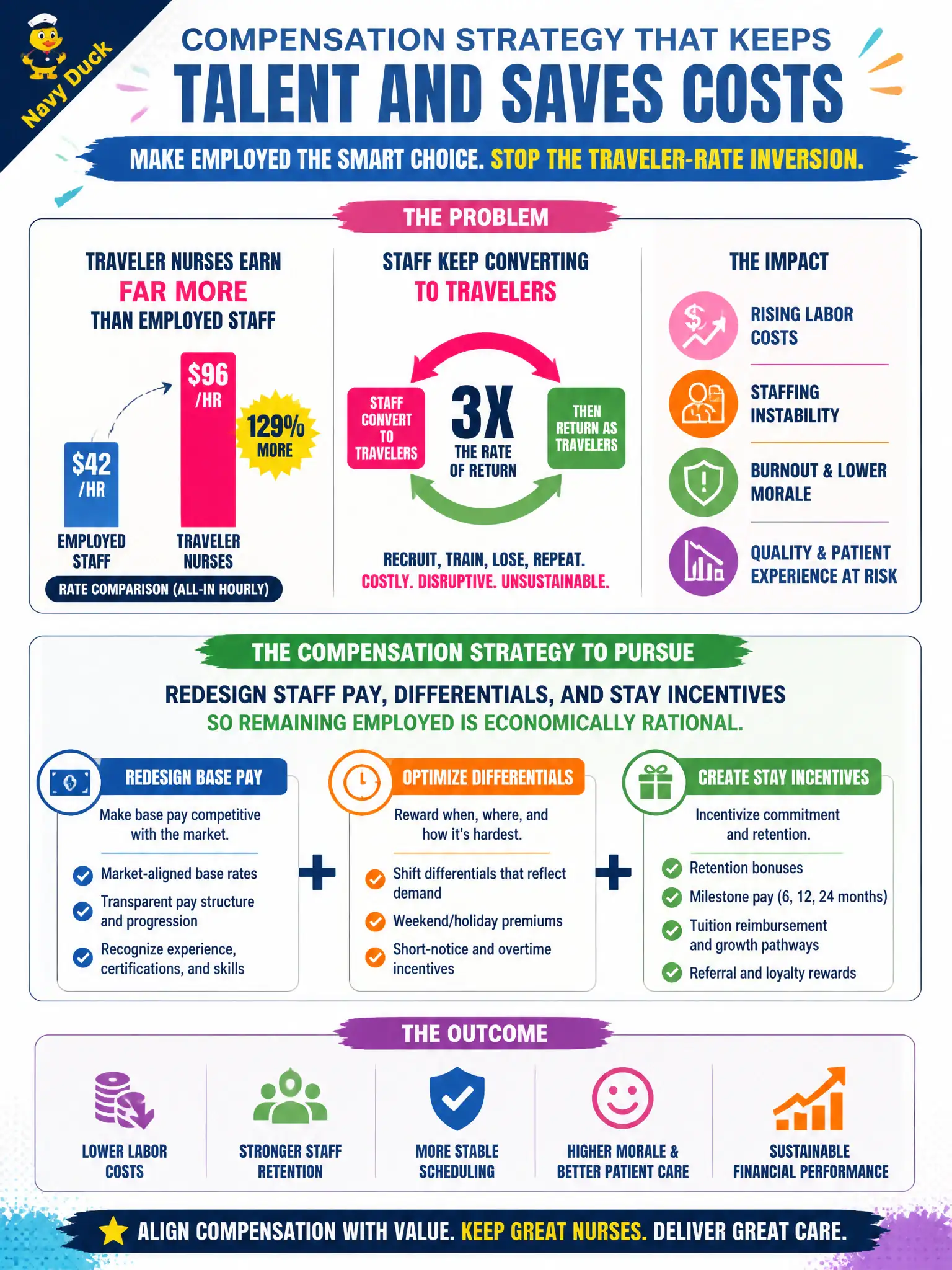
At the county hospital, traveler nurses earn far more than employed staff, and staff keep converting to travelers and returning at triple the rate. What compensation strategy should the CHRO pursue?
Select an answer to reveal the explanation.
Short Explanation
If the traveler badge pays three times the staff badge, the hospital taught people how to quit. The loop stops when staff pay and stay bonuses make the employee deal make sense. Parking stickers do not beat a traveler check.
Full Explanation
Traveler-rate inversion is a staff compensation strategy failure at a county hospital. When travelers earn far more than employed nurses and staff convert to traveler status to return at triple the rate, the rational move is to redesign staff base pay, differentials, and stay incentives so remaining employed is economically sensible while travelers stay a true surge tool. Feeding the inversion raises cost and hollows institutional skill.
Banning travelers entirely even when units cannot meet required ratios prioritizes a purity rule over patient-safety staffing and is often operationally impossible. Matching traveler rates for every staff nurse on every shift without a funding plan is fiscally reckless and still may not restore employed career paths. Offering only extra parking avoids the wage problem and will not stop conversion to traveler agencies.
Exam caveat: redesign must fit budget cycles and any nursing agreement; phased differentials and retention bonuses can bridge without an overnight full traveler match. Operational check: quantify conversion-to-traveler volume and premium cost versus a modeled staff stay package, implement the redesign on the worst units first, and track employed vacancy and traveler hours monthly for two quarters.