
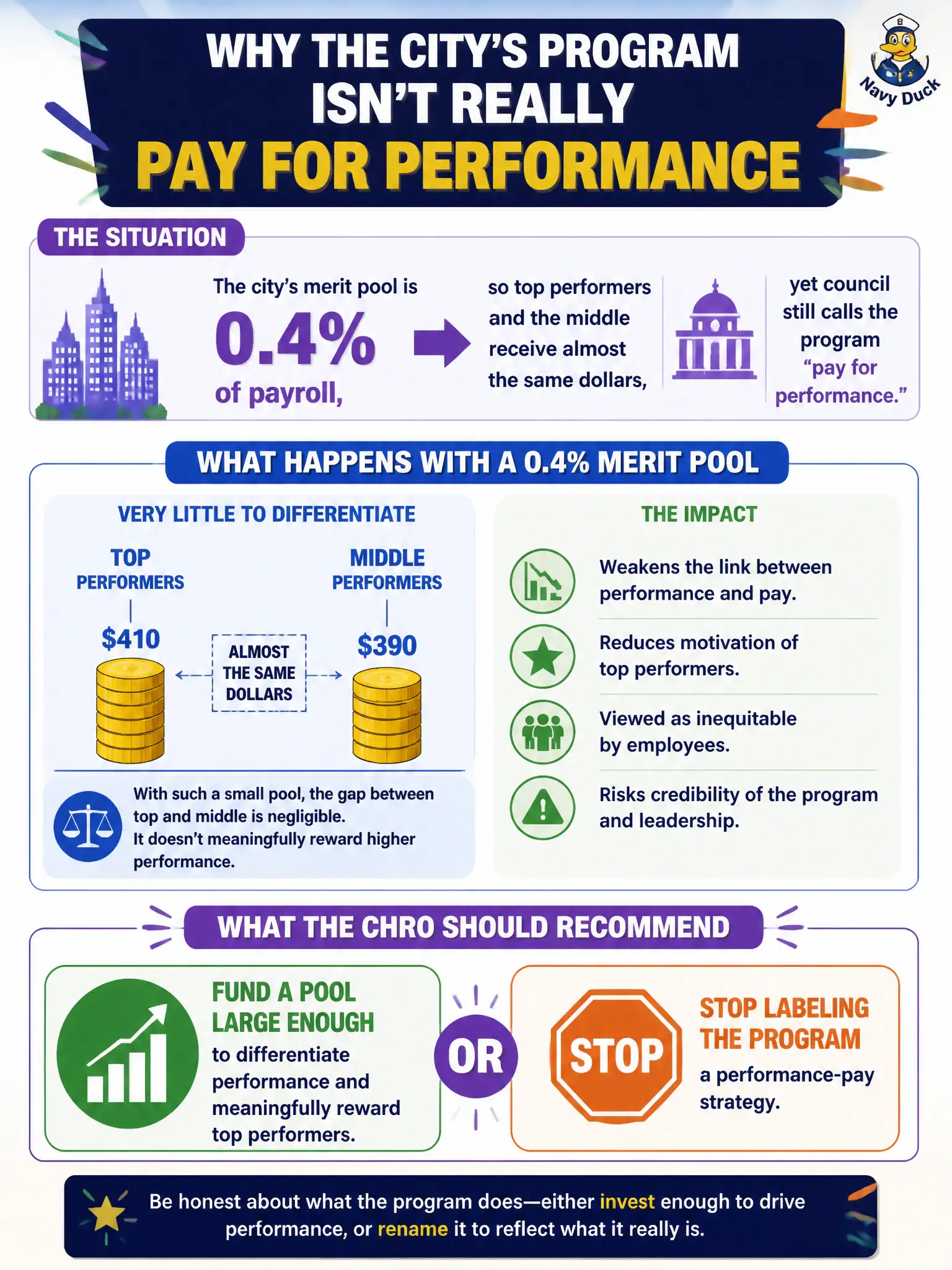
The city's merit pool is 0.4 percent of payroll, so top performers and the middle receive almost the same dollars, yet council still calls the program pay for performance. What should the CHRO recommend?
Select an answer to reveal the explanation.
Short Explanation
A merit pot nobody can see without a magnifying glass is not a strategy — it is a rounding error wearing a name tag. Either put real money in it or stop calling it pay for performance. People can do the math on a two-cent raise.
Full Explanation
Merit and incentive strategies work only when the pool can create a meaningful difference between high and typical performance. A 0.4 percent of payroll pool that leaves top performers and the middle with nearly identical dollars is a rounding error wearing a strategy label; the CHRO should either fund differentiation or stop calling the program pay for performance so raters and employees are not trained that ratings are theater.
Keeping the tiny pool and telling raters to stretch labels so it "feels like merit" corrupts performance management without creating economic signal. Giving the entire pool to executives so the headline still says merit exists converts a workforce program into an executive carve-out and worsens equity optics. Hiding pool size while describing it as market-competitive merit is communications deception that collapses when employees do the arithmetic.
Exam caveat: some jurisdictions face hard levy or charter caps—honest labeling and alternative recognition tools beat a fictional merit brand when dollars truly cannot move. Operational check: publish the pool percentage and modeled spread between top and middle ratings to council before cycle kickoff; if the spread cannot exceed noise, retire the performance-pay label for that cycle and document the decision.