
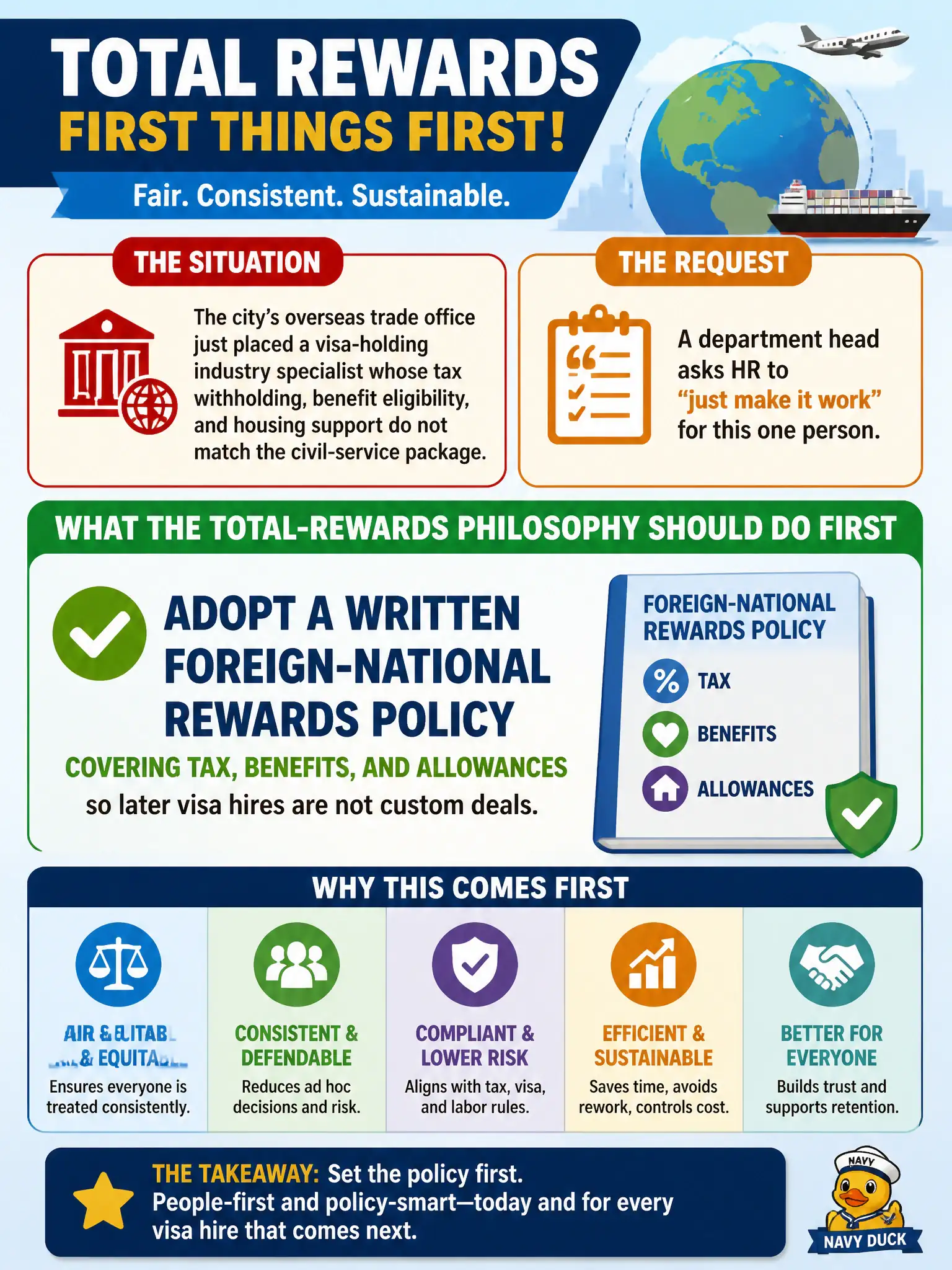
The city's overseas trade office just placed a visa-holding industry specialist whose tax withholding, benefit eligibility, and housing support do not match the civil-service package. A department head asks HR to "just make it work" for this one person. What should the total-rewards philosophy do first?
Select an answer to reveal the explanation.
Short Explanation
A one-off deal is like cutting a spare key on a napkin — it works until the next person shows up and nobody remembers the combination. Foreign-national tax and benefit rules belong in a written philosophy, not a hallway bargain. Then the next visa hire is a policy application, not another scramble.
Full Explanation
A civic total-rewards philosophy must cover distinct populations before a department asks for a one-person improvisation. Visa-holding specialists often face different tax withholding, benefit eligibility, housing, and relocation rules than civil-service peers; writing those differences into policy creates equity, budget predictability, and an audit trail council and finance can defend when the next trade-office hire arrives. SPHR-level practice treats foreign-national rewards as philosophy design, not a hallway exception.
Approving a one-time cash stipend without documenting recurring visa-related rules fails because it creates an undocumented entitlement that finance cannot replicate and that later candidates will cite as custom. Copying a neighboring city's informal handshake fails as governance: undocumented precedent is not transferable policy and collapses under public-records or equal-pay scrutiny. Paying the specialist as a contractor to dodge the benefit philosophy fails on classification and strategy—mislabeling employment status relocates the snowflake problem into joint-employment and IRS risk without solving how the city will treat the next visa hire.
Exam caveat: a written foreign-national policy still must align with federal immigration and tax constraints and with any civil-service or bargaining limits; the document is not a blank check to invent ultra vires perks. Operational check: before the start date, confirm a council- or CHRO-adopted policy names tax, benefits, and allowance treatment for visa holders, that payroll can apply the rules without a special spreadsheet, and that the same framework is queued for the next overseas-office requisition rather than another one-off memo.