
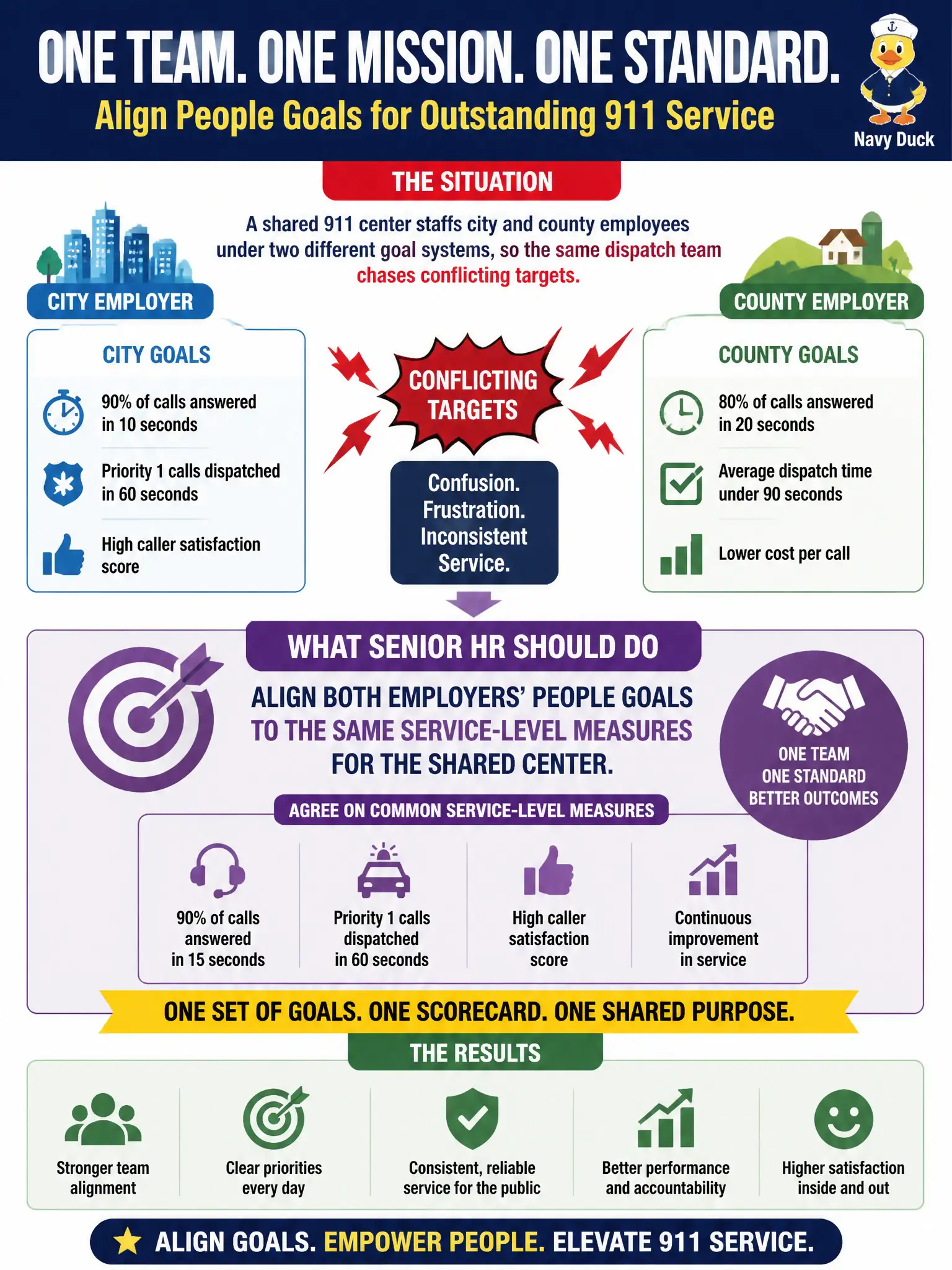
A shared 911 center staffs city and county employees under two different goal systems, so the same dispatch team chases conflicting targets. What should senior HR do?
Select an answer to reveal the explanation.
Short Explanation
One radio room cannot run two scoreboards. City and county badges do not change the fact that the caller needs the same service level. Point both employers' people goals at the same measures or the team will tug in opposite directions on every shift.
Full Explanation
A shared 911 center staffed by city and county employees under two conflicting goal systems forces one dispatch team to chase opposite targets. Senior HR should align both employers' people goals to the same service-level measures for the shared center. Callers do not care which badge answered; civic emergency service requires one scoreboard in one radio room.
Letting each employer keep separate goals and averaging scores at year-end fails by concept: averaging conflicting targets does not create coherent shift behavior. Scoring only city employees and treating county staff as unmeasured guests fails fairness and leaves half the team unmanaged. Splitting the center into two rooms so each workforce keeps a separate success definition fails by destroying the shared-service model residents fund.
Exam caveat: alignment requires intergovernmental agreement on measures; HR leads the people-goal rewrite inside that governance. Operational check: adopt common service-level metrics, rewrite both employers' goals, and audit a month of shifts for conflicting incentives before the next appraisal cycle. Public employers should record the chosen control and rejected options in the talent or labor file so future leaders understand how the decision protects continuity of resident services.