
A city's mentoring program randomly pairs every employee. Retention in a few hard-to-keep roles has not moved. How should HR evaluate and redesign it?
Select an answer to reveal the explanation.
Short Explanation
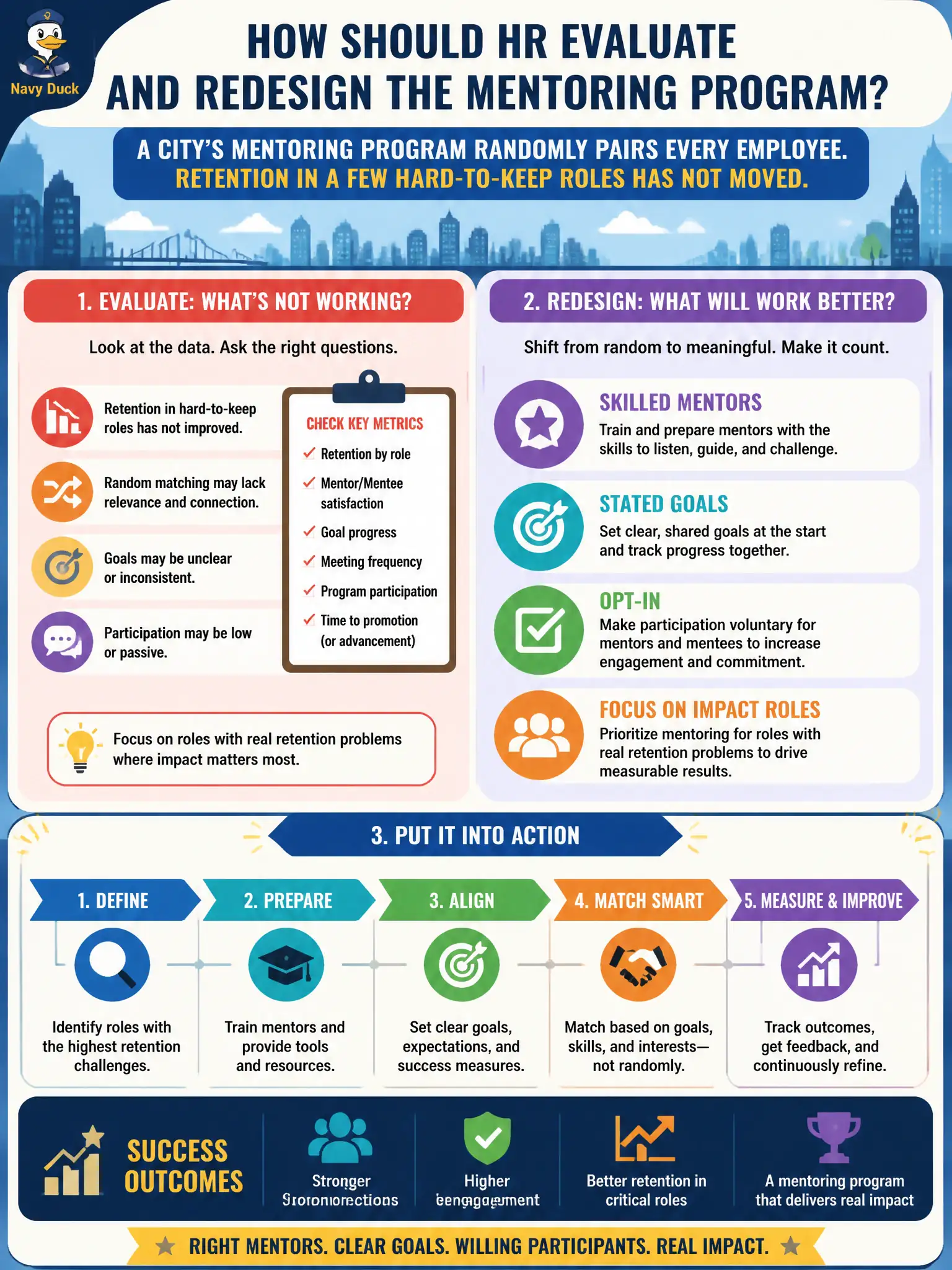
Random pairing for everyone is a mixer, not a retention design. Mentoring needs skilled mentors, goals, and a reason to be in the room. Point it at the roles that are actually walking out.
Full Explanation
A mentoring program that randomly pairs every employee while retention in hard-to-keep roles does not move should be evaluated as a mixer, not a retention design. HR should convert it to skilled mentors, stated goals, and opt-in focused on roles with real retention problems. Public employers have limited mentoring capacity; civic stewardship aims that capacity where turnover harms service continuity for residents who depend on those hard-to-keep roles.
Keeping universal random pairing so dashboards look inclusive fails by concept: coverage optics are not retention outcomes. Mandating pairing for people who already have strong networks while skipping high-turnover roles fails by misallocating scarce mentor skill. Replacing mentoring with a yearly pep talk fails because inspiration events are not developmental relationships with accountability.
Exam caveat: focused mentoring must still be accessible through clear opt-in criteria to avoid patronage; 'focused' is not a secret club for favorites. Operational check: identify high-turnover roles, train mentors, set goals and check-ins, and compare retention in those roles against the random-pairing baseline after two cycles. Public employers should document the rationale in the talent plan so council and managers see why rejected options would weaken continuity for residents.