
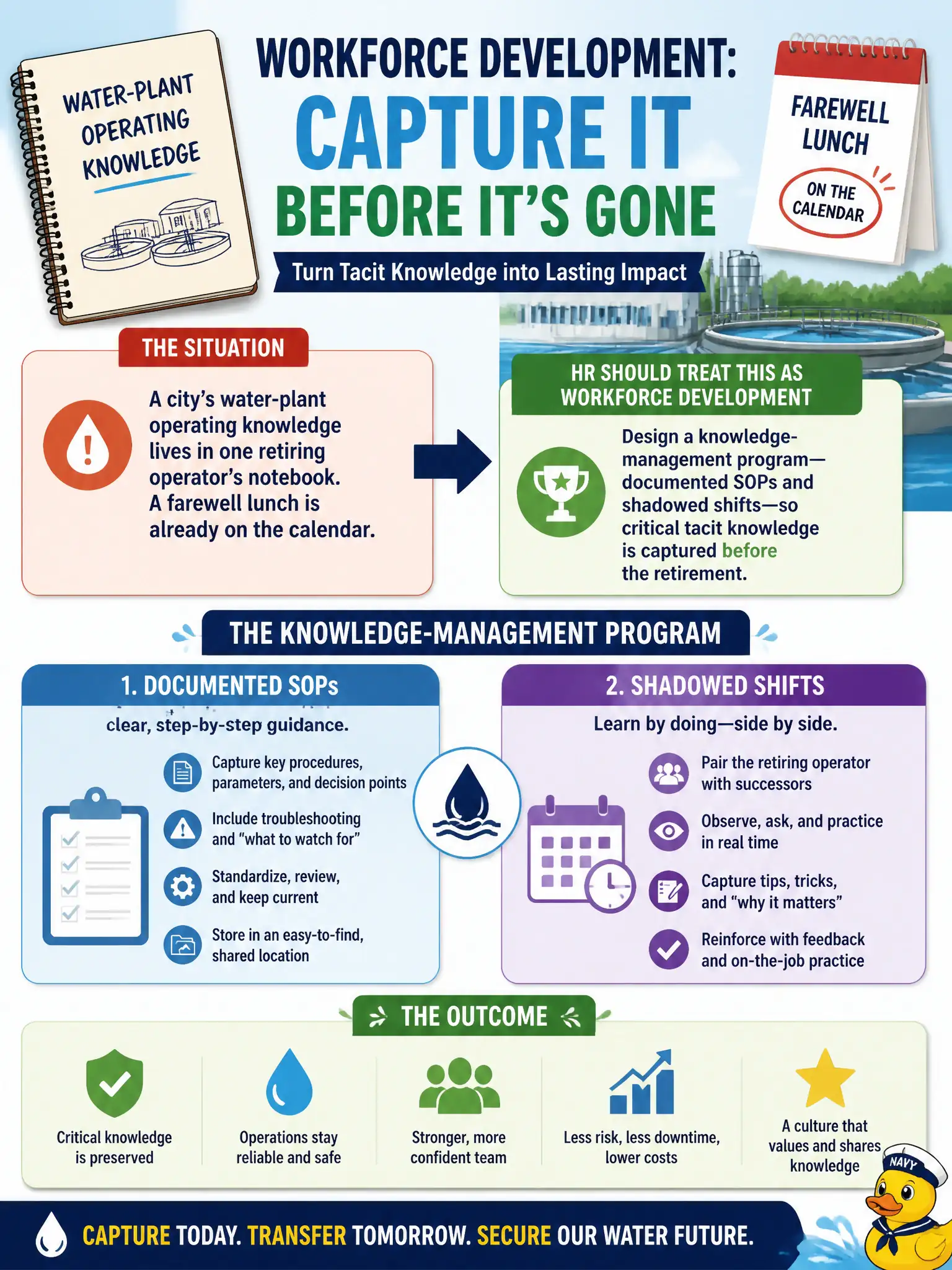
A city's water-plant operating knowledge lives in one retiring operator's notebook. A farewell lunch is already on the calendar. How should HR treat this as workforce development?
Select an answer to reveal the explanation.
Short Explanation
One notebook in one locker is not a plant—it is a single point of failure with a retirement date. A cake does not transfer how to run the filters. Write the SOPs and put someone on the shadowed shifts before the keys leave.
Full Explanation
When water-plant operating knowledge lives in one retiring operator's notebook and a farewell lunch is already scheduled, workforce development must treat this as critical knowledge management, not a social event. HR should design documented SOPs and shadowed shifts so tacit know-how transfers before retirement. Civic framing is stark: residents depend on continuous water treatment; a single notebook in a locker is a single point of failure with a cake date. SPHR development strategy captures mission-critical knowledge while the expert is still on payroll.
Treating the farewell lunch as the knowledge-transfer event fails by concept: ceremony does not produce operable procedures or observed competency. Waiting until the vacancy posts and hoping the next hire reconstructs the notebook fails because reconstruction after departure is reverse-engineering under operational risk. Converting the notebook into a motivational poster fails because inspiration décor does not run filters or satisfy regulatory continuity.
Exam caveat: knowledge capture must respect safety and regulatory documentation standards; informal notes still need validation before they become official SOPs. Operational check: inventory critical tasks from the notebook, assign shadow shifts with sign-off milestones before the last day, and verify a second operator can perform key sequences without the retiree present.