
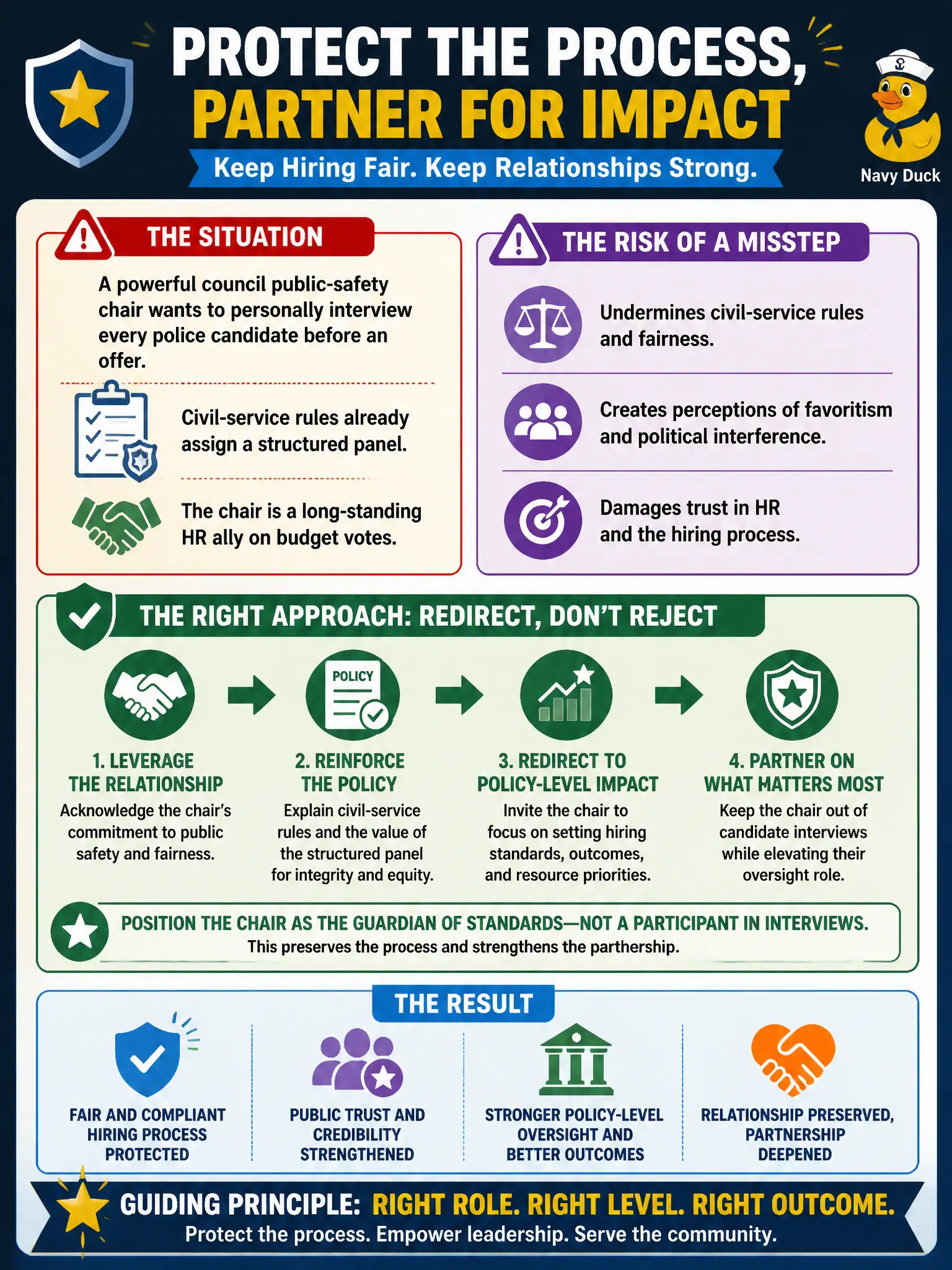
A powerful council public-safety chair wants to personally interview every police candidate before an offer. Civil-service rules already assign a structured panel, and the chair is a long-standing HR ally on budget votes. How should the CHRO protect the hiring process?
Select an answer to reveal the explanation.
Short Explanation
A powerful chair who wants a seat in every police interview is like a landlord who insists on tasting every meal in the restaurant downstairs. You do not pick a sidewalk fight, and you do not hand over the kitchen. Use the relationship to park the chair at policy—standards and outcomes—where council oversight actually belongs.
Full Explanation
Protecting a civil-service police hiring process under political pressure is an influence problem, not a courage-theater problem. The correct approach uses the existing relationship with the public-safety chair to redirect that official toward policy-level oversight of hiring standards while keeping the chair out of candidate-level interviews. Council chairs legitimately care about academy quality, background rigor, and community trust outcomes; those belong at the standards and metrics layer. Putting an elected official into every structured panel interview injects politics into individual selection decisions, creates inconsistent scoring, and opens discrimination and patronage claims that the city—not the chair—will defend. A CHRO who can move a powerful ally without a public rupture preserves both merit rules and the budget relationship the department still needs.
Publicly demanding censure converts an ally into an enemy, escalates a process dispute into a council spectacle, and rarely improves panel integrity. Adding the chair as a required interviewer rewrites the panel around political reality and abandons the civil-service design the question asks you to protect. Ignoring the request is not a strategy: unanswered political asks harden into expectation, then into interference on the next academy class.
Exam caveat: relationship-based redirection is not the same as secretly allowing the chair to score candidates off-book. Influence that keeps the official 'happy' by violating merit rules fails the concept. The tested skill is stakeholder management that upholds process.
Operational check: document the civil-service panel composition and scoring rules; meet the chair with a one-page standards dashboard (pass rates, adverse-impact monitors, background cycle time); confirm in writing that candidate interviews remain with the designated panel; and brief the city manager if the ask recurs so the boundary is institutional, not personal.