
After annexation, former township employees join city civil service with different identity, pay, and work rules. How should HR treat those differences?
Select an answer to reveal the explanation.
Short Explanation
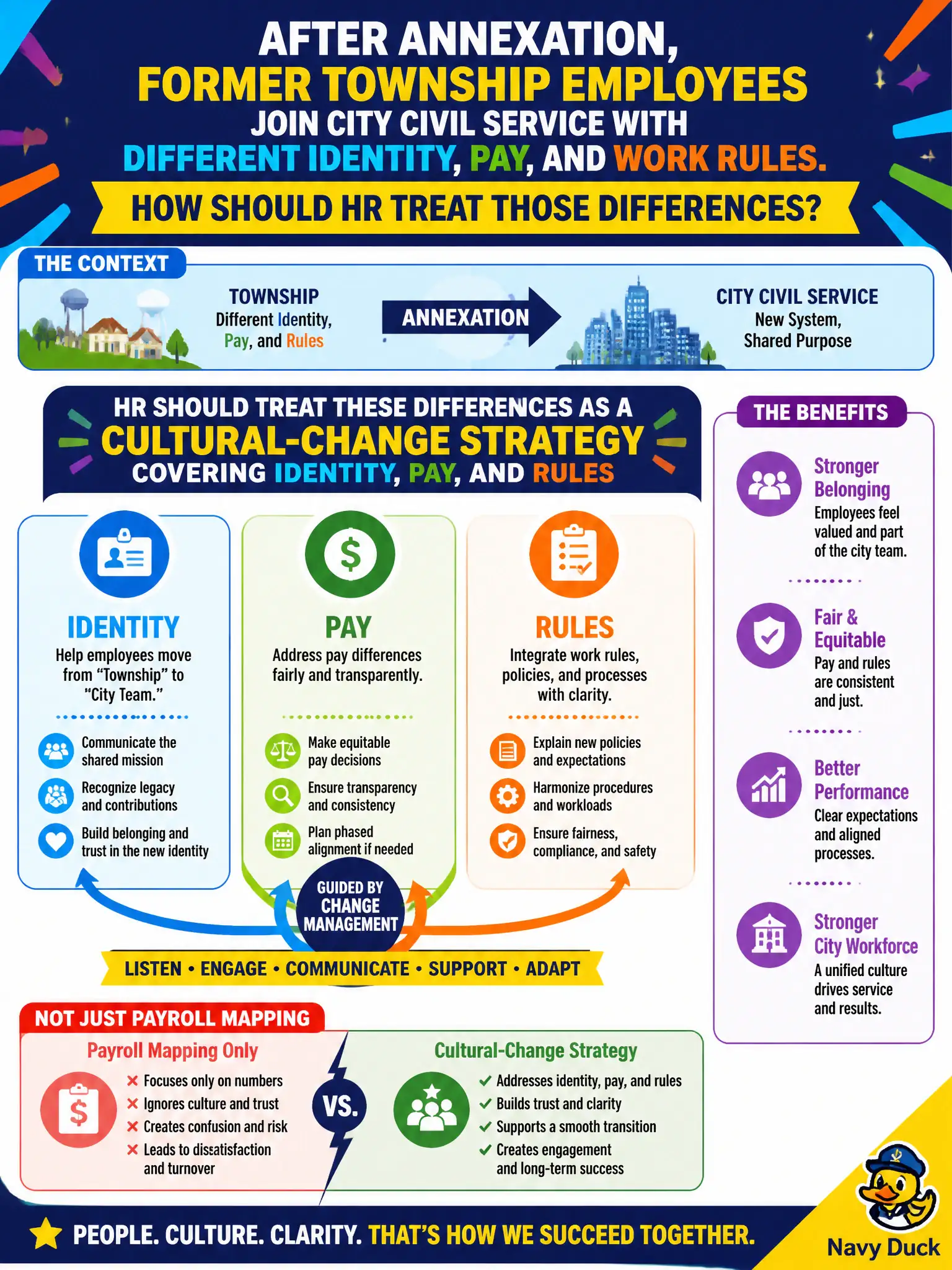
Annexation is not just moving names onto the city’s payroll file. People show up with a township identity, different pay, and different rules. Treat that as a cultural-change strategy or the merger stays legal on paper and messy in the shop.
Full Explanation
Treating annexation differences in identity, pay, and work rules as a cultural-change strategy—not only a payroll mapping exercise, indefinite delay of civil-service coverage, or a communications blackout until the first grievance—is correct. Annexation is not just moving names onto the city’s payroll file; people arrive with township identity and different rules that will drive conflict if unmanaged. Payroll mapping alone misses culture and fairness work. Delaying civil-service coverage indefinitely leaves a two-tier civic workforce without a plan. Waiting for grievances to force communication is reactive harm. Exam caveat: SPHR merger integration includes culture, pay, and rule transitions, not legal consolidation alone. Operational check: map identity, pay, and rule gaps; design transition communications and training; address pay equity and rule harmonization with bargaining where required; and measure integration climate for the annexed municipal workforce. Annexed township employees bring identity and rule differences that payroll mapping cannot absorb. A cultural-change strategy covering identity, pay equity, and work-rule harmonization—with bargaining where required—prevents a permanent two-tier civic workforce.