
A city is consolidating two recreation centers into one residual organization. How should HR design the change?
Select an answer to reveal the explanation.
Short Explanation
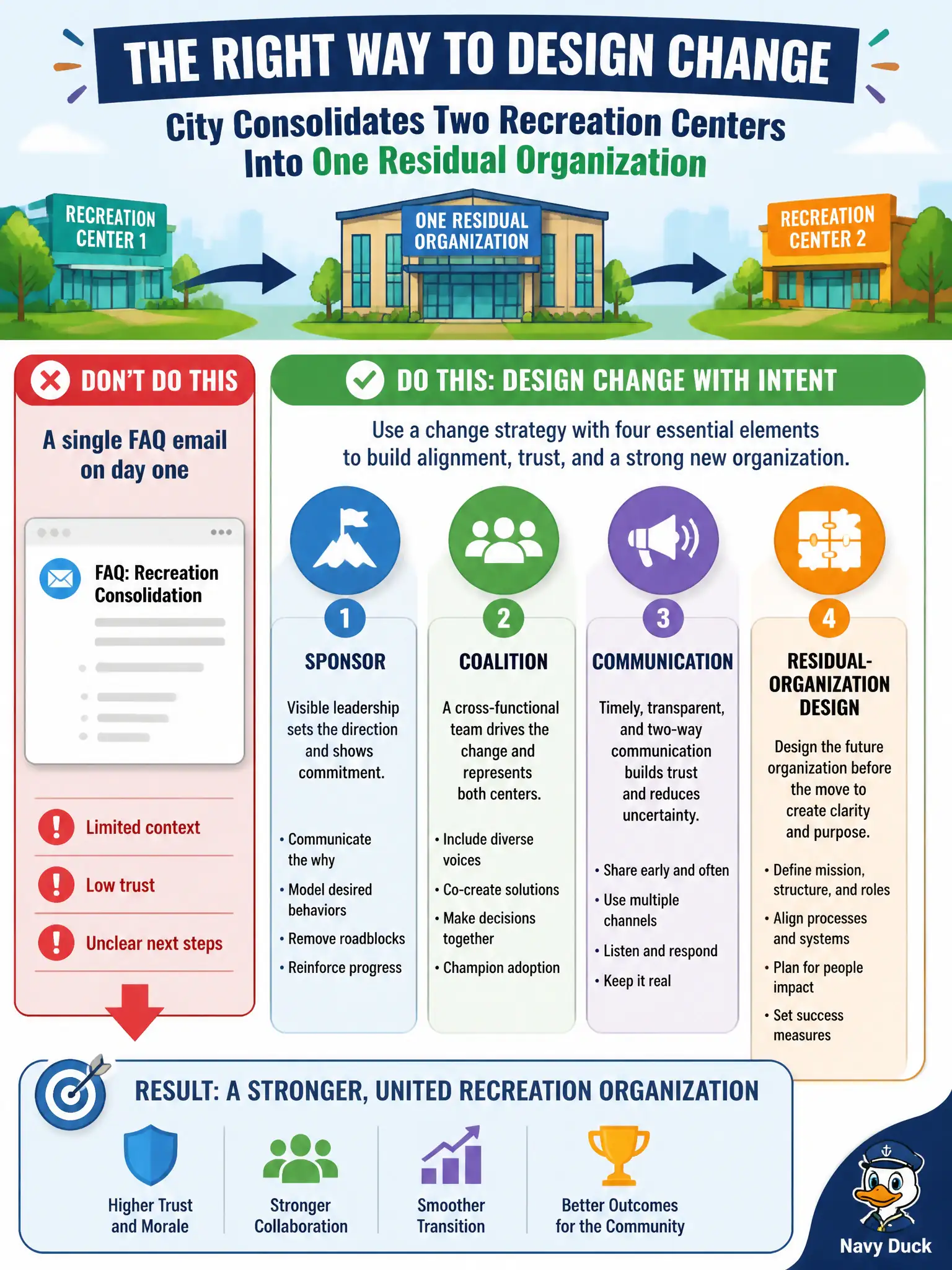
Merging two rec centers is not a day-one FAQ. Somebody has to sponsor it, a coalition has to carry it, people need a real communication path, and the leftover org has to be designed. An announcement is not a change strategy.
Full Explanation
Designing consolidation of two recreation centers with a change strategy that includes sponsor, coalition, communication, and residual-organization design—rather than a single day-one FAQ, silence until locks change, or indefinite conflicting policies—is correct. Merging centers is not an announcement; someone must sponsor it, a coalition must carry it, people need a real communication path, and the leftover organization must be designed to operate. A morning FAQ alone under-prepares staff and patrons. Silence until staff discover new reporting lines manufactures distrust. Letting each center keep conflicting policies indefinitely preserves two employers inside one building. Exam caveat: SPHR change management is a structured strategy covering sponsorship, coalition, communication, and future-state organization. Operational check: name an executive sponsor, build a cross-center coalition, sequence communications, design residual org and unified policies, and track adoption until the consolidated civic recreation operation functions as one. Recreation-center consolidation fails when FAQ-only launches leave dual policies, unclear bosses, and no residual org design. Sponsorship, coalition, sequenced communication, and one operable future-state organization are the change strategy, not silence or permanent dual rulebooks.