
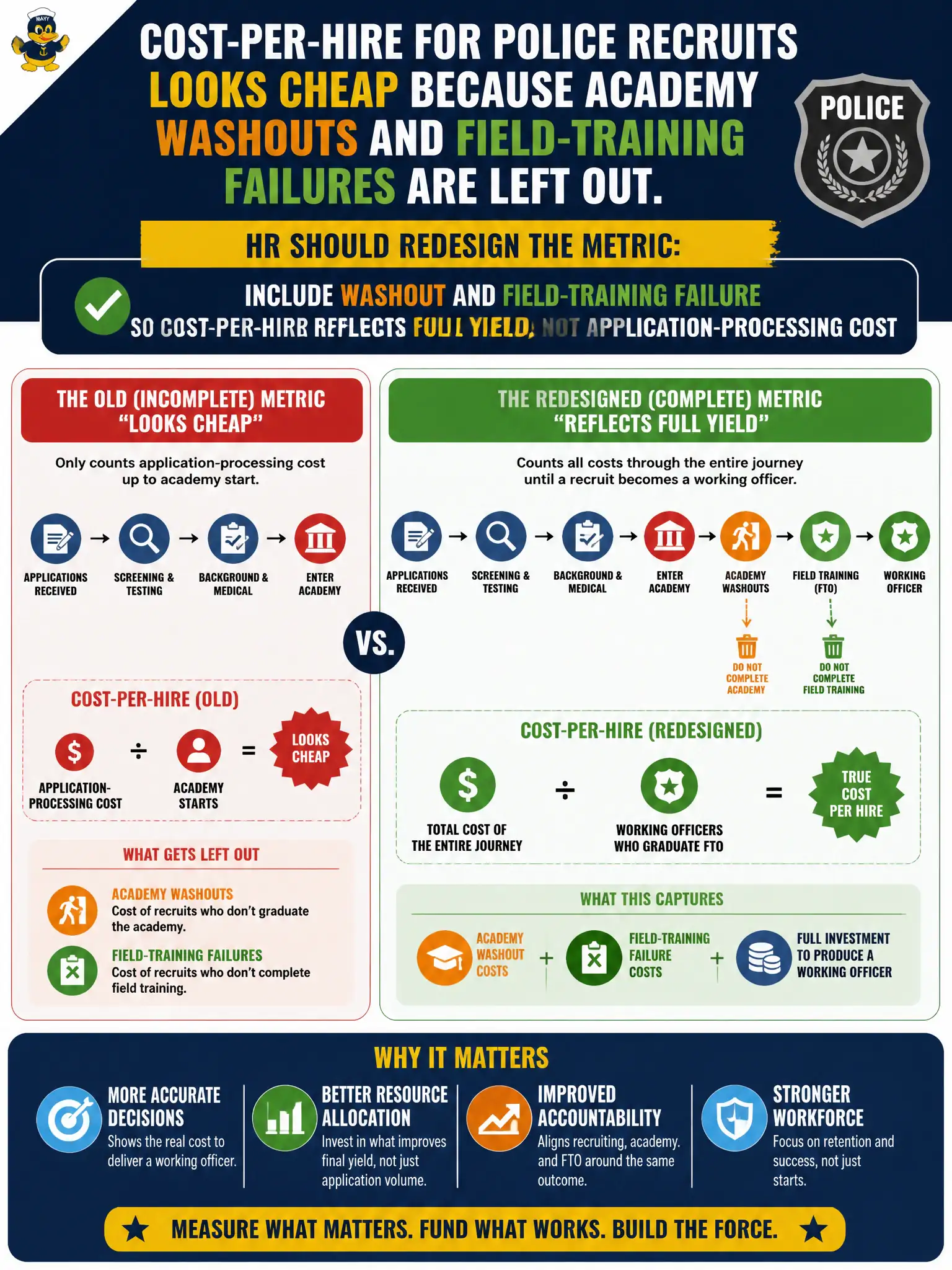
Cost-per-hire for police recruits looks cheap because academy washouts and field-training failures are left out. How should HR redesign the metric?
Select an answer to reveal the explanation.
Short Explanation
Cheap cost-per-hire that ignores academy washouts is a grocery receipt that skips the spoiled milk. Recruits who never make it through field training still cost the city. Put washout and FTO failure in the metric so the number tells the real yield story.
Full Explanation
Including academy washouts and field-training failures in cost-per-hire so the metric reflects full yield—not application-processing cost—is correct for police recruits. Cheap cost-per-hire that ignores washouts is a grocery receipt that skips spoiled milk; recruits who never clear field training still cost the city in academy seats, backgrounding, and lost patrol capacity. Counting only advertising spend divided by applications received measures marketing volume, not hire yield. Stopping cost-per-hire because public safety is supposedly exempt from HR metrics hides expensive failure modes from strategy. Reporting only the cheapest successful hire as the official figure cherry-picks and misleads council. Exam caveat: SPHR cost-per-hire informs action only when it captures full yield through training pipelines. Operational check: redefine police cost-per-hire to include academy and FTO failure costs, report yield alongside cost, and use the fuller figure to fix selection and preparatory training for civic public safety. Full-yield cost-per-hire connects recruiting spend to academy and FTO outcomes so leaders see whether selection produces sworn officers or expensive washouts. Without washout costs in the metric, councils underfund preparatory training and over-celebrate cheap application processing.