
A county internship pipeline is unpaid and daytime-only, which filters out community-college students who work. Which inclusivity redesign should HR lead?
Select an answer to reveal the explanation.
Short Explanation
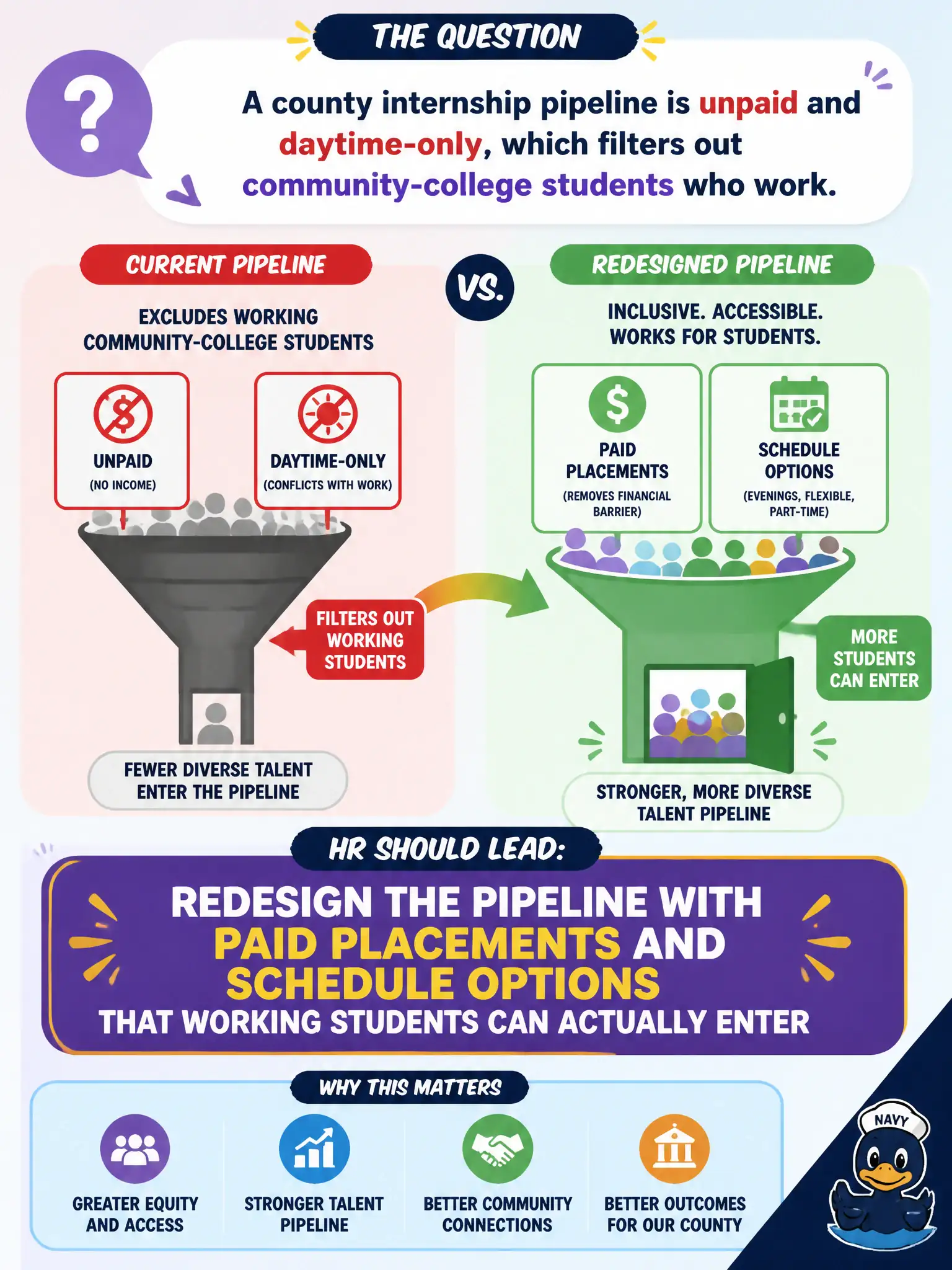
An unpaid nine-to-five internship is a velvet rope around the people who can already afford to work for free. Pipeline design is an inclusion lever. Pay the placements and offer hours working students can use, or the county will keep cloning the same starting lineup.
Full Explanation
Redesigning the county internship pipeline with paid placements and schedule options that working students can actually enter is the correct inclusivity move when unpaid daytime-only internships filter out community-college students who must earn wages. An unpaid nine-to-five internship is a velvet rope around people who can already afford to work for free; pipeline design is an inclusion lever. Keeping the unpaid daytime model and adding a brochure that praises grit leaves the barrier intact. Raising GPA cutoffs to make unpaid slots look selective further shrinks access. Limiting internships to manager referrals recreates insider networks. Exam caveat: SPHR inclusivity initiatives include who can enter early-career pipelines through pay and schedule design. Operational check: convert priority internships to paid, offer evening, weekend, or hybrid schedules where work allows, recruit at community colleges, track school and socioeconomic diversity of interns, and report pipeline access as a civic opportunity metric. Early-career pipelines shape who eventually staffs county government. Paid placements and workable schedules for community-college students who hold jobs convert CSR and inclusivity language into access, while unpaid daytime-only designs quietly select for economic privilege.