
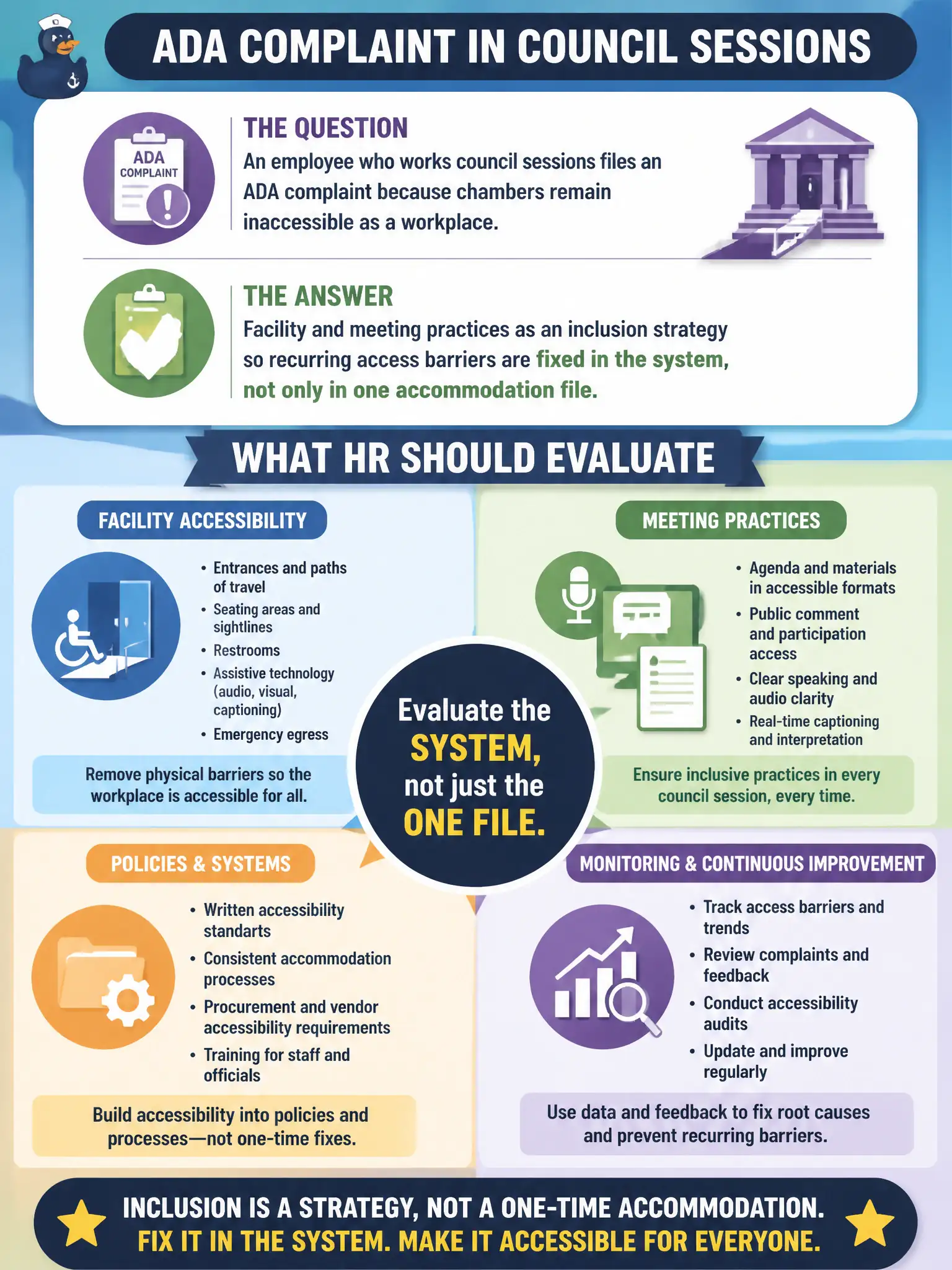
An employee who works council sessions files an ADA complaint because chambers remain inaccessible as a workplace. What should HR evaluate?
Select an answer to reveal the explanation.
Short Explanation
A chambers ramp that only gets discussed when one person files is a leaky roof you patch with a bucket. If council sessions are a workplace, access is a standing practice, not a one-off file. Fix the room and the meeting rules so the next employee does not have to sue the building.
Full Explanation
Evaluating facility and meeting practices as an inclusion strategy so recurring chamber access barriers are fixed in the system—not only in one ADA accommodation file—is correct when an employee who works council sessions faces inaccessible chambers. A chambers ramp discussed only when one person files is a leaky roof patched with a bucket; council sessions are a workplace, so access is a standing practice. Closing the complaint by moving the employee to remote-only work with no chamber duties, or reassigning them out of legislative support to avoid changing the room, sidesteps making the workplace usable. Treating the issue as a one-time facilities work order with no meeting-practice change invites the barrier to return. Exam caveat: SPHR inclusivity treats recurring access barriers as practice and facility strategy, not solely individual case management. Operational check: assess chambers against workplace access standards, fund lasting modifications, update meeting protocols, track barrier closure, and stop resolving systemic access only by relocating the employee away from civic legislative support. Council chambers used as a workplace must meet access standards as a system, not as a series of one-off employee moves. Lasting facility and meeting-practice fixes keep legislative support roles open to qualified employees and demonstrate that municipal ADA duties are structural, not optional casework.