
City council asks whether the HR department is "efficient." What should the CHRO emphasize instead of HR-staff-per-employee ratios alone?
Select an answer to reveal the explanation.
Short Explanation
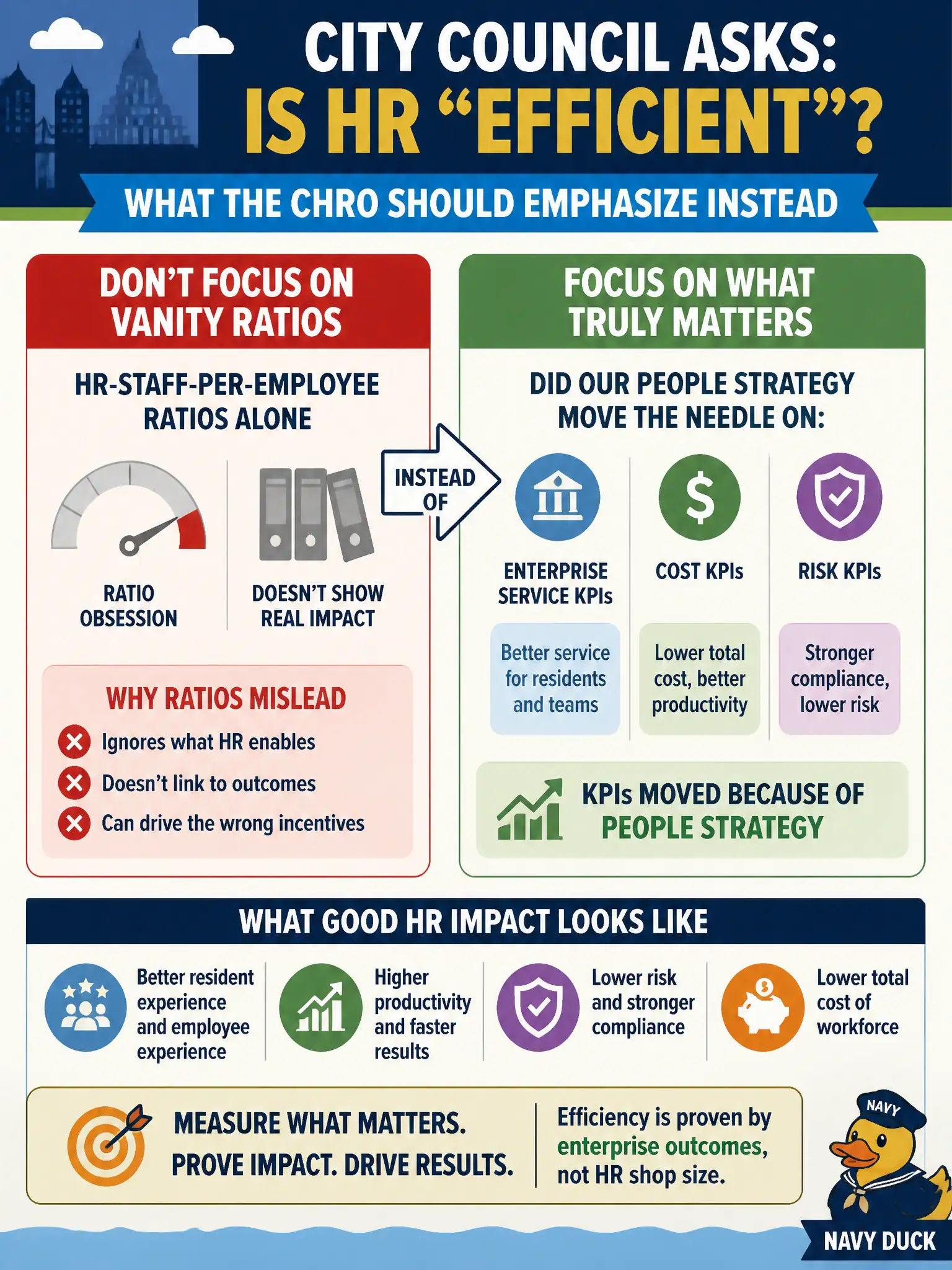
Asking if HR is efficient by counting HR clerks per employee is like judging a fire department by how cheap the headquarters is. The question that matters is whether service, cost, and risk in the city moved because of people strategy. SPHR metrics serve those enterprise goals, not HR-shop theater.
Full Explanation
Emphasizing whether enterprise service, cost, and risk KPIs moved because of people strategy—rather than vanity HR-shop ratios—is the correct response when council asks if HR is “efficient.” Judging a fire department by headquarters cheapness is the wrong analogy council sometimes applies to HR: staff-per-employee, help-desk ticket speed, personnel-actions-per-clerk, or a shrinking HR budget share can look efficient while snow routes, vacancy, and grievances worsen for residents. Those inward ratios do not prove organizational value. Ticket-queue speed measures transaction handling, not civic outcomes. Peer benchmarking of clerk throughput ignores local service strategy. Budget share reduction without outcome linkage can be disinvestment disguised as efficiency. Exam caveat: SPHR evaluates HR effectiveness through enterprise outcomes influenced by people strategy, not through internal productivity vanity metrics alone. Operational check: present council a scorecard linking people initiatives to service continuity, overtime or personnel cost, and risk indicators; show where HR actions moved those needles; and retire ratio-only answers as the primary efficiency story for the municipal HR function.