
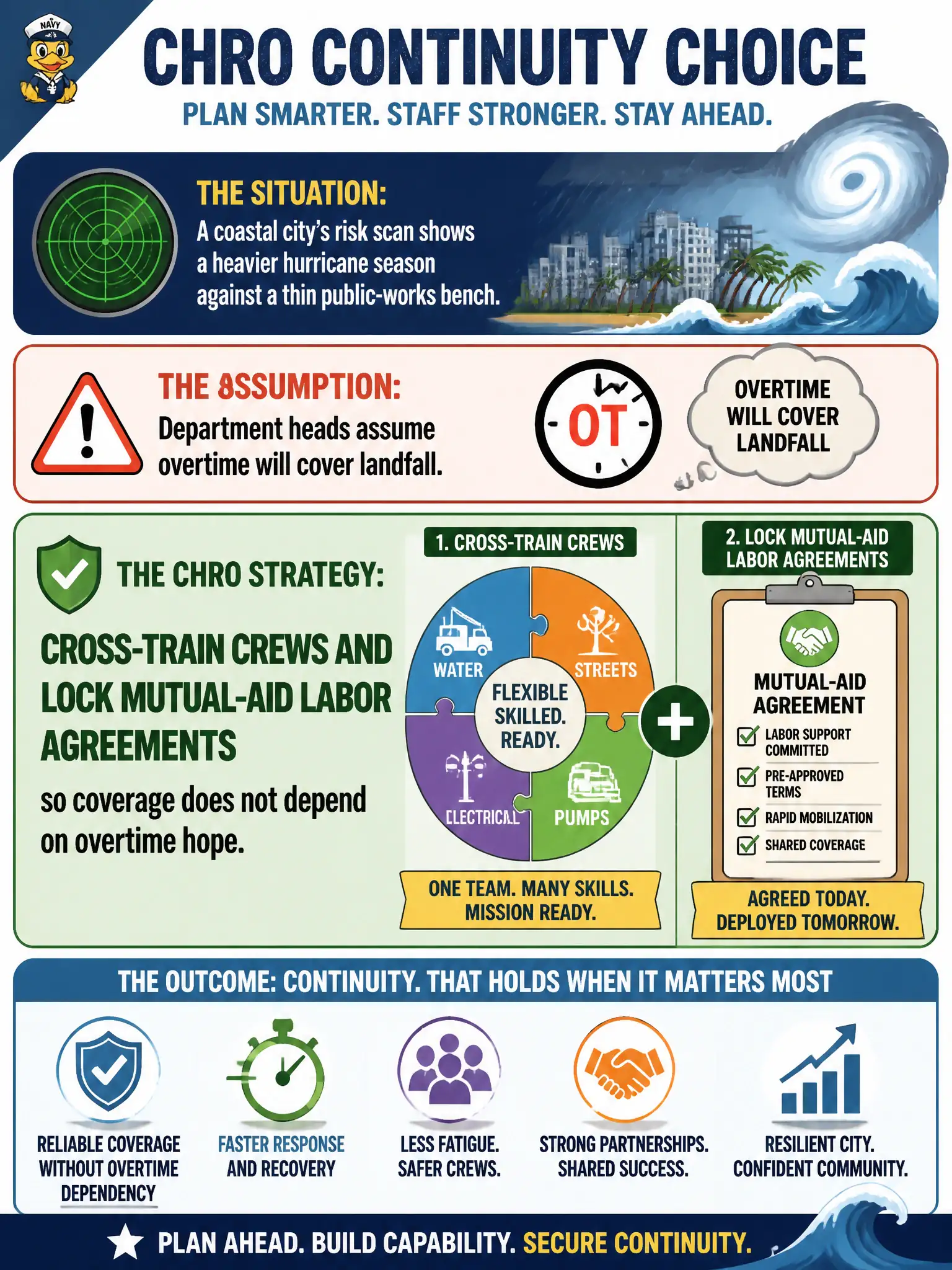
A coastal city's risk scan shows a heavier hurricane season against a thin public-works bench. Department heads assume overtime will cover landfall. What continuity strategy should the CHRO choose?
Select an answer to reveal the explanation.
Short Explanation
Hope is not a continuity plan. A thin public-works bench plus a big storm is a people-risk, and overtime is just a prayer with a time clock. Cross-train and sign mutual-aid labor deals before the wind arrives.
Full Explanation
Cross-training crews and locking mutual-aid labor agreements so coverage does not depend on overtime hope is the correct continuity strategy when a coastal risk scan shows a heavier hurricane season against a thin public-works bench. Human-capital continuity is a chosen risk treatment, not improvised volunteer overtime when landfall arrives. Unlimited overtime reliance assumes operators will always be available and safe to work, which storms routinely disprove. Canceling hurricane preparedness so staff can rest abandons readiness. A wellness vendor offering mindfulness the week of the storm may support individuals but does not create alternate certified capacity for debris, pumps, and roads. Exam caveat: SPHR risk strategy for continuity emphasizes structural treatments—cross-training and mutual aid—over hope-based overtime. Operational check: identify critical storm roles, cross-train backups, execute mutual-aid labor agreements before hurricane season, drill payroll and deployment under those agreements, and brief the city manager on residual gaps the civic workforce still cannot cover. Coastal cities owe residents debris clearance and pump operations after landfall; continuity planning that rests on hope overtime fails that duty. Store cross-training records and mutual-aid contacts with the emergency plan so the thin bench is not rediscovered in the dark.