
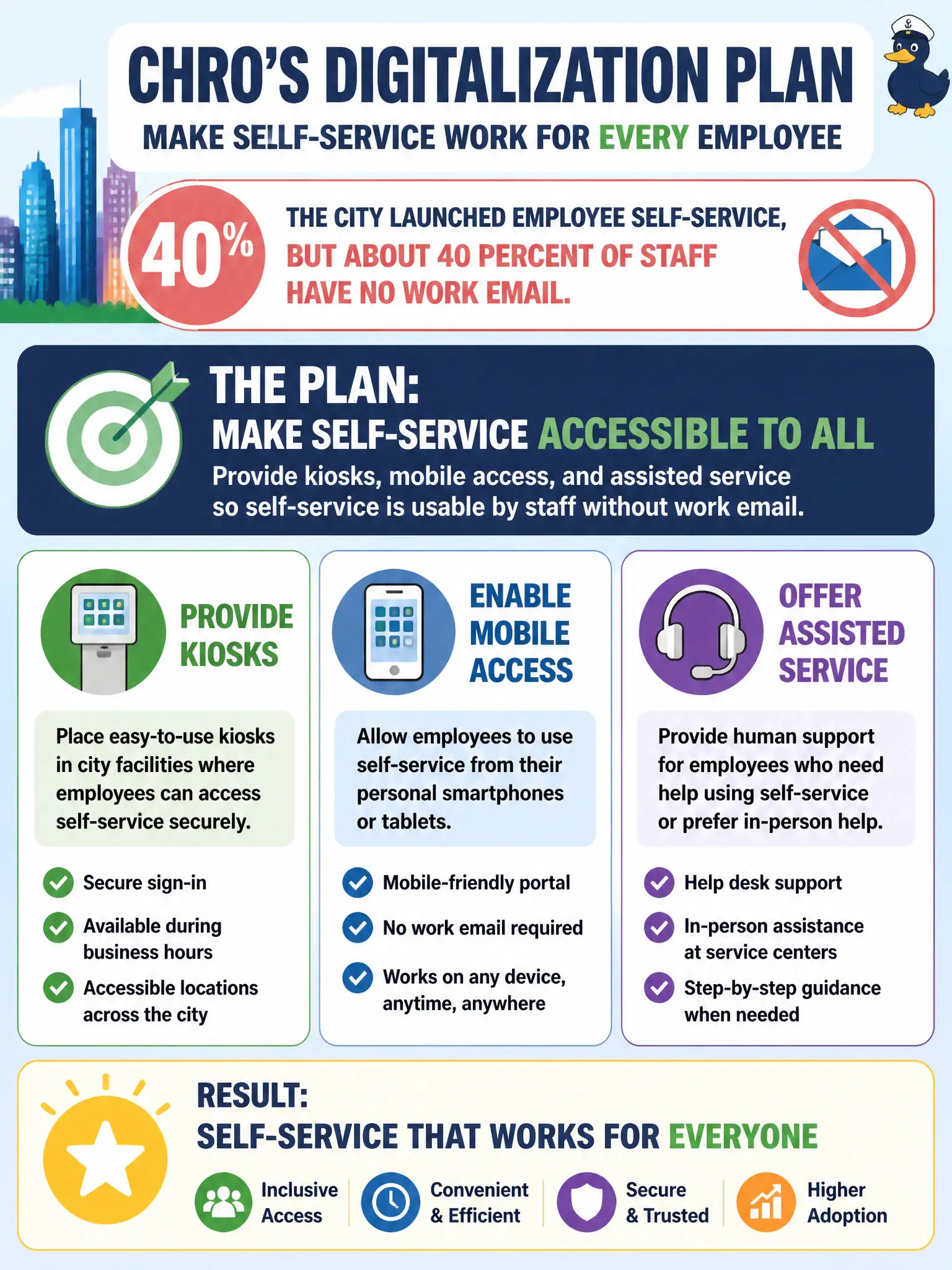
The city launched employee self-service, but about 40 percent of staff have no work email. What should the CHRO's digitalization plan include?
Select an answer to reveal the explanation.
Short Explanation
Launching self-service that only city-email users can reach is like putting the only time clock in a locked office. Field crews still need a kiosk, a phone path, or a person who can help. Access equity is part of the initiative, not a later nice-to-have.
Full Explanation
Employee self-service is a digitalization initiative only if the municipal workforce can actually use it. Providing kiosks, mobile access, and assisted service so staff without work email—often about forty percent in field-heavy cities—can reach the same transactions treats equity of access as a design requirement. Desk-user adoption alone is not success.
Telling field staff they will figure out self-service on personal phones closes the issue without equivalent, supported access and may create BYOD privacy problems. Restricting self-service to employees who already have city email hardens a two-tier HR experience. Printing the entire HRIS manual and calling that equal access substitutes paper volume for transactional capability.
Exam caveat: assisted service must be staffed and private enough for benefits and pay questions, not a public lobby spectacle. Operational check: deploy kiosk or mobile options, track self-service completion rates by job family with and without email, and keep assisted-service wait times within a published standard. Document ownership so auditors can see who maintains the control. Re-test the control after the next tabletop or hiring cycle. Keep the civic workforce impact visible in the evaluation notes.