
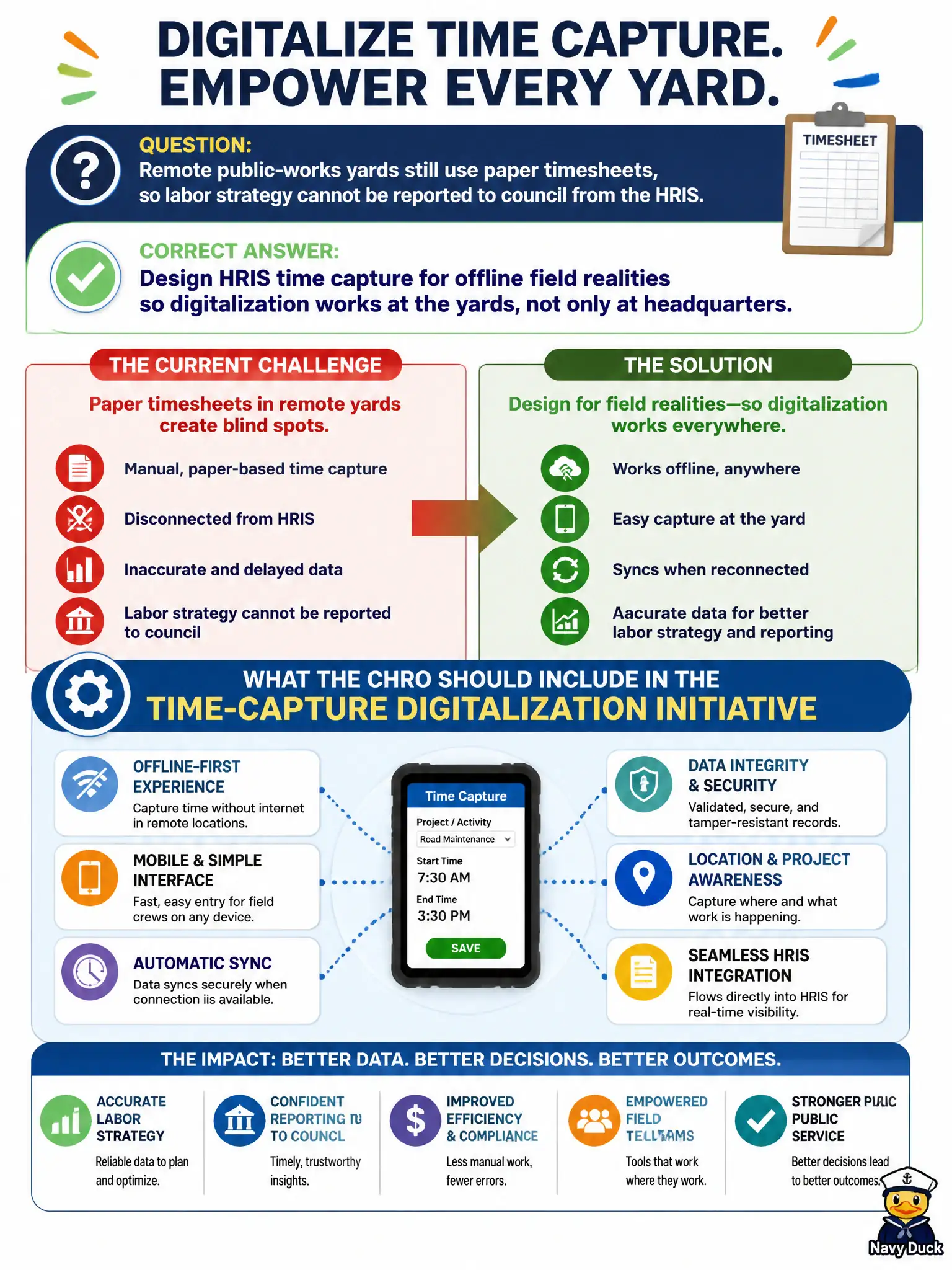
Remote public-works yards still use paper timesheets, so labor strategy cannot be reported to council from the HRIS. What should the CHRO include in the time-capture digitalization initiative?
Select an answer to reveal the explanation.
Short Explanation
A time clock that only works at city hall is like a fuel pump that only exists downtown. Yard crews live on spotty signal and paper because the design ignored the field. Digitalization has to work where the work is, including offline.
Full Explanation
HR digitalization succeeds when workflows fit field operations, not only headquarters connectivity. Designing HRIS time capture for offline field realities—so remote public-works yards can record time without perfect broadband—lets council labor reporting and payroll draw from real data instead of paper. Field-first design is the initiative content.
Requiring yard crews to drive to city hall each Friday to punch a headquarters kiosk burns productive time and still centralizes a field problem. Keeping paper in the field with month-end clerk rekeying preserves error, delay, and shadow truth. Waiting until every yard has full broadband before starting any time-capture work freezes strategy reporting indefinitely.
Exam caveat: offline capture still needs identity assurance and later sync controls so timesheets cannot be altered unchecked. Operational check: pilot offline-capable devices at two yards, measure sync success and payroll error rates, and confirm council dashboards can read yard hours without spreadsheet uploads. Document ownership so auditors can see who maintains the control. Re-test the control after the next tabletop or hiring cycle. Keep the civic workforce impact visible in the evaluation notes.