
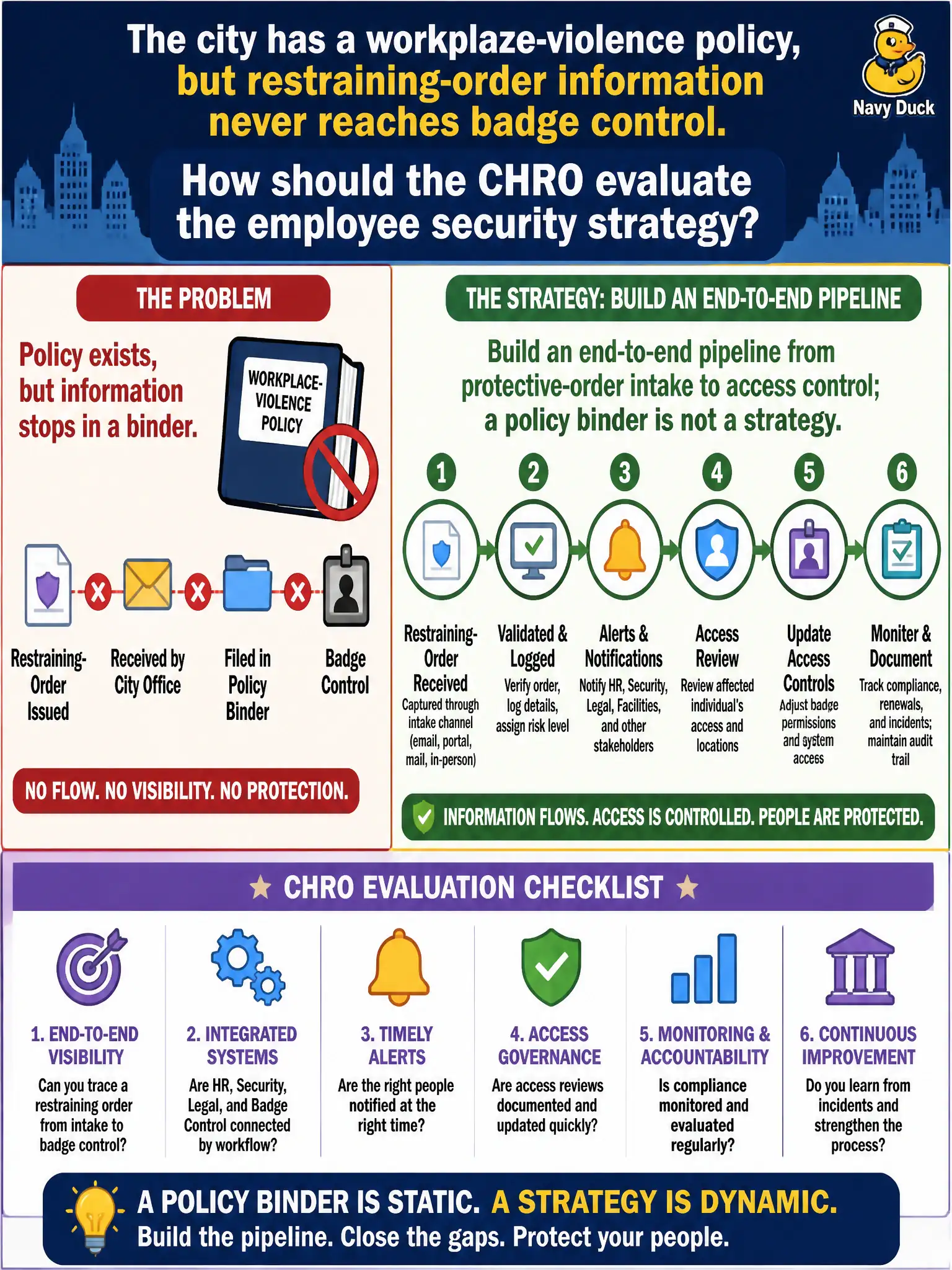
The city has a workplace-violence policy, but restraining-order information never reaches badge control. How should the CHRO evaluate the employee security strategy?
Select an answer to reveal the explanation.
Short Explanation
A policy that never talks to the badge desk is like a no-trespass sign in a locked filing cabinet. The people who control the door never see the order. Strategy is the pipeline from intake to access, not the binder on the shelf.
Full Explanation
Employee security strategy fails when protective information does not reach the operational control that would act on it. Building an end-to-end pipeline from restraining-order or protective-order intake to badge and access control turns a workplace-violence policy binder into a working strategy. A policy without that handoff leaves access decisions uninformed.
Keeping the policy as written and assuming employees will tell security themselves dumps the burden on potential victims and misses silent cases. Posting the policy in the break room and skipping operational handoffs confuses awareness with capability. Filing restraining orders only in the personnel jacket for later litigation warehouses information where door control never sees it.
Exam caveat: the pipeline must protect confidentiality—need-to-know for security operations is not a gossip channel. Operational check: define intake owners, encrypted notification to badge control, and a test case that proves access rules change within an agreed SLA after a simulated order. Document ownership so auditors can see who maintains the control. Re-test the control after the next tabletop or hiring cycle. Keep the civic workforce impact visible in the evaluation notes.