
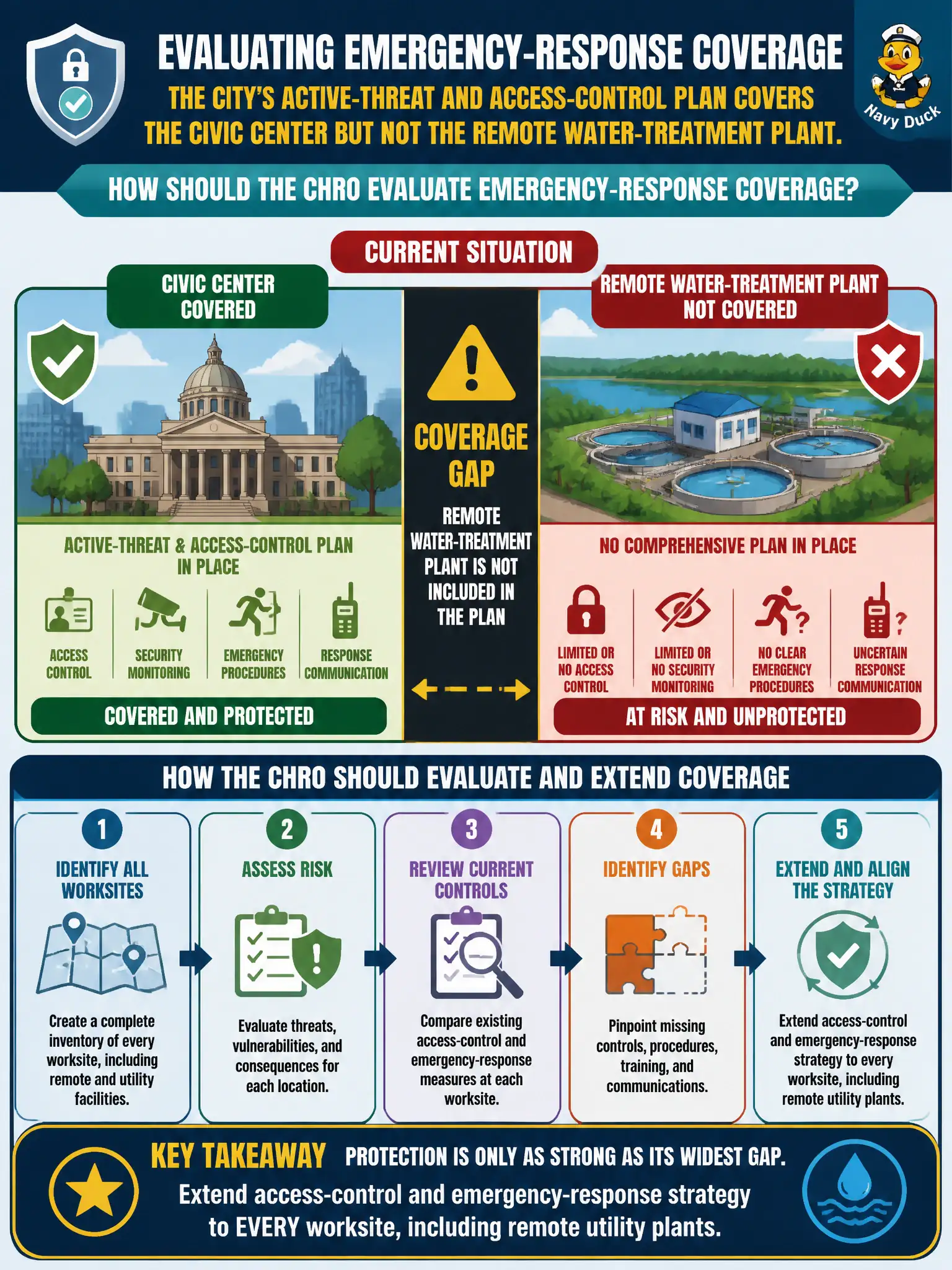
The city's active-threat and access-control plan covers the civic center but not the remote water-treatment plant. How should the CHRO evaluate emergency-response coverage?
Select an answer to reveal the explanation.
Short Explanation
A lockdown plan that only covers city hall is like a smoke alarm only in the living room while the garage burns. Water-plant crews still need a way in, a way out, and a way to call for help. Safety strategy has to follow the workforce, not the visitor count.
Full Explanation
Employee safety and security strategy must cover distributed worksites, not only high-visibility civic buildings. Extending access-control and emergency-response planning to every worksite—including the remote water-treatment plant—closes a coverage gap that visitor volume and downtown focus do not justify. Remote utility employees deserve the same designed protection as civic-center staff.
Limiting emergency-response planning to public-facing buildings because they draw more visitors ignores employee risk at industrial sites. Assuming the plant's control-system vendor already covers employee safety on site confuses process control with people emergency response. Waiting until a plant incident occurs and then adding a site annex leaves those workers unprotected by design.
Exam caveat: site annexes should match local hazards (chemicals, remote communications, lone work) rather than paste the civic-center floor plan. Operational check: inventory all worksites against the active-threat and access plan, schedule a water-plant tabletop, and verify radios, muster points, and access lists before the next audit. Document ownership so auditors can see who maintains the control. Re-test the control after the next tabletop or hiring cycle.