
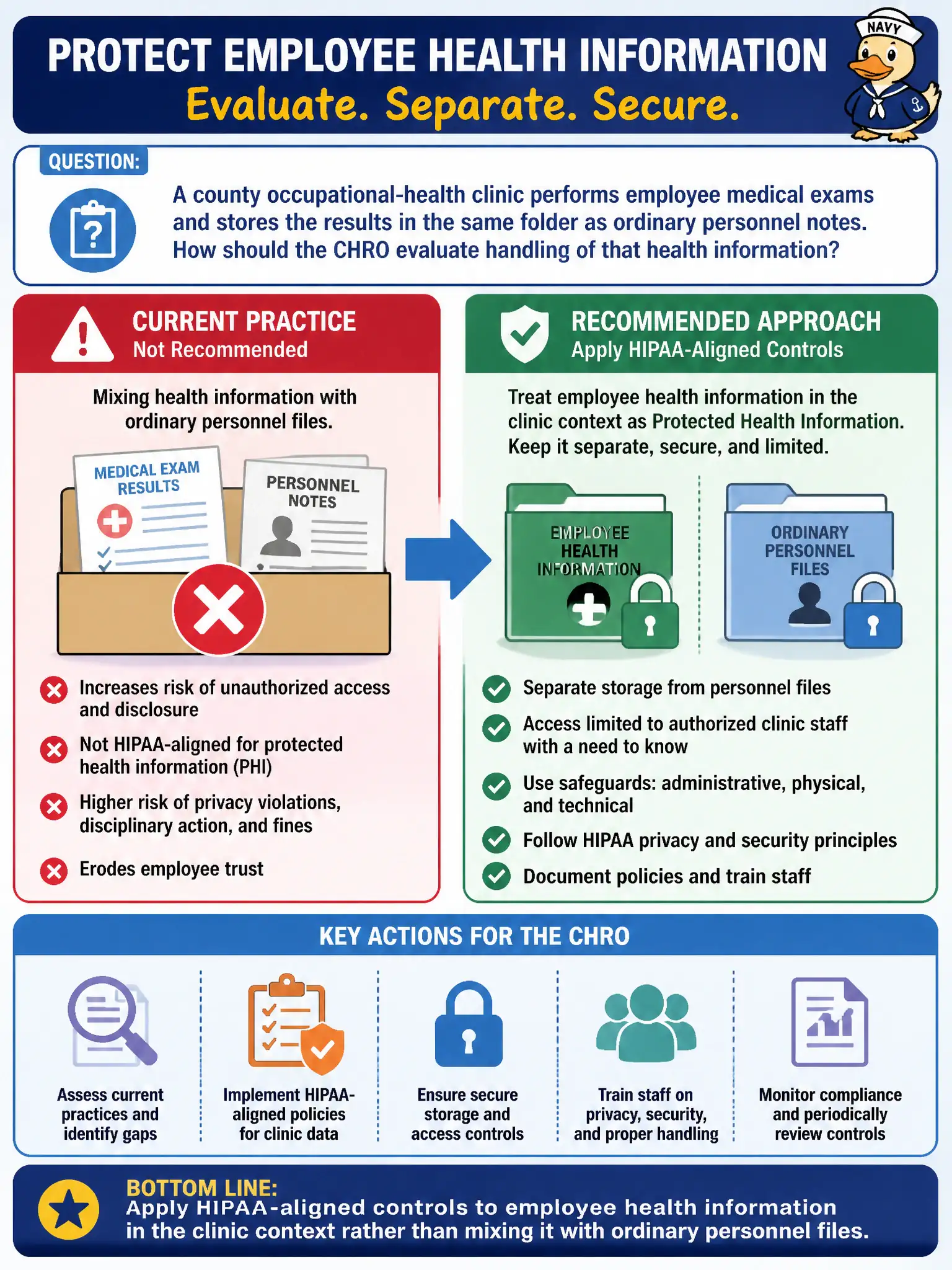
A county occupational-health clinic performs employee medical exams and stores the results in the same folder as ordinary personnel notes. How should the CHRO evaluate handling of that health information?
Select an answer to reveal the explanation.
Short Explanation
Clinic exam notes are not the same stack as a performance letter. Mixing them is like keeping a prescription bottle in the time-card drawer. When employee health data sits in a covered clinic context, HIPAA-aligned walls go up, not a nurse-by-nurse gut call.
Full Explanation
When employee medical exams are performed in a covered occupational-health setting, HIPAA-aligned safeguards apply to that health information even though the employer also holds personnel files. Applying those controls in the clinic context rather than mixing results with ordinary personnel notes is the CHRO's evaluation of handling. Employer payment does not convert clinic records into supervisor working papers.
Treating clinic exam files as ordinary personnel records because the employer paid for the exams collapses the required separation. Letting clinic nurses decide case by case whether HIPAA-style controls apply replaces strategy with ad hoc judgment. Posting exam results in each supervisor's working file to speed accommodations expands unlawful and untrustworthy access to diagnoses beyond functional need.
Exam caveat: fitness-for-duty outcomes can be communicated in limited form without transmitting full clinical charts. Operational check: segregate clinic storage and access lists, train supervisors on receiving only work restrictions, and audit for clinic documents appearing in general personnel folders. Document ownership so auditors can see who maintains the control. Re-test the control after the next tabletop or hiring cycle.