
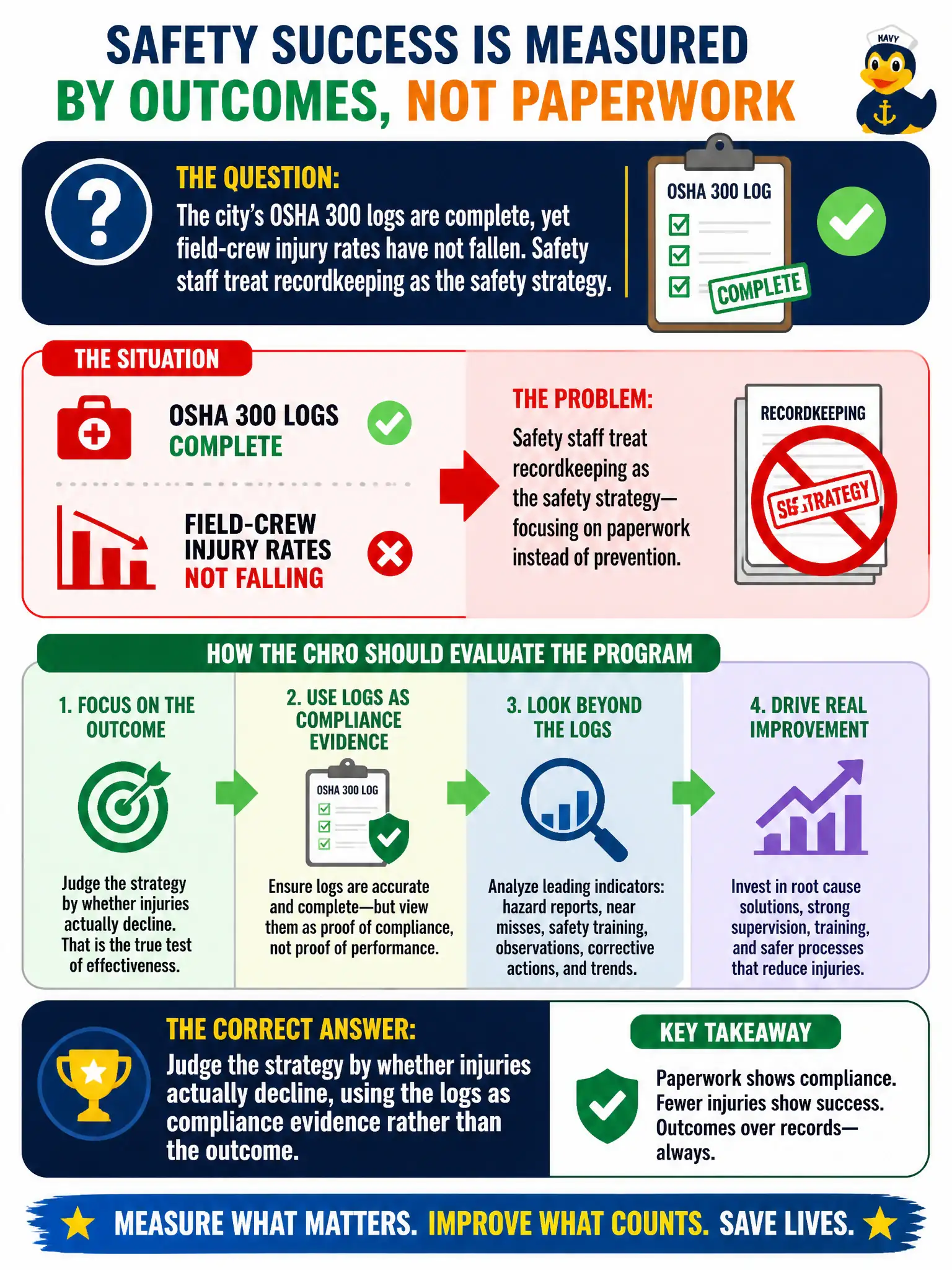
The city's OSHA 300 logs are complete, yet field-crew injury rates have not fallen. Safety staff treat recordkeeping as the safety strategy. How should the CHRO evaluate the program?
Select an answer to reveal the explanation.
Short Explanation
A perfect logbook with the same number of hurt crews is like a fire-exit diagram that nobody ever uses. OSHA records prove the city filed the paperwork, not that the work got safer. Strategy is judged by fewer injuries, with the logs as the compliance receipts.
Full Explanation
Evaluating employee safety strategy at SPHR depth means looking at outcomes plus compliance, not OSHA logs alone. Judging the program by whether field-crew injuries actually decline—while keeping complete logs as compliance evidence rather than as the outcome—redirects a city that has mistaken recordkeeping for strategy. Prevention is the goal; logs are the scorecard input.
Treating complete OSHA 300 logs as proof the safety strategy works confuses documentation with risk reduction. Stopping OSHA logs so staff can spend more time in the field drops a legal duty and blinds the city to trends. Transferring all injury review to the city attorney and dropping operational safety goals converts prevention into a claims file.
Exam caveat: outcome focus still requires accurate recording; under-recording to improve rates is a compliance and ethics failure. Operational check: pair OSHA metrics with leading indicators (near-misses, hazard corrections), set injury-rate targets for field crews, and review whether controls—not paperwork volume—moved the rates. Document ownership so auditors can see who maintains the control. Re-test the control after the next tabletop or hiring cycle. Keep the civic workforce impact visible in the evaluation notes.