
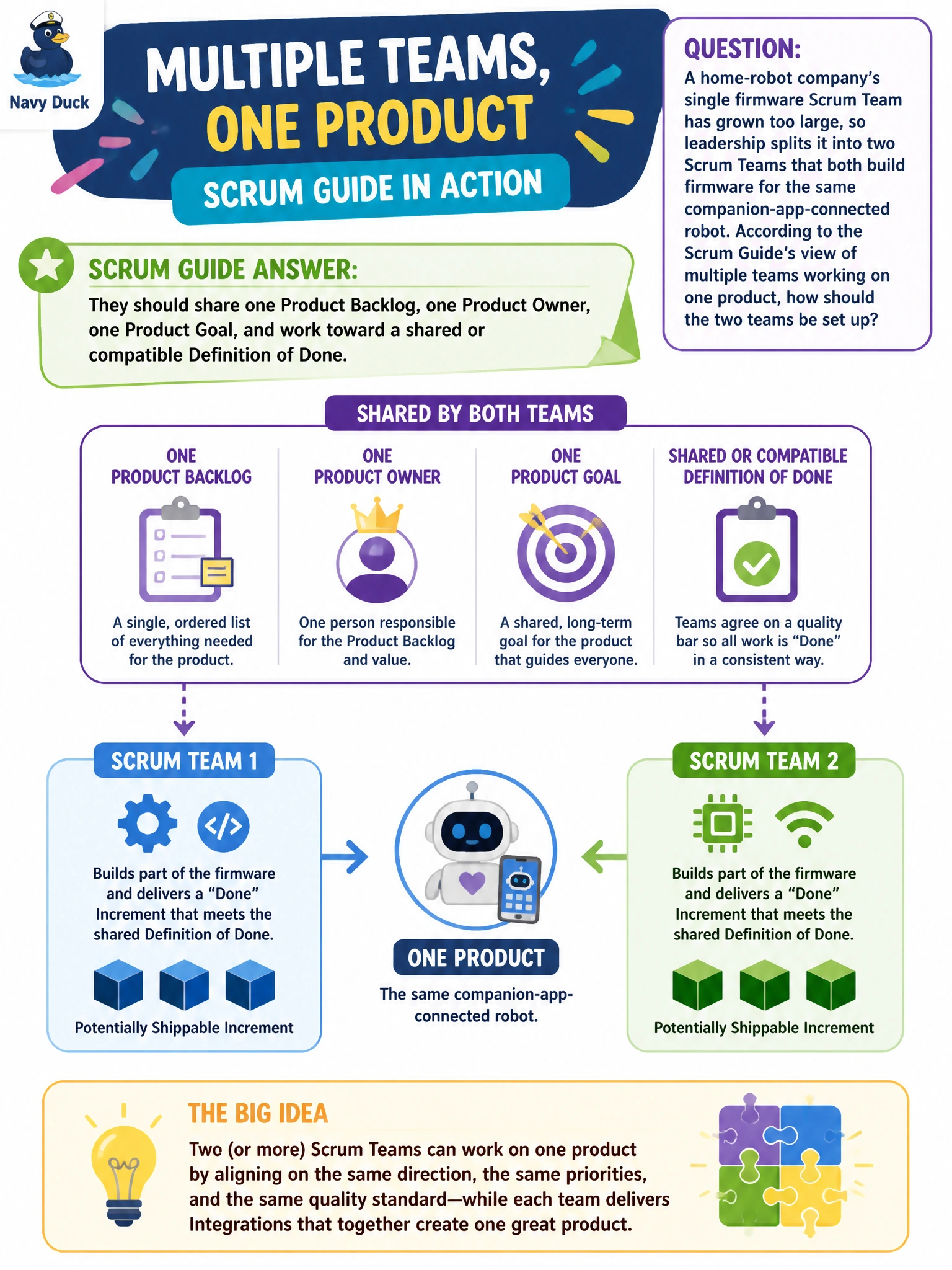
A home-robot company's single firmware Scrum Team has grown too large, so leadership splits it into two Scrum Teams that both build firmware for the same companion-app-connected robot. According to the Scrum Guide's view of multiple teams working on one product, how should the two teams be set up?
Select an answer to reveal the explanation.
Short Explanation
One product still means one backlog, no matter how many teams are pulling from it. Splitting the team doesn't mean splitting the product — it just means two crews are now working off the same prioritized list toward the same goal, with a definition of "done" they can both stand behind. Give each team its own backlog and owner, and you've quietly created two products wearing one robot's skin.
Full Explanation
When multiple Scrum Teams work on the same product, the Scrum Guide's model keeps the product itself singular: one Product Backlog, one Product Owner accountable for maximizing its value, and one Product Goal the teams collectively work toward, with a Definition of Done that all teams' work must meet so a shared Increment stays releasable. Giving each new team its own Product Backlog and Product Owner recreates the very problem team-splitting was meant to solve — competing priorities and duplicated ordering decisions for one physical product. Allowing incompatible Definitions of Done breaks the point of a single Increment: if one team's firmware meets a lower bar than the other's, the combined build can't be honestly called done. Declaring two separate products with separate Product Goals abandons the premise that this is still one robot with one companion app; the codebases diverging is an engineering integration challenge, not evidence the product itself has split. A caveat: the Guide doesn't prescribe a coordination mechanism beyond this — no dictated ceremony connects the two teams, only the shared artifacts and commitments. Concrete check: ask whether a customer-facing Increment could be assembled and demoed at Sprint Review from both teams' work under one Definition of Done — if not, the split isn't actually structured around one product yet.