
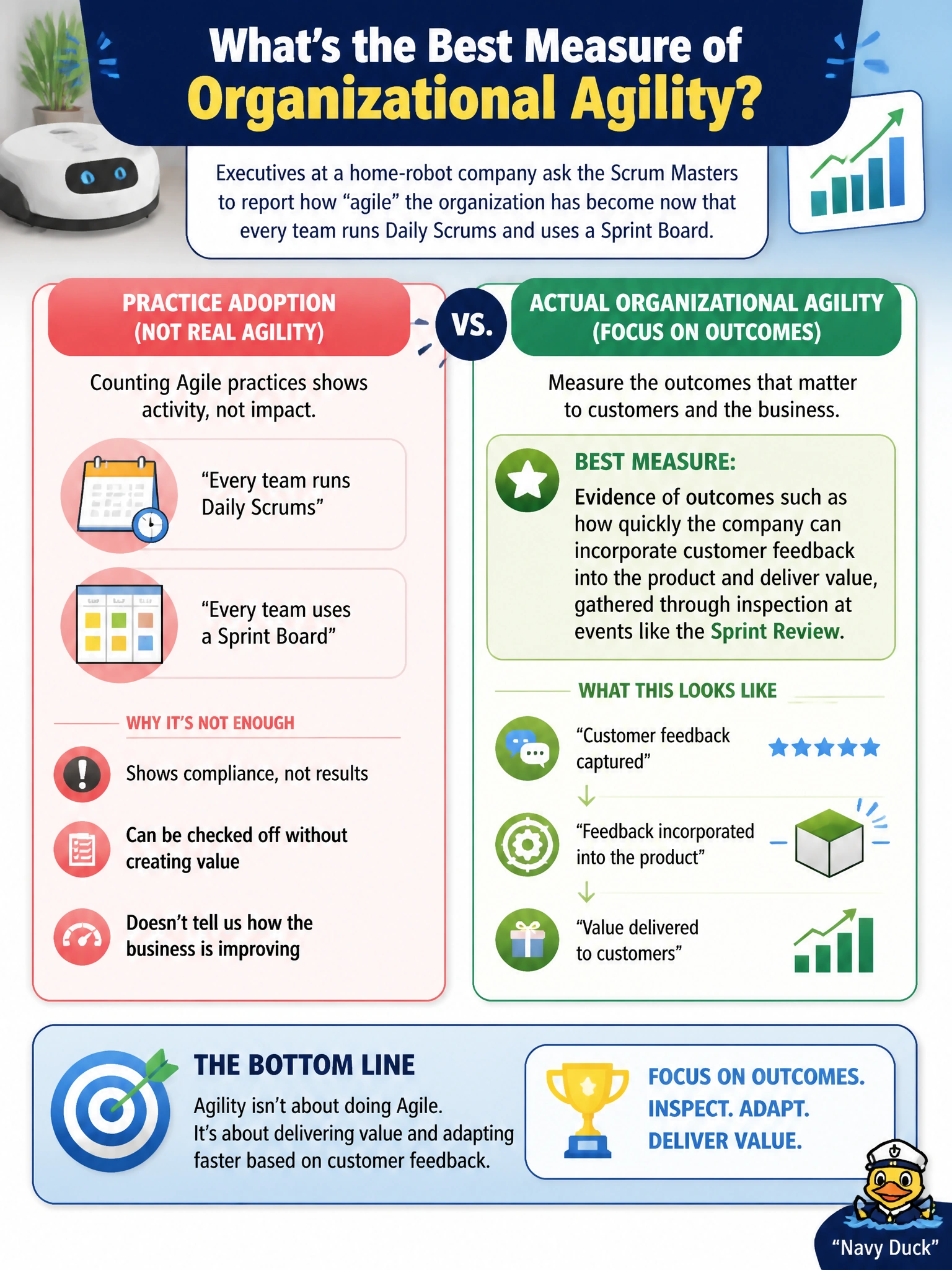
Executives at a home-robot company ask the Scrum Masters to report how "agile" the organization has become now that every team runs Daily Scrums and uses a Sprint Board. Which measure would best reflect actual organizational agility rather than practice adoption?
Select an answer to reveal the explanation.
Short Explanation
Running a Daily Scrum tells you a team followed a recipe, not that anything got better. Real agility shows up in whether the company can actually notice a change and respond to it — how fast customer feedback turns into a different Product Backlog, how often an Increment ships value. That's the kind of evidence worth reporting up, not a checklist of ceremonies completed.
Full Explanation
Empiricism is about inspecting real outcomes and adapting based on evidence, so the honest way to measure organizational agility is to look at outcomes: how quickly customer feedback changes the Product Backlog, how reliably valuable Increments reach users, and how well the organization responds when circumstances shift. Sprint Reviews are a natural place to gather this evidence because they inspect the actual Increment and its progress toward the Product Goal. Counting completed ceremonies conflates doing the events with getting value from them — a team can run a Daily Scrum every day and still fail to inspect and adapt meaningfully. Certification counts measure training investment, not organizational behavior; a room full of certified people can still work in a command-and-control way. Counting teams that have adopted a board and standup measures surface compliance, the exact vanity metric this question is warning against. A caveat: outcome evidence takes longer to gather and is harder to reduce to one number than a compliance checklist, which is precisely why executives default to the checklist. Concrete check: pick one product outcome — time from customer report to shipped fix, for instance — and track whether it is actually improving over several Sprints.