
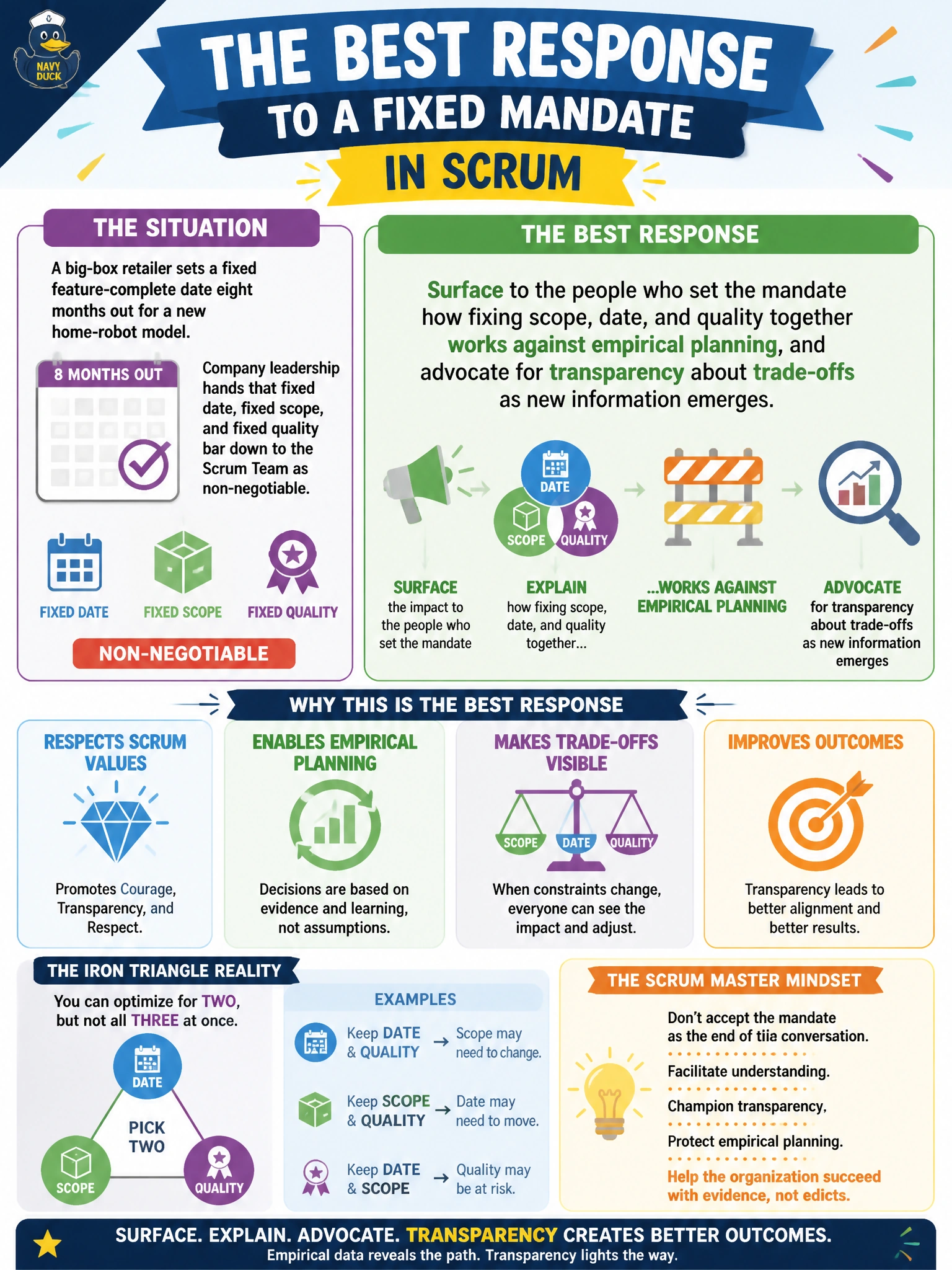
A big-box retailer sets a fixed feature-complete date eight months out for a new home-robot model, and company leadership hands that fixed date, fixed scope, and fixed quality bar down to the Scrum Team as non-negotiable. The Scrum Master recognizes this as an organizational impediment. What is the best response?
Select an answer to reveal the explanation.
Short Explanation
Fixing the date, the scope, and the quality bar all at once doesn't leave room for anything to be learned along the way — one of those three has to be allowed to flex, or every Sprint just becomes catching up to a plan made before anyone knew anything. That's an organization-level problem, not a team-level one. The Scrum Master's job is to say so, out loud, to the people who set it.
Full Explanation
Empiricism assumes that what will actually be needed and how long it will take can't be fully known upfront, so a mandate that locks scope, date, and quality simultaneously eliminates the very flexibility Scrum relies on to adapt as the team learns. That is squarely an organizational impediment, and the Scrum Guide has the Scrum Master serve the organization by helping people understand which of their practices help and which get in Scrum's way. Treating the mandate as untouchable business reality and hiding it from the team denies the team the transparency to plan realistically. Refusing to run Sprint Planning is a form of the team absorbing the conflict by shutting down, which helps no one and isn't within the Scrum Master's authority to demand. Leaving it entirely to the Product Owner ignores that this is a cross-organizational conversation involving retail and leadership, not just backlog ordering — the Product Owner benefits from the Scrum Master surfacing the tension too. A caveat: the retailer's date itself may genuinely be fixed; the goal isn't to eliminate the constraint but to make its cost visible so scope or quality trade-offs get decided consciously. Concrete check: ask whether anyone with authority over the mandate has seen a forecast based on real Sprint data, or only the original top-down date.