
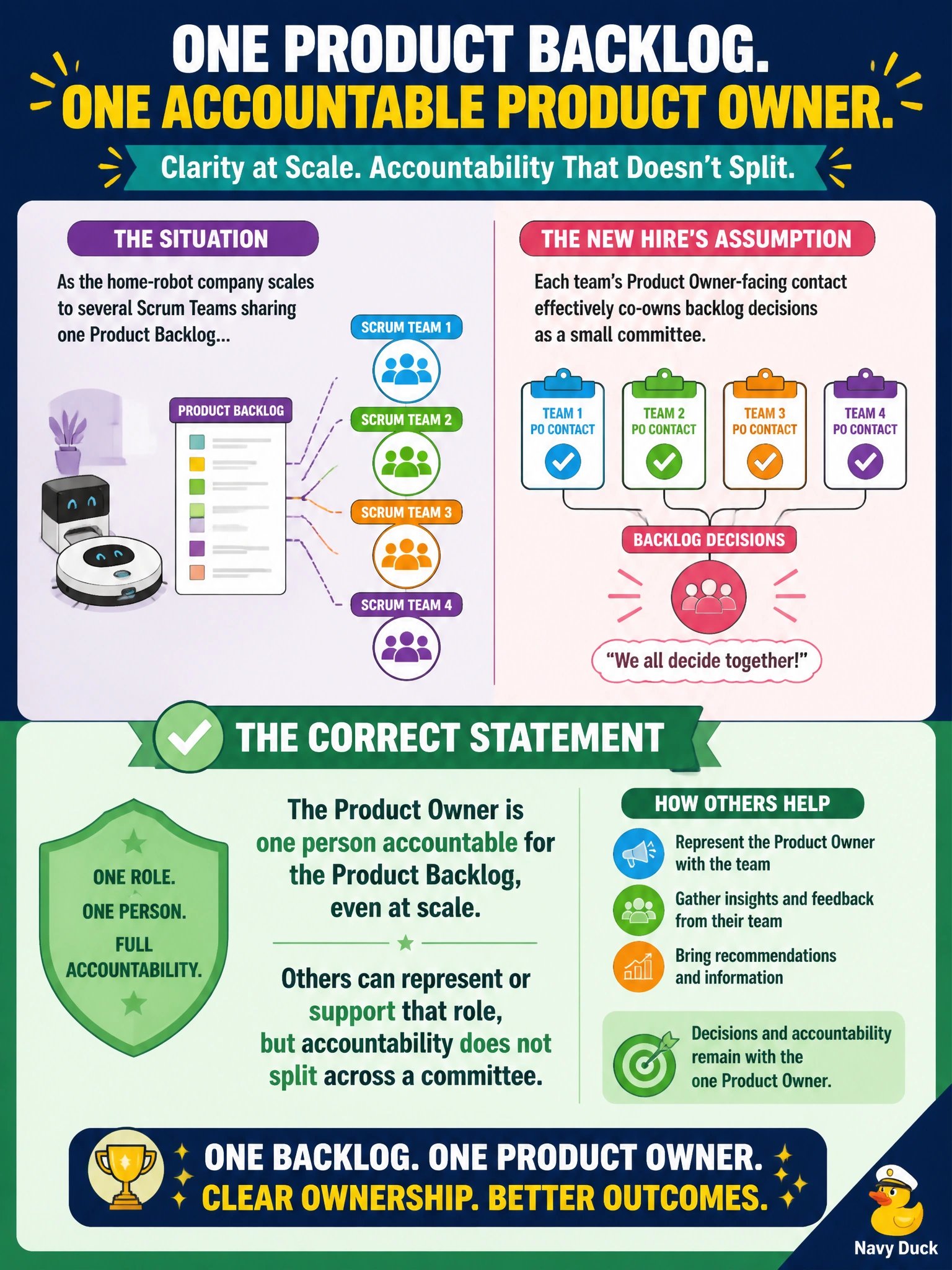
As the home-robot company scales to several Scrum Teams sharing one Product Backlog, a new hire assumes each team's Product Owner-facing contact effectively co-owns backlog decisions as a small committee. A veteran corrects this assumption. What is the correct statement?
Select an answer to reveal the explanation.
Short Explanation
More teams pulling from the same backlog doesn't turn the Product Owner into a committee seat — it's still one person accountable, even if others help represent that person day to day. Committees are great at discussing tradeoffs; they're terrible at owning a single, clear yes-or-no on what's next.
Full Explanation
The Scrum Guide is unambiguous that the Product Owner is one person, not a committee, and that principle doesn't dissolve as a product scales to multiple Scrum Teams. Delegation to proxies or team-level representatives can absolutely exist in practice to help a Product Owner stay reachable across four teams, but accountability for the Product Backlog's content, availability, and order still rests with a single named person. Treating those representatives as a co-owning committee reintroduces the exact problem single accountability solves: competing opinions with no one accountable for the final call, which tends to produce a backlog that reflects whoever argued longest in the room rather than the clearest read of value. A fully independent Product Owner per team is equally wrong for a single product — it fragments the one backlog this scenario explicitly describes into several, undermining the shared prioritization scaling is supposed to preserve. The Scrum Master role doesn't absorb backlog authority either, at any scale; that role serves the Product Owner and organization, it doesn't replace the Product Owner. A concrete check at scale: can everyone name the single Product Owner accountable for the shared backlog, even if several people help represent that person's decisions day to day?