
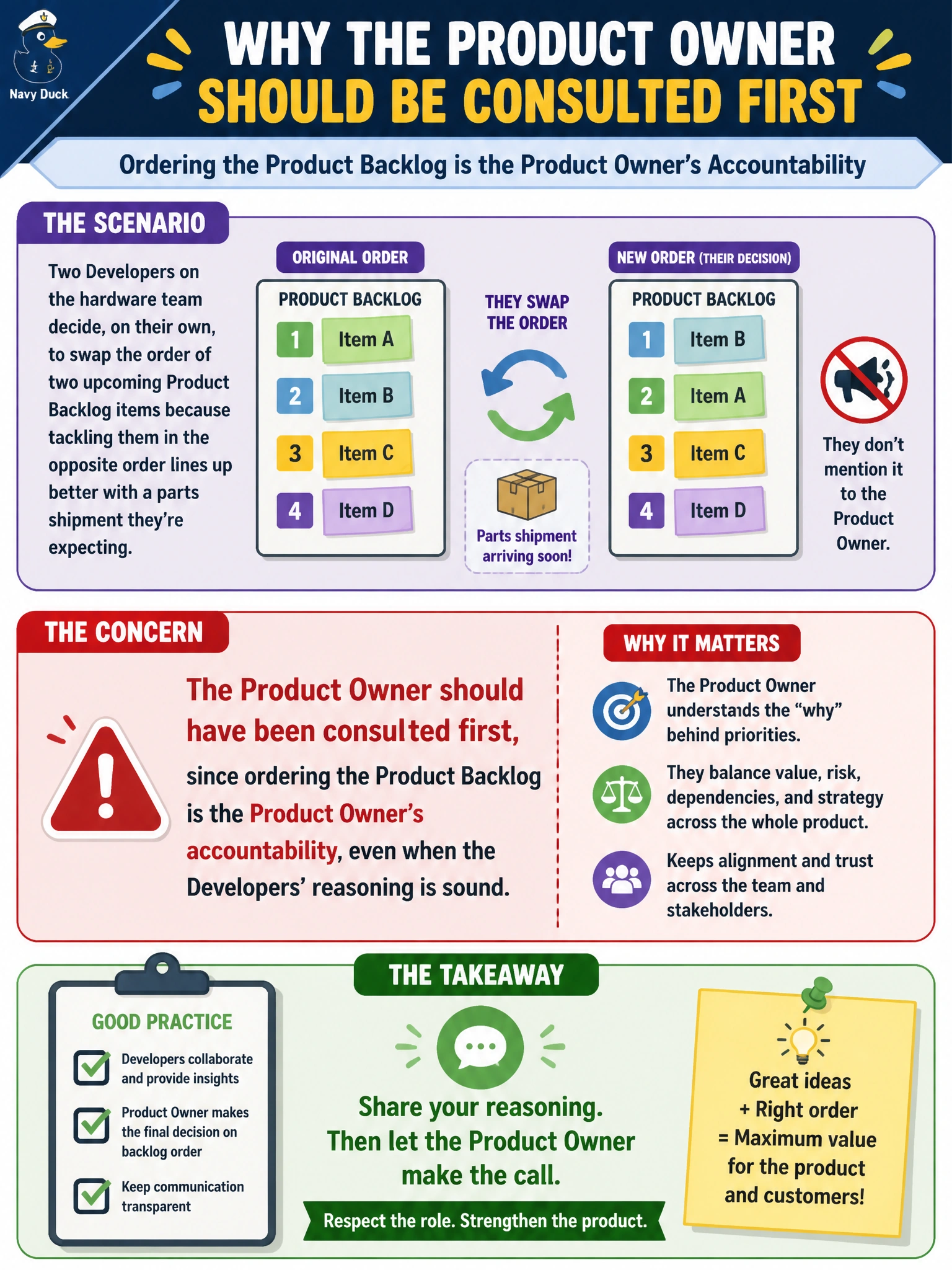
Two Developers on the hardware team decide, on their own, to swap the order of two upcoming Product Backlog items because tackling them in the opposite order lines up better with a parts shipment they're expecting. They don't mention it to the Product Owner. What's the concern here?
Select an answer to reveal the explanation.
Short Explanation
The parts-shipment logic might be completely right — but 'right reasoning' still has to go through the person accountable for the order. Flag it to the Product Owner, who can fold it into the bigger picture, rather than swap it quietly and hope it lines up with everything else that matters.
Full Explanation
Even a well-reasoned change to Product Backlog order is still a Product Backlog decision, and the Guide places accountability for that squarely with the Product Owner. The Developers noticing that a parts shipment favors a different sequence is valuable technical insight, and they should absolutely surface it — but surfacing it and acting on it unilaterally are different things. Silently swapping the order risks conflicts the Developers can't see: maybe the Product Owner already committed the original order to a retail stakeholder, or the swapped item depends on a decision still pending from manufacturing. This isn't a paperwork problem, so 'just document it' misses the actual issue, and nothing in the Guide ties backlog reordering to waiting for a Retrospective — that event inspects how the Scrum Team works, not what belongs at the top of the backlog. The healthy pattern is the Developers raising the parts-timing insight to the Product Owner, who then decides whether and how to reorder with full context. A concrete check: does the Product Owner know, before the next Sprint starts, why the order changed and who changed it?