
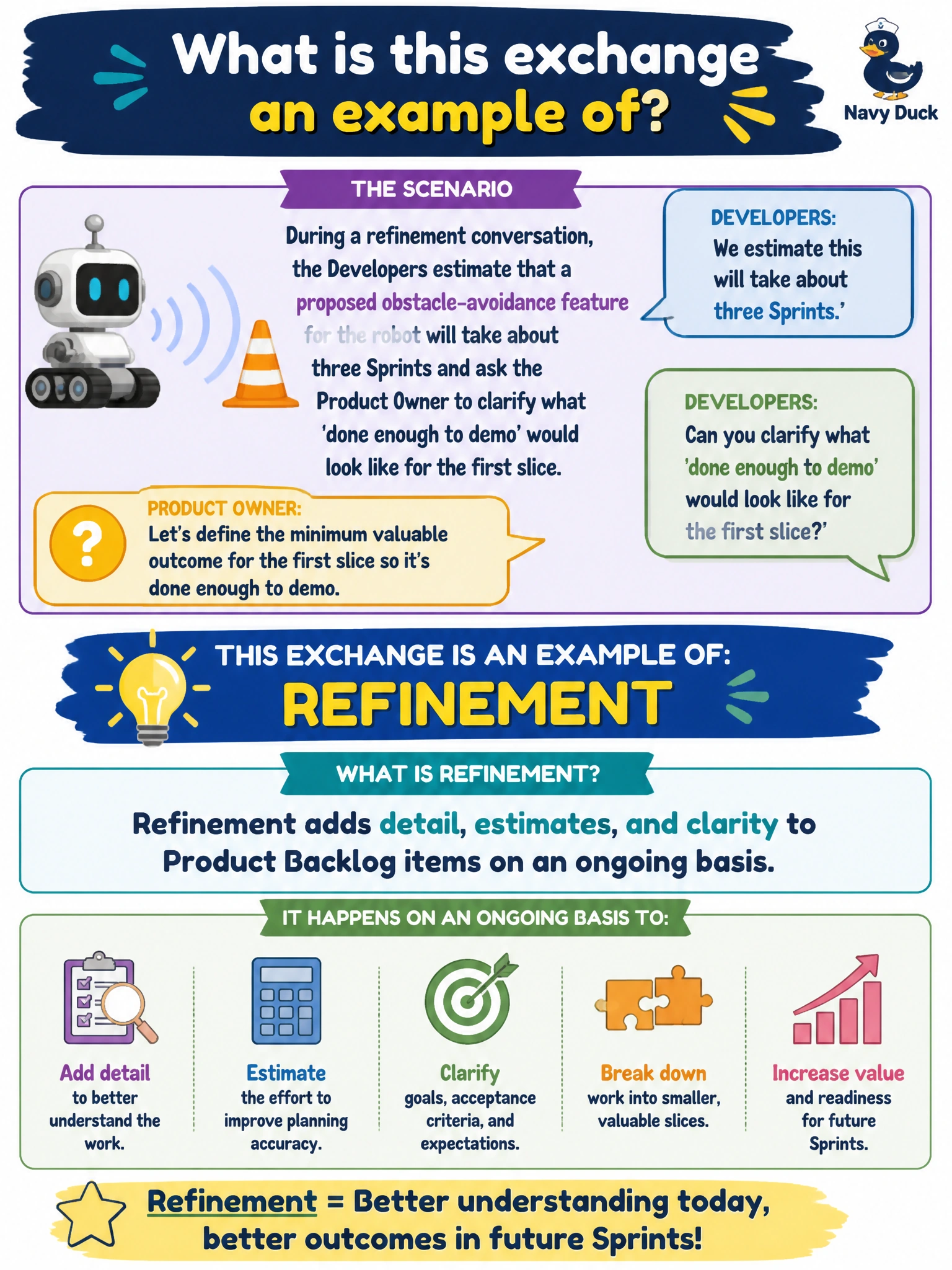
During a refinement conversation, the Developers estimate that a proposed obstacle-avoidance feature for the robot will take about three Sprints and ask the Product Owner to clarify what 'done enough to demo' would look like for the first slice. What is this exchange an example of?
Select an answer to reveal the explanation.
Short Explanation
Talking through size and 'what does a first slice look like' before the item ever gets pulled into a Sprint is exactly what refinement is for — it's the ongoing tidying-up that makes an item ready to actually commit to later.
Full Explanation
Refinement is the act of adding detail, estimate, and order to Product Backlog items, and it happens continuously rather than at one fixed point in the Scrum framework. Estimating rough size and sketching what a demoable first slice looks like are textbook refinement activities — they make the obstacle-avoidance item clearer and more actionable without yet committing the Developers to build it in a specific Sprint. That's different from Sprint Planning, which is where the Developers select Product Backlog items into the Sprint Backlog and craft a Sprint Goal for that Sprint specifically; refinement can, and often should, happen well before that moment so Sprint Planning isn't the first time anyone thought about the item. It's also not the Daily Scrum, which is a short, Developer-only inspection of progress toward the Sprint Goal, and not the Sprint Review, which inspects a completed increment with stakeholders present. Because refinement carries no fixed timebox or event status, this conversation could happen mid-Sprint, outside any formal meeting, whenever the Scrum Team decides more clarity is useful. A concrete check: did this conversation change anything already committed inside a Sprint Backlog, or did it only prepare a future item — if the latter, it's refinement.