
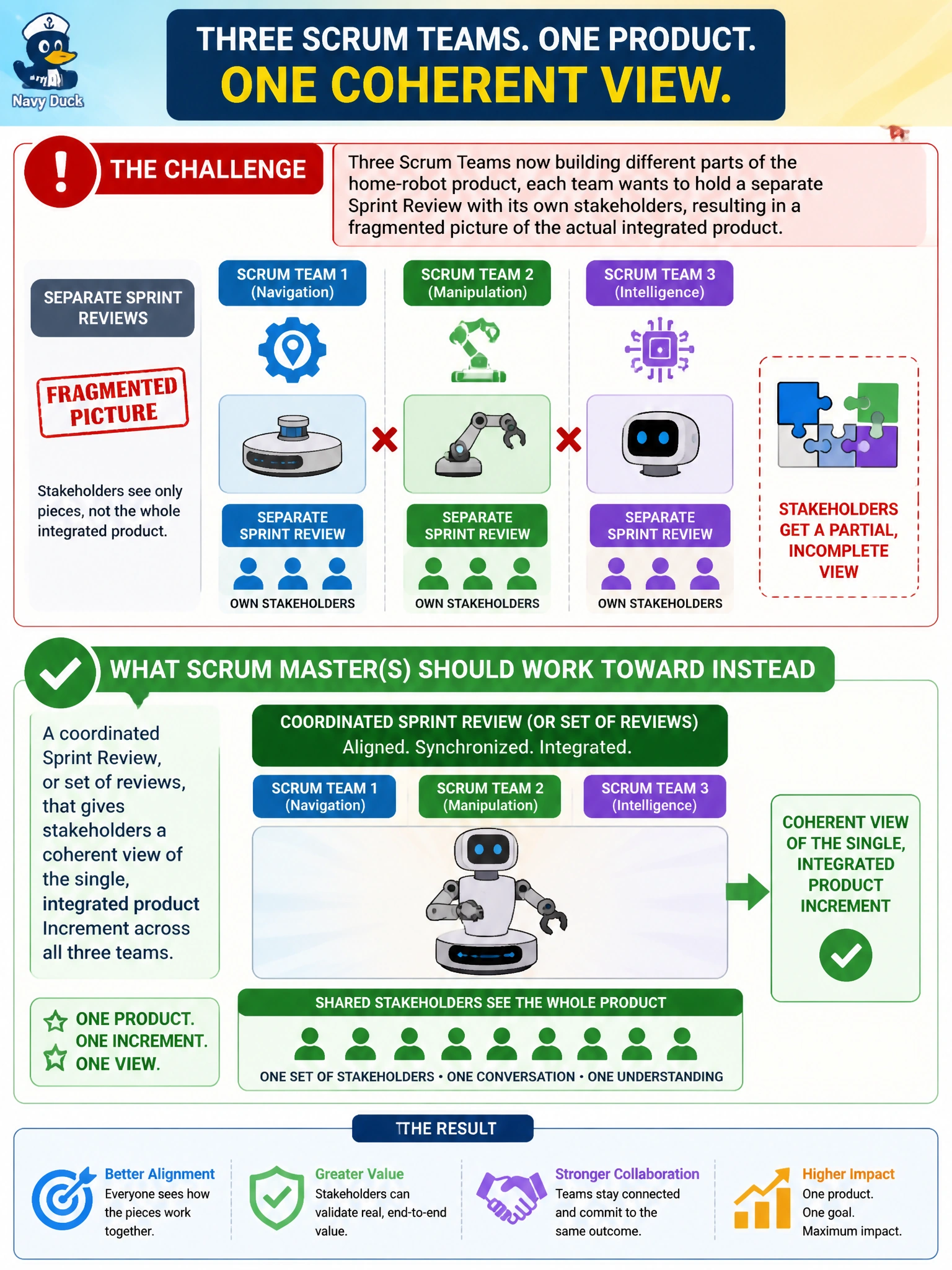
With three Scrum Teams now building different parts of the home-robot product, each team wants to hold a separate Sprint Review with its own stakeholders, resulting in a fragmented picture of the actual integrated product. What should the Scrum Master(s) work toward instead?
Select an answer to reveal the explanation.
Short Explanation
Three teams, one robot — stakeholders need to walk away seeing the whole product, not three disconnected slices of it. Coordinating the reviews so they add up to one coherent picture is exactly the kind of scaling problem Scrum Masters are meant to help solve together.
Full Explanation
When multiple Scrum Teams build one product, the Increment they produce is still one Increment, so Sprint Review needs to give stakeholders a coherent picture of that combined product rather than three disconnected demos — practically, this often means a coordinated or combined review structure the Scrum Masters plan together. Canceling the event entirely throws away the core inspect-and-adapt feedback loop with stakeholders just because coordinating it takes extra effort, which is avoiding the problem rather than solving it. Leaving the reviews permanently fragmented accepts the exact symptom described in the question — a broken, incomplete view of the product — as a permanent state, when the Scrum Masters' role is to actively address that kind of cross-team problem. Showing only one team's work assumes the teams are redundant with each other, when in this scenario they're building genuinely different parts of the same product, and skipping two-thirds of the picture leaves stakeholders with an even less complete view than before. A concrete check: ask a stakeholder afterward whether they could describe the current state of the whole robot, not just one team's slice — that's the real test of whether coordination worked.