
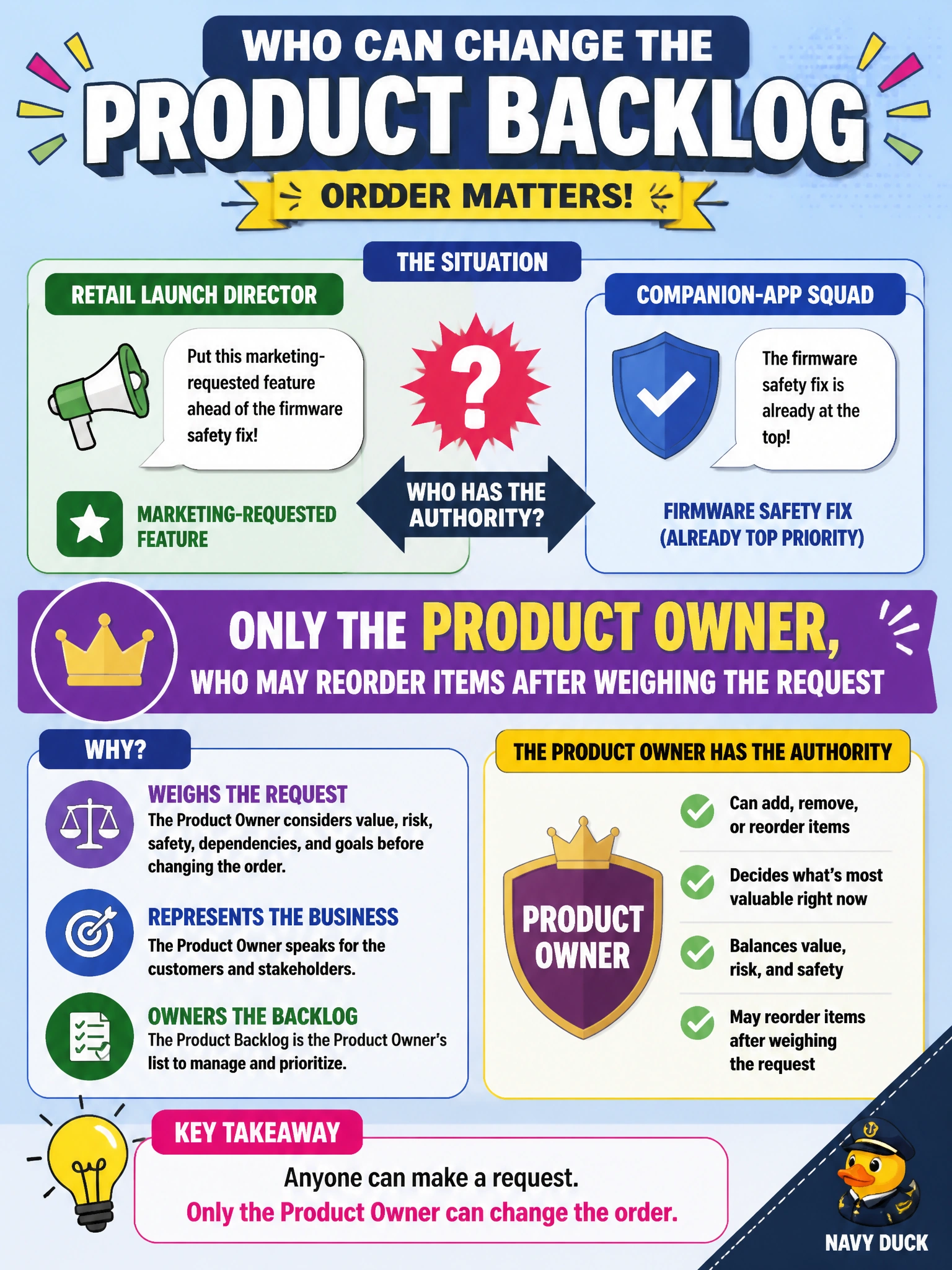
At a home-robot company, the retail launch director insists the companion-app squad reorder the Product Backlog to put a marketing-requested feature ahead of a firmware safety fix already sitting at the top. Who actually has the authority to change the order of the Product Backlog?
Select an answer to reveal the explanation.
Short Explanation
Think of the Product Backlog like a captain's logbook: lots of people can radio in a suggestion, but only the captain writes the next heading. The retail director can absolutely make the case for the marketing feature, but changing what's next is the Product Owner's call, not a vote.
Full Explanation
The Scrum Guide places accountability for ordering the Product Backlog with a single person: the Product Owner. That single point of accountability exists precisely so a hardware-and-firmware company with competing voices from retail, support, and manufacturing doesn't end up with a backlog that shifts direction every time a loud stakeholder calls a squad directly. The retail director's request is legitimate input, but it still has to route through the Product Owner, who weighs it against everything else competing for the top of the backlog, including a firmware safety fix that may be blocking certification. Letting a stakeholder reorder the backlog directly bypasses that single accountability and lets the loudest voice, not the most valuable work, drive the plan. The Scrum Master mediating priority is also a mismatch: the Scrum Master helps the Product Owner and organization understand Scrum, but does not decide backlog order. A concrete check: if a Developer can point to a Product Backlog item's position and say who moved it there and why, the discipline is intact; if the order changed after a hallway conversation with no Product Owner involved, treat that as an impediment worth raising.