
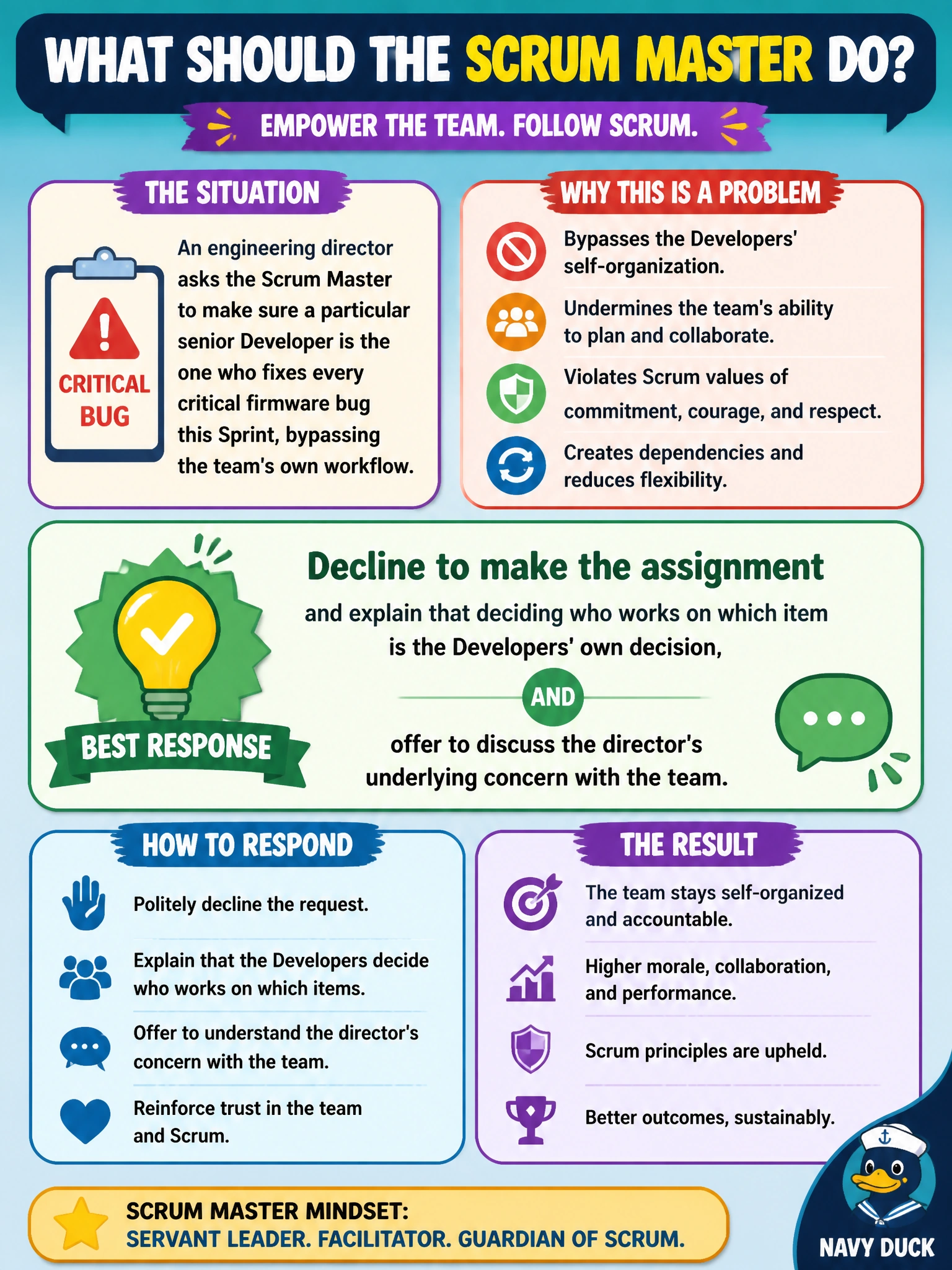
An engineering director asks the Scrum Master to make sure a particular senior Developer is the one who fixes every critical firmware bug this Sprint, bypassing the team's own workflow. What is the Scrum Master's best response?
Select an answer to reveal the explanation.
Short Explanation
A request to hand-pick who fixes what is still a request to override self-management, no matter how senior the person asking is or how urgent the bug sounds. The respectful answer isn't silence and it isn't compliance — it's naming the boundary out loud and still taking the underlying worry seriously.
Full Explanation
Self-management means the Developers decide among themselves who works on which item, and that principle doesn't bend based on the seniority of whoever is asking to override it or the urgency framing attached to the request. The Scrum Master's role is to protect that boundary while still treating the director's concern — presumably about getting critical bugs fixed fast — as legitimate and worth addressing with the team directly, rather than either capitulating or brushing the director off. Making the assignment simply substitutes the Scrum Master as the enforcer of an inappropriate directive, which doesn't fix the underlying issue of an external party dictating Developer work. Redirecting to the Product Owner mislabels the request: this is about who does the work, not about backlog ordering or value, so the Product Owner isn't the right owner of this particular decision either. Ignoring the request avoids the confrontation but leaves the director's concern unaddressed and likely to resurface, and it fails the transparency that makes these dynamics resolvable. A useful check: separate the request's form (assigning a specific person) from its underlying concern (getting urgent work handled) — decline the first while genuinely engaging with the second.